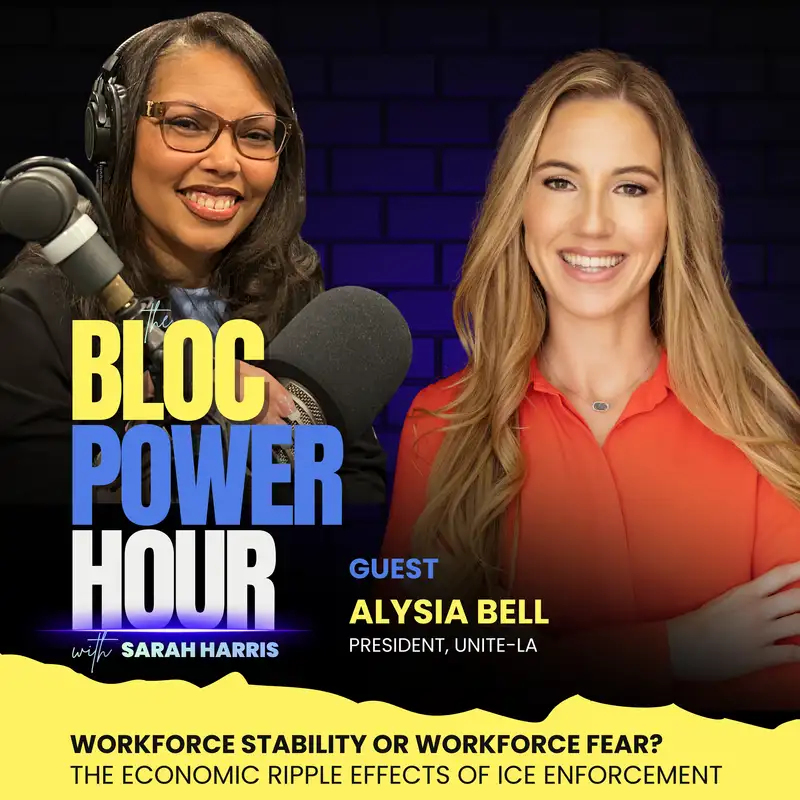
Workforce Stability or Workforce Fear? The Economic Ripple Effects of ICE Enforcement
Download MP3Yeah. Sarah Harris. Turn the mic up. The power up. Welcome to the block.
Speaker 1:Hello, everyone. This is the block power hour with Sarah Harris. It is presented by Elevate Media Collective, a media division of the Black Business Association, and we focus on economic mobility, business growth, and the policies shaping our communities. We want you to follow us at Block Power Hour and Black Business Association, and you can always connect with us at bbala.org. And of course, we welcome everybody to this show every week and those who are continuing to stick with us and return, we thank you.
Speaker 1:And if you are really resonating with the conversations that we are having, we do invite you to support us, to donate, and again, you can find that information at bbala.org. Today, we are kicking off the beginning of Women's History Month. And so in celebrating Women's History Month, this theme for this year is women leading the change towards shaping a sustainable future. And I'm so happy this month we are having some dynamic women as guests and I'm so elated to be able to present them. And the Black Business Association are proud to present our twenty third annual Salute to Black Women coming up on March 28.
Speaker 1:It will be at the Westin Los Angeles Airport Hotel from 8AM to 4PM and it's going to be a good time. We have some dynamic breakouts and some amazing honorees and it's always a great time for all to be had. So if you're interested, you can find information about the Salute to Black Women, our twenty third annual at bbala.org. For the show today, we are having a conversation where it sits at the intersection of business, work force and federal policy. So in Los Angeles County, immigration enforcement is not an abstract national issue.
Speaker 1:It shows up in our workforce participation, in our restaurants and grocery stores, in logistics, agriculture, construction and hospitality. When workers are afraid to report to the fields or show up on job sites, it affects supply chains, pricing, and business community. And so on February 12, business leaders gathered in Los Angeles to call on Congress to reject additional funding for Department of Homeland Security Enforcement, arguing that these federal decisions are economic decisions with local consequences. Our guest tonight is Ms. Alicia Bell, President and CEO of Unite LA, a twenty seven year trusted business intermediary working at the intersection of education, workforce readiness and economic systems change.
Speaker 1:Unite LA focuses on building career paths, expanding access to education and ensuring workforce readiness, particularly for individuals who face high barriers to employment. We'll discuss what expanded enforcement means to workforce stability, what small business owners are experiencing on the ground and why business leaders are framing this conversation as economic rather than partisan. That was a mouthful, right? Alicia, welcome Alicia to the Block Power Hour.
Speaker 2:Thank you, Sarah, so much for having me.
Speaker 1:I am so elated to have you here today. It's been a pleasure. We haven't had the chance to really be in person, but it's been great working in the community on some of the same type of initiatives. One of them being like the California Jobs First initiative and partnering in different ways on that. And so it's just a joy to be able to have you in the studio today.
Speaker 1:Before we dive into that, I just want to acknowledge the broader moment that we are in because since we started communicating regarding coming on the show today, of course, the news cycle has right now has just been moving in extraordinary pace. And today, much of the national tension is focused on the escalating tensions involving The US, Israel, and Iran, national security concerns, and international diplomacy. These dominate the headlines today and understandably command attention. But while foreign policy unfolds abroad, economic policy is unfolding here at home. And often when global tensions rise, domestic decisions escalate quietly in the background, including federal funding priorities, agency budgets, and workforce expansion.
Speaker 1:And so that's why this conversation today matters because while the nation debates on global security, local economies are experiencing workforce uncertainty in real time. And so with that, I believe that this conversation today about the impacts of the immigration raids and what our local economy is going through right now is still very much relevant and we need to discuss. But before we get into that, I just wanna kind of level set and say how listeners who may not be familiar, kind of tell us about your background and your path to leading United LA.
Speaker 2:Well, thank you, Sarah. My career has always lived at the intersection of education, workforce, and the economy. My graduate schooling in industrial organizational psychology really laid the groundwork for understanding how people, systems, culture intersect to drive both economic and personal success. So my career spanned education, workforce development, economic development, which really led to my appreciation as them being three legs of the same stool. And I joined United Life fifteen years ago because the organization sits in such a unique spot as an intermediary.
Speaker 2:We have the pleasure of collaborating with a broad array of stakeholders to bridge employers who need talent with a rising workforce seeking opportunity. So UnitedLA is laser focused on equitable economic mobility, and we aim to make a path from cradle through career that's wide enough for everyone to walk through. It's the only way that LA stays competitive.
Speaker 1:And with UnitedLA having operated for nearly three decades, how would you say that the conversation around workforce has evolved over that time?
Speaker 2:Yeah. Sarah, it's a pretty fascinating shift. I feel like we've moved from asking how do we train this person to questioning how do we build a system that supports long term economic mobility? Conversations that zoomed in on just training or job placement were essentially focused on classroom to cubicle, if you will. Today, we've really zoomed out with an appreciation that workforce stability is a broad ecosystem.
Speaker 2:So you can't really talk about a stable workforce today without considering childcare, transportation, and related to today's conversation, immigration policy. It's all connected. LA's economic competitiveness and worker well-being are inseparable. And a region succeeds when its workers can participate fully and when they can participate consistently. If one part of that ecosystem, like workforce stability, is broken, the whole system feels the strain.
Speaker 1:Indeed. In preparing yourself for this kind of work, what provided you the manner or means to be able to prepare you for this kind of work?
Speaker 2:Yeah. You know, I think back to that that stool, the education, workforce development, economic development really being three legs of the same stool, I think that prepared me for UniteLA's mission, which is just really focused on connecting people to opportunity, helping employers build a prepared workforce. And we do that through policy programs and systems change. Those are kind of the our three domains, if you will. So that means as we do our college access and our career pathway programming, we hit roadblocks.
Speaker 2:Mhmm. And that usually gives us insight on a policy or a state budget investment to advocate for. Once that legislation is settled, our systems team will go to work leveraging trust tables that honestly have been established and nurtured for many, many years to implement the structural shifts in how our region prepares its workforce and supplies employers with the talent they need to thrive. So I do feel like Unite LA and the wonderful talented staff I have the pleasure to work with every day. We're pretty uniquely positioned for this type of intermediary work because we collaborate deeply with stakeholders across the board, and that allows us an economic perspective on what businesses need to stay viable as well as a workforce perspective on what individuals need to thrive in LA.
Speaker 2:So when a policy shift happens Mhmm. Like these raids, we see the ripple effects in real time, and then we will work to convene regional leaders and collectively move towards change that we all desire.
Speaker 1:Is there a particular policy or something that you have championed that you're proud of or that has been a milestone?
Speaker 2:Yeah. You know, Unite LA has been involved in a number of initiatives over the year. We like to say that we work cradle through careers, so we've been deeply involved. Just zooming out for a moment, early care and education, really advocating for quantity and quality of slots available to parents, which certainly has a domino effect for the workforce. Mhmm.
Speaker 2:But we also advocate for for k 12, for higher education, for workforce development. So really cradle through career. We try to live in those in between spaces. So as our rising workforce moves from system to system from k 12 into higher ed into the workforce, what are some of those dots we can connect, and how do we advocate for more funding so that the structure supporting Angelino's to move through those structures is is strong and connected and aligned?
Speaker 1:Indeed. Thank you. And it's such important work. We will be coming back in just a second to continue the conversation. But for now I will implore you to continue to follow us The Block Power Hour on Instagram and all of our other socials and if you are enjoying this program, we want to hear from you.
Speaker 1:Leave us some comments or feedback or information. Let us know what you think. Let us know particular topics or something that you wanna hear about. This is the Block Power Hour. I am Sarah Harris, and we'll be right back.
Speaker 1:Welcome back to the Block Power Hour. I'm Sarah Harris, and we have our guest here, miss Alicia Bell, president and CEO of Unite LA. We're having a great conversation, and so we will continue on. We're gonna talk about now the press conference that you recently held and I wanna know in terms of why the step into this issue now and what precipitated having the press conference.
Speaker 2:Thank you for that good question. And why now? Because congressional funding decisions aren't just line items on a budget. They really are direct levers for labor availability and business continuity in LA. We're seeing a version of labor instability that has nothing to do with market demand or productivity.
Speaker 2:It's entirely driven by fear. And when enforcement increases, we see a withdrawal from the workplace that hits our supply chains and local commerce. And as an organization focused on economic mobility, we had to elevate these impacts. This workforce is the very fabric of our city. They are the entrepreneurs and the essential workers who keep LA running.
Speaker 2:And so when we call on congress to rethink this funding, we're advocating for the sum of all of us. A thriving economy is one where every person feels secure enough to contribute to their full potential.
Speaker 1:You, had a number of guests joining you for the press conference. Was there anyone that had like a particular story or something that, you know, moved you or something, that was relevant to this?
Speaker 2:Absolutely. I would say that when we frame this as an economic issue, it's really because the economy doesn't really have a party. Right? And so when these small businesses in LA have to close their doors early because staff is afraid to come
Speaker 1:in Mhmm.
Speaker 2:We feel like it's not an ideological problem. It's really an operational reality. Mhmm. And so we have had some business owners share, you know, just really important stories about the workforce disruption that happens. We've had folks talk about how when there is a report of an ICE raid that the streets will go quiet and they will have to close a restaurant owner says he has to close the dining room.
Speaker 2:He knows it's going to be empty. And we spoke with a grocery store that said, you know, with the supply chain, groceries aren't showing up, workers aren't coming in, customers aren't coming in.
Speaker 1:Mhmm.
Speaker 2:And so for a lot of these small businesses, it's a double hit because their workers are being affected, but also, you know, the supply chain is being impacted. So customers aren't coming in. It's impacting their workforce. And a lot of these small businesses just don't have the buffer to absorb that.
Speaker 1:Exactly. And also too, just the uncertainty of, you you get up in the morning and you say, do I report? Do I or not? And then if I don't, I don't make money. And if I don't make money, then I can't pay the rent.
Speaker 1:And then you have mortgage landlords, you know, they're in a quandary in terms of needing to have the rent paid. So like you say, it's this ripple effect that has really taken a hold of our communities and the economy. And so to me, I just don't understand in terms of why would something so non business friendly kind of action be something that we would have going on today. I do understand certain reasons behind the whole premise for the ice raze but I'm just saying as a totality of it, it's just not a business friendly move, right?
Speaker 2:Well, I mean, absolutely right and we so often talk about infrastructure in terms of concrete and steel, but workforce stability is economic infrastructure. I mean, half of small businesses are seeing revenue drops because their workers or customers are afraid to step outside, and you can't build a prosperous LA on a foundation of fear. So just to your point, Sarah, these these decisions about enforcement funding don't just sit in a policy silo. They influence labor availability, they influence business continuity, and they influence, at the end of the day, regional competitiveness.
Speaker 1:Indeed. Indeed. And so, what does the newly released economic impact report reveal about the local consequences of intensified enforcement?
Speaker 2:Yeah. I'd love to talk about that. And before I do it, I'm gonna I'm gonna zoom out for a moment and look at some long term math. There was recent Cato Institute research that found that over the last three decades, immigrants actually contributed 14,500,000,000,000.0 more in taxes than they received in benefits. And, you know, if we think about that, it's not just a contribution.
Speaker 2:That's a massive reduction True. International Right. Right. And this really underscores why workforce stability is economic infrastructure. And, Sarah, if we zoom in on our own backyard, so the LAEDC, the Los Angeles Economic Development Corporation, recently ran a business impact survey that is honestly staggering.
Speaker 2:So did you know that 82% of respondents across LA County say they've been negatively affected? And we're not just talking about a slight dip. Over half of these businesses are seeing fewer people walk through their doors and lowered daily sales. So for businesses hit the hardest, nearly half of them reported. Their revenue dropped by more than 50%.
Speaker 2:And, I mean, if we just think about it, if we lose half our income, we're not thinking about growth. We're thinking about survival. Exactly. Yeah. And that's why so I think it's two thirds of our local shops that are cutting hours, that are closing on certain days.
Speaker 2:They're delaying plans to expand. And, I mean, ultimately, we have to look at what's driving our economy. So in LA County, just some of the numbers, we have about 3,500,000 immigrants. That's 35% of our entire population. And if we look specifically at our undocumented neighbors, they generate over 253,000,000,000 in economic output.
Speaker 2:That's 17% of everything LA County produces. So they're not just part of the economy. They're a fundamental pillar of it. And the ripple effect, Sarah, it it happens fast. So if you take last year, the Downtown LA curfew from last June, that single event cost us an estimated $840,000,000 in lost output.
Speaker 2:So we have nearly a million undocumented workers in LA holding up critical sectors. You mentioned some of them at the at the top of the show, Sarah. Agricultural, logistics, hospitality, and and crucially, childcare. Mhmm. You know, we keep coming back to this phrase workforce stability as economic infrastructure.
Speaker 2:And I would just say when fear hits these frontline industries, that infrastructure cracks. Right? It's a straight line from community fear to disrupted supply chains and lost revenue for the entire city.
Speaker 1:Those are some massive numbers, the significant impact, right? And so given that, why do you think the conversation is being framed as economical rather than partisan?
Speaker 2:Yeah. You know, I I think that, you know, honestly, back to the idea of the economy not having a political party, businesses just need a stable workforce to function and workers need stability to participate. It really is that simple. I I feel like when either side of the equation breaks down, our local economy weakens. And we talked a little bit about, you know, technical terms like labor shortages or supply chains.
Speaker 2:But what we're really talking about is the human infrastructure Mhmm. Of LA. And so that's why we're advocating for the stability. It's just really the only way for people who live here, who work here in LA to succeed. And we know behind every workforce disruption statistic that we see on a spreadsheet, there's a real world consequence.
Speaker 2:And so at UnitedLA, we believe that economic continuity only happens when the people who drive that economy feel safe enough to participate.
Speaker 1:Yes, indeed. Awesome. Thank you for that. So, well, we've we've been talking a bit about the ripple effects, right? And we heard from small business owners who describe immediate impacts and empty streets after eye sightings and produce disruptions and early closures.
Speaker 1:How wide spread is this kind of instability?
Speaker 2:Yeah. Sarah, the instability we're seeing is incredibly widespread, and it happens with startling speed. So interesting. Did you know that 52% of LA businesses have already reported reduced revenue, and over half are seeing a drop in foot traffic? So talking about how widespread this is, I mean, we're seeing these numbers for over half of these, you know, business respondents to to recent surveys.
Speaker 2:And to really understand the impact, I feel like we have to look at some of the stories behind those numbers. So we talked about a couple of them, but, you know, just the fact that, you know, the restaurant owners are posting help wanted signs. Mhmm. And so in addition to customers not coming in, workforce not coming in, and then they're having, you know, capacity issues, they're posting help wanted signs. Folks aren't coming in, and that's really where this economic infrastructure is starting to crack.
Speaker 2:And so we're seeing this pattern jump from restaurants and retail into, you know, logistics, food distribution, childcare. And I feel like these are sectors that simply cannot function without a consistent daily workforce presence.
Speaker 1:Most definitely. And even though the spotlight is not here in Los Angeles per se, but what do you think about even just the feeling or the residue emotions or just thinking about what do I do because it could just happen any time again in terms of picking up with intensity.
Speaker 2:You know, I think the continued concern is so natural with an economic lens. Some of these small businesses operate on incredibly tight timelines and with razor thin margins. So they rely on this daily workforce participation to keep the wheels turning, And that chain can break really quickly. So, you know, I think about the even deeper layer here, childcare. It's such a critical sector that is sometimes overlooked in economic talks.
Speaker 2:And when childcare staffing is disrupted, it creates a huge ripple effect. You mentioned ripple effects earlier. If a childcare provider can't open because their staff is afraid to come in, parents across every other sector can't go to work. And so back to that idea of workforce stability and economic infrastructure being intrinsically linked, I feel like when you pull one thread in the logistics or the childcare sector, the entire regional workforce starts to unravel.
Speaker 1:That childcare part is so important and critical. Right? I mean, I I do have I have a son. He's he's grown and everything now, but I remember back in the days when I had a meeting or a client or something like that and if I needed childcare at the time, I'm blessed to have a good family environment where that kind of stable again, environment around me, but at the same time, you still do not get away from the stresses of being a parent and what do you do with your children. And so if there is any type of holes in that, I can tell you how stressful and how straining that can be.
Speaker 1:I just imagine that that part of it is just extremely critical to not be able to facilitate having adequate childcare. Absolutely. This is the block power hour with Sarah Harris. Welcome. We are back.
Speaker 1:This is the block power hour with Sarah Harris, and it's such a pleasure to have my guest on Ms. Alicia Bail, President and CEO of Unite LA. Sometimes I ask my guests, what do you think about the song?
Speaker 2:I love it. I love it. It's so good. How long did it take you to come up with it?
Speaker 1:Well, it took a little bit of working on it, but I just love the energy of it. So, and I hope that you guys feel that coming back in too. So back to our conversation about the impacts of the ICE raids and for immigration workforce and just how much it really does impact all of us. Right? And so for workforce development and economic competitiveness, UniteLA works heavily in career pathways and workforce readiness.
Speaker 1:How does immigration enforcement intersect with workforce development strategy?
Speaker 2:Sarah, immigration is a workforce development issue because our entire strategy depends on one thing, consistent participation. You cannot build a successful long term career pathway for someone who is living in a state of constant fear. And we advocate for workforce stability because economic success depends on the workforce that drives it. So if the human infrastructure isn't secure, the strategy for our future workforce falls apart before it even begins.
Speaker 1:Wow. And so then what happens to regional economic competitiveness when large segments of the workforce feel unstable?
Speaker 2:You know, competitiveness is, really rooted in workforce participation. So, you know, again, when a large segment of our workforce feels unstable, they withdraw, and that leads, of course, to a drop in productivity. When participation is inconsistent, employers face sudden shortages that slow down business. And in the global race for talent and investment, instability is really a competitive disadvantage. So if we can't provide a stable environment for our workers, we lose the ability to sustain our local industries.
Speaker 1:And within UniteLA in your programs, what kind of support do you provide in this way for, workforce development?
Speaker 2:Sure. So UniteLA, we have the pleasure of being about 43, 45 staff members. It's all based on partnerships. So we have collaborations with many business organizations, many community based organizations, and kind of work at that intersection of, you know, public systems, institutions of education, CBOs, and employers. So we will really take a holistic approach to our career pathways programming where in addition to career awareness and exploration and career prep and training and placement, we also look at really participant centered program design.
Speaker 2:What do the participants need? You know, many times it's something like transportation support or access to childcare. Sometimes it's, you know, something like mental health, and we have partnerships that provide, you know, mental health supports. And so just really trying to center our we call them scholars, but our our program participants, and building the program around them. We also are hearing from them.
Speaker 2:This is very recent feedback. As of this weekend, we had a lunch celebrating 15 graduates of one of our career pathway programs, My Pathway to Health. Mhmm. And they were sharing what really worked for them. And it was kind of that intersection of where their interest meets deep dive program and case management support from the United LA staff.
Speaker 2:Mhmm. And not only the connection to employers for work based learning or internships or or even entry level jobs, but also the opportunity to earn industry validated credentials through the programming so that they walk away with something that is a a tangible thing that employers, you know, value in in the workforce.
Speaker 1:Thank you, for offering that because I wanted to just be you know, we're talking about the impact and, you know, just the con side of everything, but where where is the silver linings? What are opportunities? And so I appreciate you providing that information because Unite LA works as to be a problem solver and a community partner in these things. And so it's good for people to know if they're seeking support or solutions that they can count on Unite LA, right?
Speaker 2:Absolutely. Absolutely.
Speaker 1:All right, so I will get back to one of the other questions I had. If Congress were to prioritize workforce stability, what kinds of investments would that include instead?
Speaker 2:You know, if we want true workforce stability, we have to invest in participation. So I think we should be doubling down on the systems that allow people to work consistently. And at the federal level, that means supporting things like common sense immigration reform. And it also means, you know, pushing the SBA to reverse its policy that bars lawful permanent residents from small business loans because we can't grow the economy by cutting off our entrepreneurs. Here in California, we need to protect the DREAM Act so students can finish their degrees.
Speaker 2:And, you know, we have an opportunity to scale up SEED, which is the social entrepreneurs for economic development, scale up the SEED initiative for business owners. And then I'll just share you, NIDALA is cosponsoring a bill this year, SB eleven thirty two, which builds know your rights education directly into our state's workforce system. So I I think it just all gets back to, you know, workforce stability is is more than being just about a job. It's about ensuring every worker and student has a clear and a safe path to contribute to our economy.
Speaker 1:Excellent. Excellent. And so how should business leaders engage policymakers when federal decisions affect local economies?
Speaker 2:Sure, Sarah. So I would say business leaders can bring real world operational insight to elected officials shaping policy. By sharing these impacts, they prove that workforce stability isn't an abstract debate. It's a requirement for business viability. And when the people who power our industries are in a state of constant disruption, the entire regional economy loses its ability to grow.
Speaker 2:So I think we can agree that stability is a prerequisite for a healthy economy.
Speaker 1:Oh, indeed. Indeed. Business owners cannot thrive. They cannot scale or even think about what's next if they continuously have an environment of uncertainty and instability, right? So leading to that, we'll go into about leadership and solutions.
Speaker 1:And so what responsibilities do business leaders have in shaping workforce policy conversations?
Speaker 2:I think business leaders have a meaningful role because they are the ones on the ground with operational insights. I think business leaders can really connect policy decisions to local economic outcomes. And CEOs and small business owners alike can share their real time experiences related to staffing, to supply chains, to their ability to stay open. It's it's all connected. And, you know, I think with workforce stability being economic infrastructure, I feel like it's an opportunity for business owners and CEOs and policymakers to work together and invest in it together.
Speaker 1:Do you feel as though there's enough cooperation or participation from business leaders?
Speaker 2:You know, we have seen a lot of business leaders, small business owners participate in a variety of ways. We have had many small businesses participate in some of the studies that we've cited, and we had a wonderful group of business owners join us at that press conference that you mentioned a few weeks back. So we've been so grateful to all of the business leaders who have joined in the conversation thus far and absolutely encourage more to engage and really just sharing their insights on how decisions that are made, whether it be in DC or Sacramento, impacting their day to day operations on the ground, which, of course, has ripple effects for the whole
Speaker 1:LA economy. Excellent. What was the location you were at?
Speaker 2:We were right in front of El Serrano Green Grocer.
Speaker 1:Okay.
Speaker 2:And their, co owners, were were two of the speakers at our press conference.
Speaker 1:Okay. And, can you tell us a little bit about their story?
Speaker 2:Yeah. Absolutely. So they were really sharing that, you know, they aim to bring in fresh groceries and, you know, share them, with with folks at affordable prices and really support the community with healthy nutrition. And so they made a a great case for the what we were calling the double hit earlier, but the fact that it's not only consumers who stop coming in, but also the hit on their supply chain. So it's hitting their workforce.
Speaker 2:You know, workforce is afraid to come in. Customers are afraid to come in. The trucks stop showing up with produce and groceries to stock the store. And again, this is one of the many businesses that operate on such razor thin margins that there just isn't enough of a buffer there to withstand that kind of uncertainty for very long.
Speaker 1:Awesome. Awesome. Well, we are going to have to come back again, but this conversation is just fruitful for thought and information. This is the Block Power Hour. Again, we hope that you are resonating with what we are talking about today and our programs from before, encourage you to support and donate.
Speaker 1:You can find information at bbala.org. Again, that's bbala.org. This is the Block Power Hour with Sarah Harris and we'll be right back. Welcome back. This is Sarah Harris, and you've been listening to the block power hour.
Speaker 1:We're on KABC seven ninety, but we can also be found on podcasts at block power hour. Go to Instagram. You can find our information there at block power hour or the bbala.org for the Black Business Association. It is presented by Elevate Media Collective, which is a media division of the Black Business Association. And we are so glad that you continue to join in for the Block Power Hour.
Speaker 1:We are back with our guest Ms. Alicia Bell, again, President and CEO of Unite LA, and we are discussing the impacts of immigration enforcement and our workforce economy. And so Alicia, thank you again. It's been a great conversation and our mission aligns. I see that you have in your title about Equitable Economic Mobility and that is certainly one of the pillars that we focus on.
Speaker 1:To you, what does equitable economic mobility mean to you?
Speaker 2:Thank you for asking. UniteLA's vision and mission are really centered on equitable economic mobility, and we do that through the lens of education and workforce development. So to us, that means removing barriers to quality education and to streamlined career pathways, not just into any job, but into high mobility jobs in growth sectors for the Los Angeles region.
Speaker 1:Excellent. And so with having partners in this mission, what does a collaboration with organizations like Unite LA and the BBA and others to collaborate to ensure workforce resilience.
Speaker 2:Well, we are thrilled to collaborate with you, Sarah, and absolutely much more to come. You know, I think together, partners can create a unified front for the LA economy. I think we can align on several things, on employer needs, on workforce systems, and then really rooted in community realities. So I think together, we can share individual stories, for example, from small business owners, and elevate them into a collective dataset to inform policymakers how workforce participation is tied to economic continuity. And essentially, I think together we act as a bridge.
Speaker 2:Right? We make sure that when a decision is made, again, whether it's a state decision or a federal decision, you know, the people making it understand the ripple effect that it has on, for example, an LA storefront.
Speaker 1:Awesome. What should small business owners be thinking about right now to protect continuity in uncertain policy environments?
Speaker 2:You know, advice to small business owners is to move into network mode. I really do believe that we're more resilient when we're plugged in to regional networks. Mhmm. And my recommendation would be to stay closely connected to business associations and other networks. And and certainly, we, of course, welcome you to to stay connected with our team at Unite LA, but all of these partners are tracking key policy shifts in real time.
Speaker 2:And you just shouldn't have to be a policy expert to run a bakery or a logistics firm for that matter. So I think by engaging together collectively Mhmm. Businesses can share resources. We can plan for staffing variability and and really lend our voices to a larger group. So I I do think resiliency as a team sport.
Speaker 1:I thank you for that. That was an amazing segue into the importance of associations and chambers and other type of networks to help give you that support that you need. Because like you said, if you're a business owner, you're focused on the day to day and what your business is. And so it's not always easy to be able to have these things in mind about what policy works for me or not, but if you can have that kind of support behind you. So for the Black Business Association, we thank you for that input on there.
Speaker 1:So I have one last question regarding leadership and solutions. If you could leave Congress with one economic message today, what would it be?
Speaker 2:If I could leave Congress with one economic message today
Speaker 1:What? Something that would actually penetrate and work. Sure.
Speaker 2:I mean, the the the short pitchy version is is the, you know, workforce stability is economic stability. But, you know, I really think we have to move past the idea that immigration policy exists in a vacuum. Every policy that creates fear or disrupts labor participation sends a shockwave through our small businesses, our supply chains, and really the entire regional economy. So LA's ability to compete on a global stage depends entirely on our people feeling safe enough to show up and and to participate. So the idea that stable, inclusive workforce participation is what fuels our growth and our community prosperity.
Speaker 2:So I would say the message is simple. Disrupting the workforce is disrupting the economy, and we all want a strong competitive country. Mhmm. I think we need to start by protecting the human infrastructure that powers that economy.
Speaker 1:Indeed. And and, of course, we have so much going on here in Los Angeles, the things that are already unfolding and those that we all have in mind with the major games and stuff coming around that in each particular kind of community, there are a number of different kind of activations or, you know, plannings to come around to really cultivate that kind of economic mobility environment, all kind of different opportunities. And so it just goes to show that we want to be able to have it so that they don't have to worry about do I have a stable environment to report to work to? And the business owners, will they show up today, will I have the customers at my door and all of that kind of stuff. So you can't stress it enough in terms of the importance of having a stable workforce.
Speaker 1:Was there anything else in particular that you may have in mind that you wanted to convey today?
Speaker 2:You know, I'll just tag on to what you shared about the upcoming LA twenty eight Olympics and the number of sporting events that Los Angeles is so honored to be the host for. I just think it underscores the importance of what we've already talked about. You know, we want the Olympic Games and all of the major sporting events coming through our region to be a benefit to Angelino's, to our workforce, to our economy, to our businesses, leading up to and during the sporting events, but also for a long time after. We want them to be a catalyst for workforce opportunities and for economic opportunity for for businesses and workers alike. So just tagging on to what you shared, United LA really is on the global stage with with hosting all of these events.
Speaker 2:And so it further underscores what we've already talked about.
Speaker 1:It's just a beautiful picture, especially when you talk about cultural districts and fun zones and all of the different activations across our vast land coming with the Olympics where things are gonna be all over. And that is a beautiful picture to me because everybody's out in force. There's jobs opportunities. There's business opportunities and that's what we want to see, right? Those kinds of activities growing and not hampering us to be able to have that come to fruition.
Speaker 1:So I love that, I love that. So it's been a great conversation and important conversation. I do have just some block fire kind of questions just to kind of like see where you're at on a quick little things, nothing fancy or heavy. First of all, there's one, I will say. The one is to finish the sentence and then we'll go on to the lighter ones.
Speaker 1:It's economic stability begins with The workforce. Okay, should have known that. Should have known that. Everything begins with the workforce. Yes.
Speaker 1:Okay. An accomplishment that you personally are proud of.
Speaker 2:You know, the continued partnerships that the wonderful team and board of directors at United LA continues to cultivate because, you know, the the old saying of it takes a village, I am so grateful to see the feedback from our program participants, from our partners, the way that some of our, for example, career pathways initiatives have evolved to be more holistic and really learner centered. Mhmm. And it's all thanks to the numerous partnerships. So I'm really proud of UniteLA's growth of partnerships that support, the participants going through our programs.
Speaker 1:You answer a question, you sound like me when somebody don't know, my brain goes to business. It goes to what I'm working on and not the person. Well, that's fine. This one question and then we're about to wrap up and this segment goes by so fast, but in your spare time, you would enjoy.
Speaker 2:In my spare time, I enjoy every second with my husband and our soon to be eight year old son. My son Maddox is turning eight on Wednesday and we're so excited. So he is definitely the light of our life.
Speaker 1:Wonderful. Well, again, it's been such a pleasure having you here on the Block Power Hour. I enjoyed this conversation. To everybody out there, I really do hope that it has resonated with you and that you take away something from that. We do want to hear from you.
Speaker 1:Please go to block power hour on Instagram and leave us a comment and let us know what you think. This show has been presented by Elevate Media Collective, a media division of the Black Business Association. We encourage you to support this program and donate. The information can be found at bbala.org. Again, that's bbala.org.
Speaker 1:And where can you find Unite LA?
Speaker 2:Unitela.com.
Speaker 1:Wonderful. This is the Block Power Hour. I'm Sarah Harris. Thank you for joining us and come back next week.