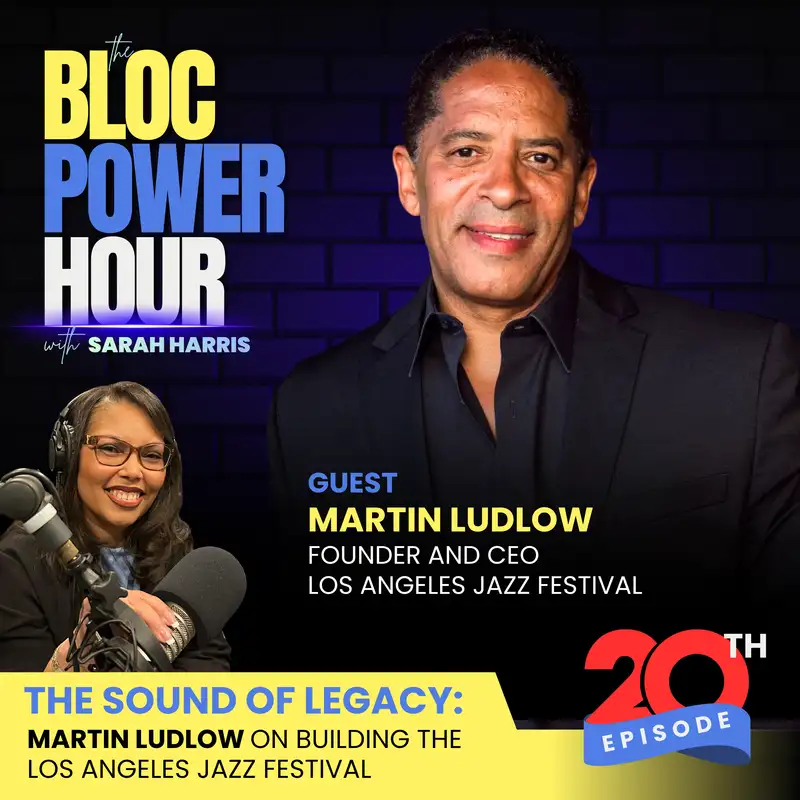
The Sound of Legacy: Martin Ludlow on Building the Los Angeles Jazz Festival
Download MP3Yeah. Sarah Harris. Turn the mic up. Turn the power up. Welcome to the block.
Speaker 1:We're a rise
Speaker 2:to the
Speaker 1:power in the hour. The block ain't stopping. Every minute Turn the mic up. Bike up. Bike up.
Speaker 3:Welcome to the block power hour. I'm your host, Sarah Harris. It is such a pleasure to have you joining us here today. This show is presented by the Black Business Association's media division, which is Elevate Media Collective. We are so glad to be able to have our guest in the studio today.
Speaker 3:The man, the man, mister Martin Ludlow. He's founder and CEO of LA Jazz Festival and so much more. I'm so glad to be able to have him in the studio. Also, we are delighted and honored to be able to have our partner that sponsors and supports us throughout the year, the Black Business Association, which is US Bank. Without them, this program would not be possible.
Speaker 3:We do invite you, those who have been resonating with our conversations and discussions here on the Block Power Hour to join us as a sponsor or to donate. You can find out more information at bbala.org. Again, that's bbala.org. Alright. So for today, again, I wanna introduce our guests.
Speaker 3:Our show is the sound of legacy Martin Ludlow on building the Los Angeles Jazz Festival. This is not just a festival. It is a celebration. It is a movement of supporting tourism, culture, entrepreneurship, and just bringing the community together. For me as a music fam, I'm delighted to be able to have this kind of opportunity and experience in Los Angeles.
Speaker 3:So again, joining us is the visionary behind this effort, Mr. Martin Ludlow, founder and CEO of the Los Angeles Jazz Festival. Welcome Martin.
Speaker 2:Thank you, Sarah. Thanks for that incredible intro. I appreciate it. Love the energy.
Speaker 3:Well, that's what we do bring here. For the Block Power Hour, we are about bringing peoples together, bringing different experiences and opportunities together to elevate our collective here and we want to inspire others to do the same thing. And I think that's exactly what you're doing here today. So in discussing the vision and your journey, kind of give us some background about your personal journey on why you thought of and was inspired to bring us the Los Angeles Jazz Festival.
Speaker 2:I appreciate that. You'll have to keep me honest on time because this is a subject that I can go on and on about, but it really does go back to just childhood. I was raised in Ohio, was raised in a small town called Oberlin, Ohio, and Oberlin is well known for kind of really two major distinguishing characteristics. One, Oberlin's conservatory music is second to none. It's one of the top three conservatories in the world.
Speaker 2:If you want to be a first chair cellist, or you want to be a director of a national philharmonic, you want to go to Berkeley, Oberlin, or Juilliard.
Speaker 3:Okay.
Speaker 2:And so, you know, as a young high school student, actually in middle school, I was able to take advantage of the programming that, you know, the local university would give to the diversification of the community. And I started picking up drums, picking up trumpet, playing piano. And so that launched a long time career in music right there. Second element was the fact that Oberlin was one of the last stops on the Underground Railroad. You know, during the fifteen, sixteen, seventeen hundreds, you were an enslaved individual.
Speaker 2:You and your family, if you could get to Oberlin by sunup, you would sleep in the basements of many of the homes that still exist to this day. And by nightfall, you had a one night journey to Lake Erie, and in Lake Erie, you could catch a boat and get to Canada, where slavery was not part of the economic system predominantly in Canada. So for tens of thousands of enslaved human beings, they passed right through the streets that I rode my bike on and, you know, rode, you know, scooters and so forth. And that was my upbringing. So I had an awareness as a child that there was something very significant and hallowed about the neighborhood and the community that I was in.
Speaker 2:And through that experience, I really came to study the history and evolution of jazz. It was so impactful to me. As a high school student, I was actually able to work my way up to first chair trumpet in both the jazz ensemble and also in our concert band. And then that led me to actually getting auditions at Oberlin as a high schooler, and then I was able to sit in. By the time I was a high school sophomore, I was on stage playing with Muddy Waters, Bobby Blue Bland, Preservation Hall jazz band.
Speaker 2:And so I was really taking the drums. And about that time, I took to an instrument that changed my life forever, and that was two turntables and a mixer. Oh, were you? So that was it. Was where it all came together.
Speaker 2:And I started learning how to promote for our band, and I started learning how to build large events where the community would come out, and that kinda changed everything from there.
Speaker 3:Did you have a DJ name? I did, but I'm not gonna
Speaker 2:say No. It on I appreciate you, Sarah, for trying to get me to do that. There's a couple of people like my daughter's back there saying, oh, is he gonna say that? But no, that was that was the kid. They're kidding me.
Speaker 2:And that DJ Handels actually was who had led my family, my mom and my dad to saying, you know, my father was a pastor.
Speaker 3:Okay.
Speaker 2:Very socially active social justice minister, and my mother was a union president. And they both looked at me and said, you know, it's time you start doing something redeeming with that skill set you got. And so I started building tarmac arrivals when Reverend Jesse Jackson was running for president of The United States in 1984. So that was really when I started bringing the power of music and large crowds together around the idea of pushing social justice, economic justice, political reform, law changes and so forth. So that really did kick off a long thirty, forty year career in politics and big events.
Speaker 3:Wow, that's a lot. And I love when you talk about the power of music and a lot of that power is being universal in its nature where it can connect and touch all of us, right? Absolutely. In many different ways.
Speaker 2:Well said. To your point, I remember my father taking me on a picket line with the United Farm Workers in Idaho, believe it or not. And I was listening to a white guitarist by the name of Pete Seeger. You know, Pete was playing music for the Strikers. I then got a chance to meet this incredible woman by the name of Joan Baez.
Speaker 2:And Joan was doing, you know, music around the civil rights movement and was marching with Doctor. King. And so I saw that at a very early age, and then obviously Harriet Belafonte became just the ultimate because he was bringing such an incredible Caribbean sound and jazz and Absolutely. All of And you know, for so many civil rights workers, that power was very evident.
Speaker 3:And he was an advocate too.
Speaker 2:He was right next
Speaker 3:to. Right.
Speaker 2:Through and through. Through and through. Mhmm. Yeah. To this day, I mean, so many people in this country that are still with us that were active in the civil rights movement, you know, he was more than than a musician.
Speaker 2:Was an
Speaker 3:Oh, definitely.
Speaker 2:Totally. I'm a union employer, so our stagehands are men and women of IAC Local thirty three, and most of them get me all the time on union violations because I'm the first one to go pick up a hammer and saw and get to bit know, get busy, I'm like, we gotta do this. But no, it really was when I got to LA, I had been so steeped in jazz and classical, and I really knew that jazz was America's original music form, and it really was born here by our people. And so when I got to LA and I came across one of the biggest, you know, festivals that LA has, and its context to jazz, just the brand of it was sort of incongruent for me. And it was probably that inception moment in my mind that I started thinking about why don't we have something in this major city that's on the level of Montreal and obviously New Orleans.
Speaker 2:So it took a long, long time. I got interrupted by a few things in life, but it was intensely probably about fifteen years ago that I started, I visited Venice Beach and started thinking that there was only one place that I would wanna put this festival, it felt like it was the right place to put it. And that really came by way of an honest conversation around the history of jazz and knowing connectivity to our story as a people, whether you look at it through the lens of pre colonized Africa, jazz was created through the evolution of the African drumming and African sounds. It really moved its way to The Caribbean, from The Caribbean to New Orleans. And New Orleans, true to its food and culture, really essentially was the melting pot of sounds and rhythms that were originally called jazzm, pep energy in Congo Square.
Speaker 2:And that was a regular sort of ritual of people coming to Congo Square and being able to, you know, do what they had to do in terms of business in Downtown New Orleans, but by night being able to celebrate that they had been able to get through another day and get through, you know, the hardships of life, and that in its essence is sort of the core of jazz, the pain and the joy of life. And that was for me, the realization of this interconnectivity to water and the ocean. One of the things that I always struggled with as a young kid was how there was this racial epithet that blacks and water don't mix when I knew as a kid that Africans were some of the best maritime champions of the world ever. We could navigate waterways, we could move ships, and you know, you can go down that whole rabbit hole, but it was just so incongruent. And I felt like when you come full circle, and all the victories that we had in terms of fighting for the right to be free, and fighting for the right to be equal, the last bastion of Jim Crow was denying us access to public pools, public fountains, and public beaches.
Speaker 2:And so when you look at our history nationwide, you'll see a very, very sad, a very painful chapter where black owned properties, black owned resorts all over this country, from coast to coast, were taken from our people, sometimes with the power of eminent domain, right? The theory that government has the ultimate power to take property for quote unquote the greater good, and to find that a lot of these black owned resorts and properties on coastlines were taken for the sole purpose of giving it over to a white proprietor just seemed like one of those stories that needed to be elevated to a much higher level. And so the only righteous place to put the culminating weekend of this festival was put it back on our coastline, put it on our property, which is Dockweiler Beach. And so, that was really the beginning of a conversation that has now taken fifteen years. We ended up spending five years working with the California Coastal Commission.
Speaker 2:We ultimately did prevail, got a unanimous vote of the Coastal Commission. Mhmm. First time ever that they've allowed a full scale mega festival to take place on Dockweiler Beach, and I understand it. Coastal commission is in position for good purpose to protect the coastline. But unfortunately, we all know that those rules and those, guidelines have often pushed us out, and that's where we call it coastal racial pushout.
Speaker 3:Coastal racial push out. Well, you've put a whole lot of, not just thought, but process and time into really thinking about how this would really roll out. So I appreciate your thoughtfulness on creating this experience for us. When we come back, we're gonna talk a little bit more about the forming of the LA Jazz Festival and a bit more about what's coming up at the Jazz Festival. Okay?
Speaker 3:So this is the Block Power Hour. I am Sarah Harris. We'll be back soon.
Speaker 1:This is the Block Power Hour.
Speaker 3:Welcome back to the block power hour. I'm your host, Sarah Harris. We have in the studio mister Martin Ludlow. He is the CEO and founder of LA Jazz Festival. It's a seventeen day experience for Los Angeles during the month of August.
Speaker 3:Welcome back to the Block Power Hour. Thank you,
Speaker 2:thank you. Good to be here. Great to be here.
Speaker 3:Awesome. Love talking to you in the first segment about your personal journey and how you arrived at being inspired to create the LA Jazz Festival. And so right now we want to go in and explore some of the incredible lineup as well as the community programming that you have going on with this historical inaugural festival. So tell us, you do have an impressive lineup. It features artists like John Legend and Janelle Monae, and I'll let you talk about more of the others, but what was the dreams of the initial rollout with the kind of artists that you wanted to bring on board?
Speaker 2:No, I appreciate the question. It really is telling a very intentional narrative around jazz to hip hop and everything in between, because, you know, if you talk to an acoustic jazz artist today, like Wynn Marcellus, he's going to lecture you about, you know, everything that is sort of spun out of jazz and, you know, you never want to argue with a legend like Wyndt and Marcellus, but, know, I did share my point of view. He loves this festival, by the way. When we had originally tried to pull this off a couple years ago, Winton was in immediately, he was one of the first musicians that I talked to, and we stay in touch. And you know, it really is a tribute to the creativity.
Speaker 2:At its heart, improvisation is so essential in jazz and central to its core. But I do understand that there's a long time dialogue around what type of music can quote unquote be classified as jazz. So for me, it's important, when we announced the naming of New Orleans Corridor in LA about two years ago, the VIP reception that we had after that, we had John Clayton on our stage, who is, in my opinion, the dean of jazz on the West Coast, one of the all time great upright basses. And his son Gerald obviously is without question one of the up and coming rock stars in jazz. But we also had on that stage, Rance Dobson and James Fontelroy from fifteen hundred or nothing.
Speaker 3:Yes. Mhmm.
Speaker 2:And we wanted to have a conversation about the evolution of jazz and the conversation came down to eight keys. And it was a conversation about the sounds and the rhythms and the syncopations and how in one bar you could bend a note. And for me as a young high school musician, that's exactly how I felt it. I was playing Dizzy Gillespie and Duke Ellington and Benny Carter, but I was also starting to track with guys like Stevie Arrington and M. Tume, and it was just, you were hearing these sounds being bent and it was just so creative and so distinctively funky, and you just wanted to get into that.
Speaker 2:So we've played that out on the biggest stage, I think, the world, that being LA. And to your point, you have from a John Legend, Janelle Monae, a Raphael Saadik, a George Clinton, Parliament Funkadelic, but you also have from The UK, an Ezra Collective, Nubia Garcia, you've got from South LA, a Tara And Harris so it does tell that narrative. Our opening artists is Justin Lee Shultz, you know, incredible young musician from South Africa. We have Joey Alexander from Indonesia and one of the most revered young 20 year old pianist. And you'll see
Speaker 3:You're movement bringing in in the the I mean, I feel like people will be introduced to artists that maybe they haven't heard of or just something like that. So it brings on added experience and layer to it. And for me, you talk about the evolution, but there's the influence from jazz that leads to other things. And like you said, you don't necessarily pocket it into jazz, but yes, it's been influenced. And the one thing that I've always been amazed about, and you mentioned it before, like the eight bars, I've heard that before where it is just a few notes or bars or what have you, I'm not a musician, but I'm just saying is that that simplicity can then turn into the variety that we see today in music.
Speaker 2:Yeah, no, that's right. We have so many legendary artists and we also have neighborhood garage bands on this show.
Speaker 3:Okay.
Speaker 2:And that was one of the real key factors for us in putting this together. So to your earlier question, so we launched on Friday, August 7 with our opening night. Mhmm. That will obviously be an incredible moment. That'll be in Leimert Park.
Speaker 2:This will be a night of some VIP moments, dignitaries, but we'll also have some tickets available for the public. We launch with Fernando Polum's youth band right out of Le Mer Park. We then go to one of the all time greats in Latin jazz, Pete Escavedo
Speaker 3:Yeah.
Speaker 2:And his family band. From there, it's Chief Adua, one of the top, top trumpeters in the world, and just again, still very young. And then Kenyon Dixon, great vocalist, then to the legend, Layla Hathaway. So I think part of what we want to do in that opening night was just give you a tapestry, give you a flavor of that reach and the rainbow of the festival in one night. From that moment, the next day, launched two very exciting initiatives.
Speaker 2:One is called Jazz in the Park. 25 free concerts in public parks from Moreno Valley to South LA, Orange County, up to Antelope Valley. And then that night we launched our Jazz After Dark series, which will be 70 shows in community based, you know, favorite restaurants from Harold and Bell's to Doolins to you name it, all across the city. Our intent there was to really bring out community based restaurants and could be galleries, nightclubs, what have you. We know that there are some beautiful, beautiful high end clubs and restaurants in the city, but we really
Speaker 3:want bring You're catching the real flavoring essence
Speaker 2:Yeah. In that grassroots, very grassroots. And you marry that up with legendary artists or community artists. And, you know, if you can imagine that 20 year old right now who's just coming out of high school, got his or her band together, they've only been playing for a couple years, and their name is gonna appear on the same concert with John Legend, right? That's what it's about.
Speaker 2:I'll never forget, Terrence Martin did something that, it reminded me of the great, great musicians that had an impact in my life When we did the naming of New Orleans Corridor, which we should talk about at some point, you know, he was our featured artist, and he grabbed young students from Fernando Polam's Youth Academy and brought them up on stage. And he didn't bring them up on stage to have them as, you know, kind of like figures He standing on the backed up and he pointed to each one of all right, now to trombonist, your solo. Trompeter, your solo. Sax player.
Speaker 3:Right there on the spot.
Speaker 2:Right there on the spot in June to form. What did they do? They killed it. They killed it. And so that's what it's about.
Speaker 2:And that's why I say evolution, because I think each of those moments is very evolutionary with that young kid that just experienced being on the stage with a Terrence Martin, followed by 1,500 or nothing. Know, they're gonna do that. They're gonna take it and they're gonna do it a little bit different. They're gonna cook it a little different as they would say. And that's what we love about this show.
Speaker 2:We ultimately get to the final week. Final week, we're gonna have Wednesday, what we call coastal cultural tours Mhmm. Where we are gonna invite tourists from around the world that are coming in for the all the music and the food and the and the environment to take a tour of locations along LA's coastline that do speak to that history of coastal racial pushout. We are gonna take you to Bruce's Beach. We're gonna take you to the Inkwell.
Speaker 2:We're gonna take you to the Viceroy Hotel, and similar to the founding fathers of jazz and mothers of jazz in Congo Square, through the course of a tough day, in the evening, we're gonna celebrate. It'll be very much like that vintage African marketplace that we all used to go to Right. For so many years. Just celebratory food, music. And then on Friday, something that we're really excited about.
Speaker 2:First time ever, particularly in LA, we have a project called the State of Jazz Conference. This will be a full day of bringing together jazz festival producers from around the world to talk about the future of the genre and talk about how do we lift the jazz ecosystem. And that's what really is probably the most fundamental element for me in this whole experience, is lifting up the jazz ecosystem here in LA as the leading entertainment capital, I think, the world.
Speaker 3:And where does that one discussion take place?
Speaker 2:That'll be on Burton Chase Peninsula, and our county officials are working with us right now. But if you haven't been to Burton Chase Peninsula, it is one of the most beautiful parks in all of Los Angeles. Honestly, I think it's one of the most beautiful parks in the world, because it's situated right there in the marina, but it is still meandering hills and so forth. And so later that night, after you finish the conference, go home, shower up, get changed, because you wanna be in Downtown Venice for our Caribbean street carnival. Four stages, 25 artists.
Speaker 2:Wow. We have an Afrobeat stage, a Latin jazz stage, a Cuba stage, and a New Orleans stage. And we're gonna just have an incredible street party with food from those cultures, music, art, it's and just gonna be a moment. Doors are open at 4PM. That'll go until 10PM.
Speaker 2:All of these are free. Everything I've talked about up to this point Free. Is free until the next day. Saturday and Sunday is our culminating weekend, and those are gonna be two full days on Dock Weiler Beach. Now even at Dock Weiler Beach, if you're trying to get tickets to Dock Weiler Beach, go to our website, www.lhsfestival.com.
Speaker 2:Mhmm. And you will be able to get some free tickets to those two shows as well on Saturday and Sunday. Mhmm. But what we're really excited about on those two days is we're debuting something that has never been done before. We are taking luxury box seats, and we're putting them on the beach, on the sand.
Speaker 1:Really?
Speaker 2:And we are building luxury cabanas. So the box seats are four seaters and six seaters. The cabanas are 10 seaters. If you go to our website Mhmm. You can actually take the mouse, hover it over the footprint, you can see what
Speaker 3:we're building. Your space on there?
Speaker 2:Purchase your space. Absolutely. We're gonna be experiencing, you know, box to box meal service. We
Speaker 3:Oh my god.
Speaker 2:You're be able to live it up when the weather's the warmest, the wind is the lowest. You're right there on the beach, sunset. Wow. John Legend coming out and you're getting ready to eat your, you know, filet How
Speaker 3:best how better to experience something like that on that level? Are you thought you're thinking about everything. We have so much more to talk about. We're gonna come back and discover more of the parts that you have going on that makes it so special. This is the block power hour.
Speaker 3:We're here with mister Martin Ludlow, founder and CEO of the LA Jazz Festival. I'm Sarah Harris, and we will be right back.
Speaker 1:This is the block power hour hour.
Speaker 3:Welcome to the block power hour. We are having a conversation with the visionary man, mister Martin Ludlow, founder and CEO of LA Jazz Festival. This is the block power hour, and it's presented by the Black Business Association. We do welcome your support. If you want to donate or become a sponsor yourself, please visit bbala.org.
Speaker 3:Again, that's bbala.org. Also, follow us on socials at Block power hour, and that is b l o c, and then you can find information on past shows and view them on podcasts. We are talking to mister Martin Ludlow. Thank you for coming here in the studio. It means so much to me that you joined us here to elevate and enlighten people on what you're doing with the LA Jazz Festival, but also more importantly, what it really means to the city, to our culture and to economic power that you can bring as well.
Speaker 3:I want to get into some of that, but before the break, we were talking about all this amazing experience and so for those who are just kind of joining in right now, I really want you to kind of expound a little bit on the main event kind of things that's happening and tell them what kind of wonderful experience that they can have.
Speaker 2:Yeah. And it really is the, you know, the icing on the cake. It's really it's the culminating weekend. So on Duckweiler Beach, August 22, August 23, we're gonna do something that's never been done before. We're literally building a full concert compound complete with luxury box seats, luxury cabanas.
Speaker 2:We're gonna have one of the largest outdoor stages in the world, and we brought in the best of the best. Our production team is world renowned. Our stagehands are men and women of Iozzi Local thirty three, and we're gonna have food and beverage director. We're gonna have concession stands. So everything that you would expect in a concert venue, you're gonna experience with the one thing you probably haven't had too many occasions to experience, and that is that entire moment happening on Dockweiler Beach right there by LA's coastline.
Speaker 2:And so the doors will open at eleven, and we're gonna have 10 artists on Saturday, 10 artists on Sunday. Saturday's gonna be just an incredible energy. Sunday's gonna be incredible energy. And for those who can swing it, we deliberately put together reserve seating opportunities, box seat opportunities, and the cabana opportunities. And I think it was for us important, you know, given that LA is what it is, to really ask, you know, LA to step up and step out to bring a level of festival this size to LA and to build it on the, you know, on the history of our ancestors, you have to find a way to finance it.
Speaker 2:And so those last two days are the only experiences throughout the entire seventeen days where you're actually paying to get into an event. And so we really believe that the folks of the city, businesses, organizations, corporations are gonna purchase these. I had a really good friend of mine at a bank that I won't mention the name of the bank, but they called it and said, man, I'm gonna do business at this festival. I wanna get a couple of the box seats. I wanna invite my clients.
Speaker 2:I want them to come out, and we'll close deals. And I and I'm hearing that more and more, and we love that because that's really what it is about. But you can come for the week and, you know, get yourself an Airbnb. Get yourself a place to stay and enjoy all the experiences of the festival from the coastal cultural tours on Wednesday Mhmm. And Thursday, the conference on Friday, the Caribbean Street Carnival Friday night, the, you know, closing two days on Dockwater Beach, Saturday and Sunday, and really enjoy the best of our nightlife as well.
Speaker 2:These shows that we're doing called jazz after dark, those are gonna go from 10PM to 1AM. Our goal here was to bring a little of the Paris nightlife, a little of the New York nightlife to LA. You know, we go to sleep at 10:00. So that is an intentional part of the festival, and we right now have over 200 food and beverage venues, restaurants, bars, galleries that have asked for an opportunity to work through the process with us. Right.
Speaker 2:And we're right now almost at seventy that we are confirming, and we're gonna be releasing a beautiful map on our website, and we'll be doing a big press event to announce all the restaurants that we have partnered with to make this possible. So very exciting, and it's a good opportunity.
Speaker 3:Like, started touching on some of the things that I was curious about because as far as the economic impact and what that means for, like, local businesses, as well as for the residents and everything, the opportunities they're in because when you can come and like you were saying, the other corporate partner or business was talking about how they would bring and and be able to have clients or network or what have you there, there's opportunities there. But larger than that for the local businesses, I was wondering what kind of experience would you create where, cause I see things like this, like where people are saying all this stuff is happening, especially as music heads or jazz heads or whatever you want to call them, that they're saying, I want to touch on this. I want to go here, here, here. And they're really kind of like bragging rights. Like I have been to this one and all of them or as best they can.
Speaker 3:Is there a way that you have where they can be able to map out their experience and be able to put an itinerary together or something like that, where they can say, basically touched as much as I can of this festival?
Speaker 2:I love that, yeah. So on our website, we're gonna be launching couple of links that you'll be able to go to, but one will be particularly that. We're also launching an app, so you can actually build out your experience through the app.
Speaker 3:Oh, great.
Speaker 2:And then we have one link that will be specific for folks who wanna be vendors, because we know a lot of people in LA, self employed and have launched their own companies, whether it's a food vendor, whether it's an art vendor, so forth. We're looking for a lot of people to work the festival. We're looking for people who want to be a vendor at the festival. And as you mentioned, there's multiple ways that you can get involved between the 25 concerts that we're doing in the parks to the 70 plus events we'll be doing late at night, jazz after dark, and then obviously the Caribbean Street Carnival, and even the big event. We're still putting together, you know, some of the key vendors.
Speaker 2:We're still looking for folks that bring different services on all host of levels. So if you're out there and you're listening to this great show and you want to find a way to get involved, please visit our website at www.lajazzfestival.com and start tracking the opportunities that we're presenting, because we need you, we need you, we need you.
Speaker 3:Excellent, yeah, that was one of my things, like what kind of opportunities exist for vendors and artists? Are there any commissioned work or anything like that on the artist level that is coming along with the Jazz Festival?
Speaker 2:So for those that were at our press conference on Thursday next to the Dunbar Hotel to really lift up and elevate that century long story of jazz down Central Avenue and throughout South LA, we released the key art that we commissioned for year one.
Speaker 3:Okay.
Speaker 2:And that was produced by an incredible local artist by the name Vakseen, V A K S E E N. He's had that moniker And for a long the art was just incredible. And so we revealed that, and he really captured the essence of the festival in LA and the energy of jazz and food and music. So that has been put out there, but we are going to be doing exhibitions throughout the festival. Again, those details will be coming out on the website soon.
Speaker 2:We have a phenomenal creative director in Piyama Habibula. She has been phenomenally praised for the taglines and the logos and the color palettes and so forth. So you're going to have great opportunity if you're an art producer, if you're a music producer, and I mean that artistically, not necessarily through the mechanics, but if you're musician, and if you're a food and beverage, so forth. So really to your point, opportunities from top to bottom.
Speaker 3:Right, and as far as the artwork, where they have like the t shirts or whatever kind
Speaker 2:of memorabilia from the day as Yeah, looking forward to launching that. So you will be able to get the merch from the website. Obviously we want you to come out to the shows and grab the merch there. Yes. But it'll range everything from t shirts to shot glasses.
Speaker 2:It is jazz. So we gotta make sure we're including that.
Speaker 3:I forever will see people wearing stuff from like ten years past or whatever, was showing the lineup of who was there. So we always do wanna be able to say that we were there. So I think that that's great. So, you know, Los Angeles is preparing for global events. Of course, we have coming here now is the FIFA World Cup, but also for the Olympics coming in 2028.
Speaker 3:And so how do you see LA Jazz Festival positioning in that world class cultural destination way? How do you see it fitting with that?
Speaker 2:Yeah, I think first is just really hats off to Mayor Karen Bass. She has embraced this festival since before she was mayor. Excellent. When she was chairwoman of the Congressional Black Caucus, you know, she was appearing at the California Coastal Commission, telling, you know, the Coastal Commission, this is an incredible economic opportunity for the region, and we need to really fight to make sure it's there. So Karen has been along the way with me since the very beginning and has just heroically stepped up to help us on every single turn.
Speaker 2:And I think she and her wisdom saw that this is a world class city. We ought to be the host of world class events.
Speaker 3:Excellent.
Speaker 2:Whether it is the Super Bowl, the NBA All Star Game, the Olympics, the World Cup, and the LA Jazz Festival. And so I think the infrastructure that LA has been putting together and rebuilding under her leadership, I think the fact that the city's public safety teams are taking these big events seriously, and then the opportunities that it's really created in the ecosystem of event productions means your mom and pop shops are getting, you know, all the sort of institutional knowledge and wisdom of doing the first big event, and then they go to the second big event. And so it's not just about how the city does, it's how the grassroots does in learning how to handle traffic and job opportunities and posting and information and all that. So I think for us, we feel blessed that our festival is launching right after World Cup. We're gonna build off of the the knowledge base of those experiences.
Speaker 2:We're working with the same department of transportation.
Speaker 3:We're
Speaker 2:working with the same fire department, etcetera. And so, I think from a marketing standpoint, it really is another opportunity where families are able to look at economical forms of entertainment. This is a very, very challenging economy right now globally. And I think people are really pushing the envelope and asking how can we get things that actually are affordable? And that is in essence why 75% of our tickets are free, and that's what we wanted to do.
Speaker 2:So I think we're looking forward to the partnerships. The leadership of the Olympics comes by our headquarters and meets with us almost monthly.
Speaker 3:Excellent. Good.
Speaker 2:And there's some great leaders there, Eric Aldridge, who many
Speaker 3:of Mhmm.
Speaker 2:Of your listeners are very familiar with Eric. He's just an incredible human being. And so Eric has taken, you know, very intentional steps towards finding those cross promotional opportunities, and we also know that the World Cup is gonna bring one of the most diverse audiences to LA.
Speaker 3:And
Speaker 2:so we are making sure that a lot of our marketing is going up. You're gonna see street posters going up. You're gonna see advertisements in the beauty shops and the barber shops and all that. Because as folks are coming in, we want them to know Yeah. You know, get back to LA.
Speaker 2:If you're coming back to LA, this is a place that can really host you and host you well. So we're excited about it. And Airbnb, by the way, could have been a better sponsor for us because that's what their core commodity is is they essentially are creating
Speaker 1:Right.
Speaker 2:Those affordable entertainment opportunities and leisure and experience that you can't get it sometimes with a big
Speaker 3:that experience. So we'll come back again. This is the Block power hour. We are with mister Martin Ludlow, CEO and founder of the LA Jazz Festival. Hello.
Speaker 3:This is Sarah Harris. I'm your host of the block power hour where we connect culture, business, innovation, and community to the power of economic mobility. And, of course, yes, that does mean the LA Jazz Festival. And we have mister Martin Ludlow, who is the founder and CEO. It's been a delight talking to him.
Speaker 3:Welcome back, Martin.
Speaker 2:Thank you. Thank you. Loving the conversation, Sarah. You're great.
Speaker 3:Excellent. Thank you so much. We will get into a bit more about what's going on with the Jazz Festival as far as the lineup and different things that you can do. Wanna make sure that you come out and support and attend and purchase tickets. That is for August twenty second and twenty third.
Speaker 3:But I was reading something, kind of interesting in terms of your approach on the LA Jazz Festival as being green and being intentional about that. Can you kind of speak to us why that was part of your mantra for this event?
Speaker 2:Yeah, so California Coastal Commission, when we first started meeting with them, you know, made it really clear that their existence since they were founded in 1972 was to protect California's coastline from erosion and from sort of being, you know, from attacks and things that could cause the ecosystem to really be impacted. And so that is a critical part of what I think folks who do visit the coastline don't often think about. It's easy to take that for granted. And so it obviously made sense for us to fully embrace the concept of the impact to climate change and the impact to sustainability. And we wanted to make not only a statement in the way in which the festival is produced, but in a broader sense, how important it is to our future as a people.
Speaker 2:So it really was consistent with a lot of the core values of who we are, and I think what they have in front of their mandate is making sure that you're as much as possible banning fossil fuels from the coastline. That's probably one of the most fundamental ones. So we are, in this first year, going to be bringing people to the festival by way of tram, and we're excited about that. And we're seeing a lot of events around the world, and we're seeing a lot of venues even here in Southern California, like the Hollywood Bowl. Hollywood Bowl is getting an incredible boost from tram experiences where people are coming in from Orange County, coming in from Inland Empire, coming in from even South LA, and they're using the local trams.
Speaker 2:And they're coming in, they don't have to worry about parking. They don't have to worry about all the access points because the tram is bringing them right up to the front door. And that's bringing people out of their car. If you can have one bus instead of 55 cars,
Speaker 3:did you'd be smart the right In terms of, because for the beach, in terms of parking and how to get there. Thank you for bringing that up. Ways that people can easily and with peace of mind, be able to come and just have a good time and not to worry about that.
Speaker 2:Absolutely, absolutely. And so that'll be a very, very easy to access experience. We're gonna be parking everybody at the Forum in Inglewood. It's a thirteen minute ride straight down the 105. It's a very quick run.
Speaker 2:And so you kinda compare that to trying to get to that big concert in the desert. It may take you four hours to get there. So we're excited about it and really think that this is, in the words of one of the coastal commissioners, really innovative, and they were very excited about it. We're very excited about it. And so even our generators on-site are gonna be driven by green power.
Speaker 2:And so we know that there are more and more festivals worldwide trying to do their part. We're gonna have a very significant salt waste diversion program, trying to find those renewable products so that we're not just throwing a bunch of trash from, you 20,000 ticket buyers into the landfills. We ought to be doing our best. And I think at its core, the best of jazz and the best of the culture is about being very frugal and being very conscious of your environment around you, and that's something that we hold very near and dear with the LA Jazz Festival.
Speaker 3:I appreciate your thoughtfulness on that part because especially this being a beach event, we know that plastics are just really eroding our beaches. So I just appreciate you leaning forward and into that. Okay. So for this event, again, we are talking about seventeen days across the month of August, starting August 7 in Leimert Park and culminating on August 22 and the twenty third on Dockweiler Beach. And so is there anything else in particular that you wanted to point out to us that makes this such a special occasion?
Speaker 2:Well, I think things that make it special, you've allowed to be articulated today, but I will say that this is only gonna work if Corporate LA steps up. We do need partners in the worst of way. We are, as you've articulated, 75% of the tickets are free, and to do that, you really need, you know, great corporate champions. And so we're encouraging people to reach out to our website at www.lajazzfestival.com. Find a way to connect with us.
Speaker 2:We wanna find a great way. And with a quarter of a million people coming into town with such a powerful narrative, such a powerful message, this is a great opportunity for local businesses and companies to get involved, become one of our partners. Let us champion you while you champion us. We believe this is a win win, and, one of the best things about the festival and what the Coastal Commission did is this isn't a one and done. We were very blown away when they unanimously voted to approve a three year permit with the opportunity to extend it beyond that should the festival go well.
Speaker 2:And so we're doing everything we can. We're asking LA to step up, support us, help us. Let's get the three years done. Let's extend it and look back on this as some of the great cities in the world do. Montreux, New Orleans, Montreal, Newport, Rhode Island, which is probably the granddaddy of them all, and they've been doing this for fifty, sixty, seventy years.
Speaker 3:Mhmm.
Speaker 2:We are LA. This is our first. We're gonna have some challenges for sure, but we need you to get involved. Help us put this together, and let's celebrate it as one of the greatest tributes to jazz anywhere in the world.
Speaker 3:Yes. Excellent. And I'm glad that you mentioned about the Dunbar Hotel because Central Avenue has been, just like with Harlem and in New Orleans and everything, has been a key place for the culture of jazz in LA. And so I've always loved the, I was getting ready to say, the Central Avenue Jazz Festival put on by Councilman Price every year has been just so supreme. Absolutely.
Speaker 2:You know, Kern's been great, Kern's been a leader. And obviously, as you know, to your point, Central Avenue Jazz Festival has been around a long time. You know, Gilbert Lindsay, Jan Perry, Curran Price, there've been a lot of great leaders that have held that post and have kept that alive. But what's really kept it alive has just been the history of jazz on Central Avenue. And I'll just sort of end with this.
Speaker 2:When you think about LA and you think about the entertainment industry that is here, that really is our economic engine, A lot of the moments when jazz was first evolving, Hollywood was evolving into music. And those jazz musicians were coming out along the Union Pacific Rail Line, came to LA to play those scores, and by night they were playing those jazz supper clubs. And so when you think about the history and the connectivity to LA and New Orleans, it goes back over a century, and it really is through the power of our Creole musicians that came to the city and helped power the biggest economic engine that LA has, and that is Hollywood.
Speaker 3:Woo, woo. And you mentioned to me earlier about the New Orleans Corridor.
Speaker 2:Absolutely. In paying tribute to the story that I just mentioned, we asked former mayor of New Orleans, mayor Cantrell, to join mayor Karen Bass through the motion of council member Heather Hutt. We were able to declare New Orleans Corridor along Jefferson Avenue from 10th to Western. Obviously, there's a very famous church right there. It's a long standing black Catholic church in LA.
Speaker 2:This was essentially the Ellis Island for Creole families as they came to LA to work in Hollywood. And through that early, what we call the second great migration, really from 1908 all the way up to the late 1950s, as those families came out here, they would go to that church to find connectivity to jobs, housing, schools, and the connection to their family. The corridor kind of ends at 10th, and we all know what's at the corner of 10th in Jefferson. Indeed. Great one of the greatest restaurants ever, Harold and Bell's.
Speaker 2:Yep. And so we did that a couple of years ago, and, again, both Mayor Bass and Heather Hutt were instrumental in there. And George McKenna, lot of people don't, you know, talk about George McKenna, but George McKenna, one of the legendary educators in this country Mhmm. Is from New Orleans. And he was right there with us to tell the stories, share the the And that's what this festival is all about, really intentionally bringing people together around those shared stories.
Speaker 2:And for some people, they didn't know these stories. And so we wanna make sure that they're being lifted up.
Speaker 3:And even for like the newer generations coming up, it's storytelling, it's making sure to have those traditions passed down and that they're not forgotten right. That's what it's a lot of about, to keep going back. So I love hearing that you have the three year permit to be able to keep moving forward on it. Is it something planned where you always wanted to be on the beach or did you plan to kind of have it, you know, around in different settings from year to year?
Speaker 2:Well, I'll say just like jazz, this festival has evolved.
Speaker 3:Okay, okay.
Speaker 2:So there were some early ideas and it just keeps growing and I'm sure, you know, in the coming years, it'll look even different than it does today. And I'm just looking forward to, you know, the first year going well. We need everybody to buy the tickets. We need all the sponsors to come in. We need the community Well,
Speaker 3:that's what it leads back to right now, because we just have a couple minutes left. So I want you to recap the highlights of it and everybody go out and get the tickets from where, give them where.
Speaker 2:Well, best way to say it is seventeen days, 250,000 people, 200 musicians. We're looking at a opportunity for thousands of people in the city of LA to work on the festival. The Jazz in the Park will be 25 shows free to the community. Our Jazz After Dark will be over 70 restaurants. Our coastal weekend, two full days on Dachweiler Beach, and then obviously Caribbean Street Carnival Friday night with four stages: the Cuba stage, the Brazil stage, the Afro Caribbean stage, our Latin jazz stage, the New Orleans stage.
Speaker 2:So it's really gonna be an incredible opportunity, but one big region all coming together to celebrate and have a great time. So that's really what it's about. And we need you, the listeners, to come out, get those tickets, get to our website, www.lajazzfestival.com, and we need the partners to come out and help us feed this incredible opportunity for the city.
Speaker 3:Well, I'm looking forward to it. I hope that you guys are looking forward to it as well. It has been a pleasure to have Mr. Martin Ludlow, founder and CEO of LA Jazz Festival and so much more. He's not just about the jazz festival, you guys, just so much more.
Speaker 3:But nonetheless, that's what we're here to talk about today. Again, it's lajazzfestival.com. Please go get your tickets for August twenty second and twenty third, but also enjoy the free events as well starting from August 7. I am your host of the Block Power Hour, Sarah Harris. Please continue to stay in touch with us at bbala.org as well as the block power hour on socials and come back next time.
Speaker 3:Thank you.
Speaker 1:This is the block power hour hour. We talk business, culture, vision, and grind. Opportunities align when the community shines. Dreams get bigger when the people connect. Moving with the purpose and demand and respect.
Speaker 1:Innovation in our blood. Break the wind I strive. Win the message never dimming our pride.