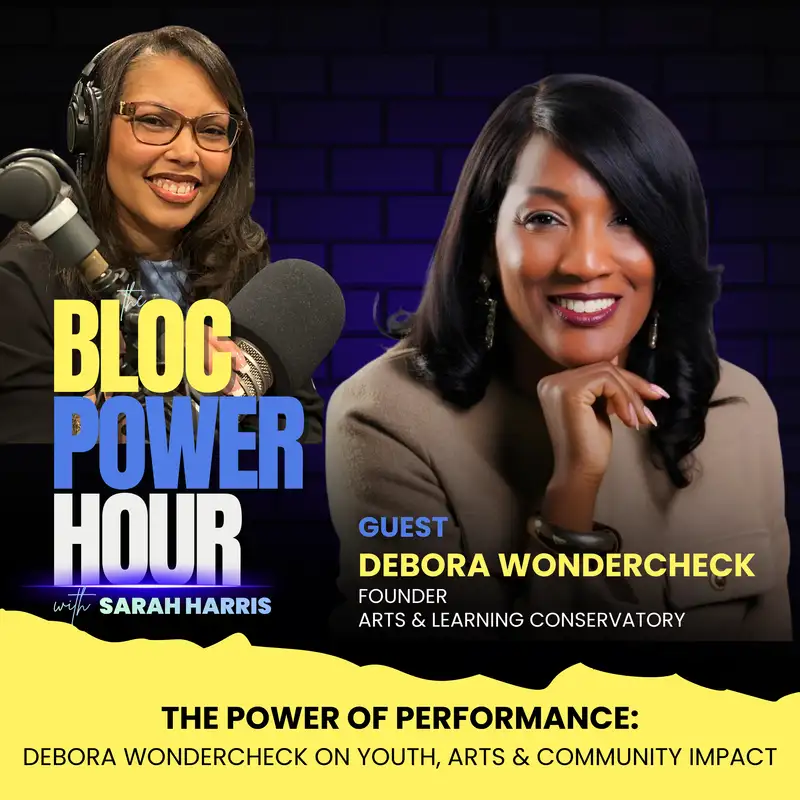
The Power of Performance: Debora Wondercheck on Youth, Arts & Community Impact
Download MP3Yeah. Sarah Harris. Turn the mic up. Turn the power up. Welcome to the block.
Speaker 2:Welcome to the block power hour. I'm your host, Sarah Harris. It is so amazing to be back with you once again at the Block Power Hour, which is presented by Elevate Media Collective, a media division of the Black Business Association. And we have such an amazing show here today. We have another individual here who I can't wait for you to be able to hear from.
Speaker 2:For this show, we are happy to have you to support the show and you can find out more information at bbala.org. Also find us on social media at block power hour, and that's b l o c, block power hour on our socials to listen to some of our podcasts after the shows, as well as to find more about the Block Power Hour. So now for today's show, it's a conversation about the power of arts to transform lives. Performing arts education is more than entertainment. It builds confidence, discipline, teamwork, creativity and purpose.
Speaker 2:For many young people, especially in underserved communities, the arts can become a pathway to healing, leadership, academic growth, and future careers. Our guest today is someone who has dedicated her life to creating those pathways. Joining us is Ms. Debora Wondercheck, CEO and founder of Arts and Learning Conservatory in Orange County. It's a nonprofit organization providing high quality performing arts education programs for the youth throughout Southern California.
Speaker 2:And we'll talk about that and their upcoming fifth annual Gospel Voices of OC benefit concert. So welcome to the Block Power Hour, Debora.
Speaker 3:I'm honored to be here, loving all this. Thank you so much for having me today.
Speaker 2:Amazing, amazing. For the Block Power Hour, we advocate of course, economic empowerment, but also things related to culture and community and those things that propels us forward in our daily lives and for mission and purpose. And so it's right in alignment of what you do. I'm so delighted to have you here today. We're going to be talking about your vision and expanding the program into the Compton and other underserved communities.
Speaker 2:So I look forward to unpacking all of that. So first of all, we always want people to know who we have on the mic with us today. Can you give our audience a little bit of your background information and what led you to founding Arts and Learning Conservatory?
Speaker 3:So my background is I'm a cellist and an orchestral conductor. I founded the Arts and Learning Conservatory based on a lived experience. My mom was an individual who wanted to play a musical instrument when she was growing up. And really around the time that she was 10, it was 1945. And she grew up in a prominent area of Chicago.
Speaker 3:It was an all white area. Her family was allowed into that community due to the fact that her father was a home builder. So they they could get a little pass to come in there. So she's the only black child in her school with her sisters. And when it was time for kids at the age of 10 to play a musical instrument, she was so excited with the rest of the kids talking about what she was gonna play.
Speaker 3:And due to the systemic issues that were going on during that time and at her school, she was denied that opportunity to play a musical instrument. So she took that energy and she said, well, you know what? When I'm married and I have kids, they're all going to play a musical instrument.
Speaker 2:So
Speaker 3:she got married years later. She didn't forget that promise and she had seven of us.
Speaker 2:Wow. This sounds like a Jackson story.
Speaker 3:It's a Jackson story. It's a Jackson story with stringed instruments. She kept to her promise. And then when she kept having the children, she would ask the Lord, please give me as many children as possible. She was a headstart teacher and loved teaching children and making sure that they had an excellent education.
Speaker 3:So with each child, she would go, okay, Lord, thank you so much for this child. And one more thing, would you please give them the gift of music? Lord, if you give them the gift of music, I'll have them serve you all the days Just of their please, Lord. So we all ended up playing stringed instruments. She exposed us to that through the school system.
Speaker 3:At the time, many of us, all of us maybe have grown up with having instruments at school. So when that came around, she encouraged us all really to play a stringed instrument. I think that was her love and what she always wanted to do as a child. So of the seven of us, six of us played a stringed instrument. We had two violinists, violas, two cellos, string bass player.
Speaker 3:And my brother who's right above me is intellectually disabled. She had him be the conductor and had him with different percussive instruments so that he knew he was a key part of our orchestra. So with that background, it was a beautiful time of playing these instruments. It created more exposure for us. It literally changed the trajectory of our families' lives in just being able to travel and perform in different string orchestras.
Speaker 3:But we also, she held true to her promise to the Lord, having us perform in different churches, community centers, senior centers, she always saw that music was something that was to be given to others and to bless people and to help people be seen and heard, but bless them with this beautiful gift of music. So we did all that. And at one point she even had us in Chicago on a Christian television station. It wasn't TV and it was like Praise the Lord Club or something like that, playing our instruments. And we also sang gospel and spiritual music as well.
Speaker 3:So with that experience, I just knew that the arts are something that I needed to give back as I became a little bit older. But the other, the flip side to all that, we had all this beautiful music happening. We're sharing the love, but in our home there was domestic violence happening. And my father, hardworking man, but it was very dangerous what was going on. Even with having more and more kids, she kept thinking, I need to get out of this situation.
Speaker 3:The time she had all of us, she felt trapped. But she also saw one of our music teachers, my brother's cello teacher who played in the Chicago Symphony, told my mom, look, if your kids get really good at this, they should be able to get scholarships to go to college. So after the first and second one got their scholarship, she was looking at that third one going, you're next. You're gonna get the scholarship. Okay.
Speaker 3:So this lovely God fearing woman turned into a drill instructor. She's an amazing all won't get a scholarship.
Speaker 2:She is an amazing woman.
Speaker 3:She was amazing. But what it was for her is she saw, oh my goodness, if this third one gets that scholarship, that means I can take four kids out of this situation, never to return. And that third one got a scholarship. And then literally after he got that scholarship, in one night we escaped out of our home. She made us bring our instruments.
Speaker 3:She's like, put that cello on your back, get that suitcase, we are leaving. And we escaped from Chicago to Denver, Colorado. We stayed in a women's shelter. So we were homeless for like three months or so. My dad figured out where we were.
Speaker 3:We had to travel to San Diego. We were in the Salvation Army there for a while. And then we traveled up to Oceanside and were still living in a women's shelter. So with that experience, I was 10 at the time when all of that happened. I was fearful of pretty much anyone that came around me.
Speaker 3:I just had extremely low self esteem. I kept thinking life is going to end. Someone's going to, you know, my dad's going to get my mom. I was just a wreck and very quiet. Didn't want to speak to anyone.
Speaker 3:But across the street from that last shelter that we were in was a performing arts school. And in that school, I again had Marcello traveling with us from all these different locations. They had a string ensemble, so I was able to play my cello there. But what was funny there is by the time I got there, I didn't want to be around the kids. Orchestra teacher had her class right after lunch.
Speaker 3:So during lunch, I stayed in the lunchroom. Orchestra was in that same room. One day I was on my cello playing the bass line from Beat It. I was jamming out, but by myself in a little corner, some little boy walks by and he's like, are
Speaker 1:you playing Michael Jackson? I'm like, yes. And he calls all these kids over, she's playing Michael Jackson. She's playing Beat It. You know, Billie Jean, she's playing Billie Jean.
Speaker 3:So all the kids surrounded me and they didn't see me as the kid who was homeless and lived across the street at the shelter. They saw me as this amazing person that had this wonderful talent and they were pulling on me. Can you teach me? Can you show me? Oh, that's so cool.
Speaker 3:I was the cool kid and I didn't realize that that instrument would give me a voice and an audience.
Speaker 2:Sounds like a pivotal moment for you.
Speaker 3:It was completely pivotal. And from that experience, I came out of my shell. I became more involved within the school community and I was beloved by my friends, as well as the teachers. And the teachers had to have known I lived across the street at that shelter, but they really built me up. But that experience changed my life completely.
Speaker 3:And I was able to take that upon leaving the shelter. And my mom got her degree in child development. We had our own place. She always kept telling me, you need to give back. Is a gift that you've been given, but you're going to give back.
Speaker 3:All of us, all the kids. So got my degree, ended up working affluent school district, became a master teacher in that district, got my master's degree. So I became a college professor, had all the things, but I kept hearing about arts programs being cut left and right. And then I had to look back at my life and how I don't know where I would be today if I didn't have music in my life and that outlet because music did get me to college on a full ride. So I thought back to everything my mom had shared with me that I need to do the same for other children, little children that could be like me.
Speaker 3:Maybe they're homeless. Maybe they're going through a tough time and music and the arts is a way that they would have a voice. Wow. So that's how.
Speaker 2:There's a lot of connecting the dots throughout your life. Amazing story. We're gonna hear more from miss Debora Wondercheck about her amazing journey and then to her mission. So come back. This is the Block Power Hour.
Speaker 2:I'm your host, Sarah Harris. We'll be right back. Welcome back to the block power hour. I'm your host, Sarah Harris, and we're having amazing conversation with miss Debora Wondercheck. Before the break, she was telling about her story in terms of coming up in a resilient, strong mother figure who led her children knowing that the answer is going to be through arts, music, and entertainment.
Speaker 2:And so that's what created, Deborah on her journey. And part of that was it gave me a vision of fame. And I just kind of have to ask this, when you were playing Beat It, and everybody there was calling people over to listen to you. Did they start dancing on tables or whatever? I just had that vision in my head.
Speaker 3:No, they didn't start dancing on tables, but they were pretty excited to hear it.
Speaker 2:Wonderful. So in telling your story in terms of your mother having to leave her husband due to domestic violence and then going into a shelter and across the street, there is a arts and performing center that you were able to go to, which became a pivotal moment and a lifeline for you. Tell us how that then transformed because we know that like your mother fed into you that to give back, but what was the journey that eventually led you to finding arts and learning conservatory?
Speaker 3:So through all of the wonderful things my mom did, I was able to get a scholarship to go to college. And upon going to college, I landed a wonderful job and was teaching in a very affluent school district. And with being there, I kept seeing and hearing about other music programs being cut left and right. And that's when I said enough's enough. I've got to find those children like myself who did not have arts opportunities, or actually I had the opportunities, but I was seeing that they weren't.
Speaker 3:So I said, I've got to do something about that and help even be an advocate for the children that did not have those resources. So after getting my master's and working at a school district for about ten years and doing extremely well and being a college professor, I decided I was going to create a nonprofit organization. I started out with just a little summer camp and I was going to do a musical. And with that musical, just have, you know, some string instruments there with kids who played and then some other kids that were doing some acting. We did that little camp and I had 21 kids sign up for that.
Speaker 3:The very next summer I was doing the same camp at a university and I had about 145 kids show up. And from there we had parents in that program stating, there's no music at our school. Would you please bring this program to our school? So we were in about three schools. When I say we, it was myself and another theater person.
Speaker 3:I'm an instrumentalist, you know, theater isn't necessarily my big thing, but I knew I was smart enough to hire a professional that knew theater to bring it in a high caliber way to the children. So we teamed up. We were in three schools. And then from there we were getting calls to go into five schools and seven schools. And then we were getting calls to go into the zip codes where a lot of people were like, we're not going there.
Speaker 3:We'll go over to Newport Beach or Huntington Beach, but we're not going to go to these places. I would go there. That's where I knew that's where I was. When I was homeless, we didn't have a car. We didn't have a washer and dryer.
Speaker 3:We had to, you know, public transportation. So I was really committed to bringing the program on school campuses, right where children were. Parents might have two and three jobs working, but we're going to get this to the kids who need it the most. And that's where I came up with the whole concept of the Arts and Learning Conservatory. So I founded it in 2004 and since then we've brought this program now to over 38,000 children across Southern California.
Speaker 2:Amazing. So you believe that arts education is so important, especially for young people today. What is some of the transformational qualities have you seen coming through youth with your programs?
Speaker 3:Well, we know even from the studies that are out there from the National Endowment of the Arts, students involved in the arts have higher grades, they have lower absenteeism and they get involved with the community. And right now, with our youth, there's a disconnect. And if we can get them involved with the arts, the other study shows the kids involved in the arts are less likely to be involved in violence or gangs or, you know, cause problems at school. And so if we can get this generation involved in that, then we're going to see a huge result. The music and the arts is essential.
Speaker 3:It's at the core of who we are as a society. And to remove that from a school system means that we're denying children their absolute rights to something that's going to be transformative for them. And like I already shared, it was transformative for me at our lowest point or my personal lowest point. So it's something that provides structure for young people. It also helps them stay regulated as far as understanding how to read people, just their emotions.
Speaker 3:And right now with the kids having just recently come through the COVID situation, it really created a huge divide. And I'm seeing that with these programs, we're teaching students about soft skills, how to read people,
Speaker 1:how
Speaker 3:to just understand when to speak, when not to speak, and not to just, you know, go off, you know, do what they want to do, but you know, have some kind of semblance of understanding how to communicate. And that's huge. That's not something you can teach in school. It's something that needs to be experienced and it's a life skill.
Speaker 2:It goes beyond just the musicality, performing or whatnot, but like you said, skills that we have. And you know, we had a good amount of the arts in school when at least when I was growing up, we'd be dating ourselves and pulling back from that more and more and more. I can't understand why would even think that it's not a necessary part of our curricular system that we should have. And I saw that you did do a travel to, was it DC or was And it so when you went there, you were advocating for what?
Speaker 3:Advocating for the arts and more funding to keep these programs in schools. What I'm finding is the arts are in schools here in California, but it's typically in areas where it's affluent. And you have, according to what Prop 13 was years ago, it really aligned with wherever your zip code is and your school is, the funding from the homes in that area funds into the school. So you can see a disparity right there. If you're living in a zip code where it's very low income, you're working class, many of the parents do not even own a home, they're living in an apartment.
Speaker 3:Well, that's the funding from the few homes in that area that goes to the school. And that is what funds the arts and that's the disparity. So we're seeing that for what it is, and now it's time to get rid of that divide. And that's why Arts and Learning Conservatory exists. We are on a mission to make sure that every single child, especially African American children, children of color who are not getting these wonderful programs have access to it.
Speaker 3:So that is really what this is all about for us. It's our mission is to bring high quality performing arts to all children and especially our children.
Speaker 2:And there needs to be a place for that, right? I saw construction phase of it, a brand new theater and you were beaming from ear to ear, just seeing it coming together and all that. So kind of tell about your process of getting a new theater and then when, you know, it finally had that and your first performance there, what was that like?
Speaker 3:Oh, it was amazing. So the building, I need to back up and let you know that that building was donated to my organization.
Speaker 2:Excellent.
Speaker 3:Yes. Was donated about ten years ago. And then within the last few years, we were able to raise funds. I'll be honest, I'm the fundraiser.
Speaker 2:Yes, you
Speaker 3:are. Else
Speaker 1:can Don't get make that twisted.
Speaker 3:So I was able to raise the funds to remodel the building because at one point there was a flood there. We were flooded out. We were kind of forced to build out the facility. But what was beautiful about that, again, God blessed me with that building. I'll just be very honest.
Speaker 3:And then with the flood, you could look at that as a negative, but you gotta make lemonade out of lemons, you know? So with that, I saw that as an opportunity to build a theater inside of our space. So raise the funds, was able to do that, opened that up about two years ago to the public. We had our first show there, and it was that facility is all about the kids. So we had a production in there of, I believe it was The Wizard of Oz.
Speaker 3:And the kids were beaming from ear to ear. Parents were so excited. And since then we've done a few other shows, but we made that facility into a theater to rent it out so that the community knows that this is here and the resources or the funding from the rentals will fund scholarships for our students so that we have another revenue stream and we always have funding available for the children to keep doing these arts programs.
Speaker 2:That's definitely important. We're going to be coming back, but before we go, can you give them where they can find more about the Arts and Learning Conservatory?
Speaker 3:So we do have a website. We're at arts,arts,thewordandlearning.org. And you go ahead and tap into that site. You can find out how to get involved, you want to be a volunteer. We definitely accept donations.
Speaker 3:If you want to donate, we will The
Speaker 2:website again?
Speaker 3:Yes. Artsandlearning.org. We gladly accept those donations and your support. If you're someone that has a skill that would like to help, maybe you're a technology person, maybe you're a lawyer and you just want to help and go ahead and give some of your support via gratis or what have you. We are open to it all.
Speaker 3:We need it all. We're growing in such a way that we've got about 60 teaching artists right now that go out into the schools. So us having more of a legal presence or support so that we go in covered, making sure everybody's tight is helpful to us. Excellent.
Speaker 2:Well, that's how you can find them. And we're going to come back for more conversation. And this is Sarah Harris with the Block Power Hour. We'll be right back.
Speaker 1:Welcome
Speaker 2:back to the block power hour. I'm your host, Sarah Harris, and we have been having some amazing conversations, some dynamic voices on this mic. In the block power hour we have had since the beginning, and miss Debora Wondercheck is no different. We do want you to be able to support our show, especially if it's resonating with you and you wanna find out more information or to donate, can go to bbala.org. We do welcome your support there and learning more about the block power hour at bbala.org.
Speaker 2:Also check us out online at block power hour on our socials. So welcome back, Ms. Debora Wondercheck. It's good to have you. I've been learning about your story as well as your mission, which is really dear to my heart too.
Speaker 2:I am a artist, a creative person, and I tried music as far as the flutes and I've told this story before, but I get light in the head trying to blow on the flute. So that's not for me, but nonetheless, I love music, I love the arts and I've always known from the beginning that it is a force in terms of that really empowers us through our lives and on many, many different levels. And so one of the things that we want to talk about here today is that you have an upcoming fifth annual Gospel Voices of OC. It's a benefit concert. And so can you tell us what the audience can expect?
Speaker 2:Well, give us some background in terms of how the gospel concert came about and then what the audience could expect for this year.
Speaker 3:So this concert came about from the whole upheaval that was going on in our nation with George Floyd and Breonna Taylor and all of the different things that were happening at that time. And so I had seen in Orange County that even though the African Americans that exist in that county are less than 3%, at the time we were 40% of the hate crimes. And I had stated that enough's enough. We got to do something that's going to bridge the community and have people see the amazing things that African American people are all about and our brilliance. So I created the Gospel Voices of Orange County as a concert to bridge the community.
Speaker 3:This is a concert that celebrates our ancestry of who we are as a people. The church has always been the center of the African American experience in the community. And so, and if you look back to enslavement times, it was a place for us to come together, worship, build each other up away from the watchful eye of the enslaver. And that kept continuing even in Jim Crow era and even through civil rights where we said, Hey, we're going to come together, stand together and say enough is enough and change what has been placed in front of us as this is how you're going to stay, this is where you're going to be. Well, we had to break out of that.
Speaker 3:And it was through our experience in the church. So with Gospel Voices, it's celebrating the voices of African Americans, whether that be the voice of choir with gospel music, whether it's the voice of orchestra, classical music, jazz, contemporary music, whether it's tap dance, ballerinas, spoken word, we do it all. And we celebrate it with the spirit of excellence. And this year we're going to be honoring innovators. So we're going to hear about African Americans who have made a huge difference, not just in our nation, but worldwide impact.
Speaker 3:And that will be there. One person that's coming that I'm so excited about that is a living legend is Mr. Floyd Norman. He is the first Disney animator that was African American that worked with Walt Disney. Wonderful.
Speaker 3:And he's living and I'm going to present to him a special honor at this particular concert. But the concert's all about honoring those who have gone before us and honoring the shoulders that we stand on and telling our story from our voice. So everything is all about African American artistry. The music you hear, the spoken words you hear, the people playing the instruments, it's all about us and the brilliance that we've brought to this nation.
Speaker 2:Oh, excellent. It sounds amazing. And for your concert, in terms of the support that it generates for your programs, what kind of impact has that had?
Speaker 3:This is the first year that we're doing a full benefit concert. With this, it was always just let's bring the community together and have them donate to the children. But this year we're
Speaker 1:like, these kids need money. So please support us because people love it.
Speaker 3:It's multigenerational. You have people there that are 70, 80 years old and a child that's 10. Everybody's getting something and they're hearing our history firsthand. But we also have the children from the program of Arts and Learning Conservatory on stage with these professional musicians, the singers, the artists, just showing the gifts and talents that they've been learning through us and also with them being mentored by these amazing individuals. So this is a benefit concert.
Speaker 3:We need donations. We want to make sure that the legacy of the Arts Learning Conservatory remains in this state for here on out, even once I'm long gone and passed, we want to make sure that these programs stay in the lives of our children. So definitely, As love donations for
Speaker 2:we say that, you plug in. What is the website again? Can find
Speaker 1:out more information.
Speaker 3:Arts with an S, a r t s, thewordandlearning.org.
Speaker 2:And the concert is taking place in June, June 27, right? In Irvine at the Barclay Theater, but you can learn more information off of their website. I would like to know, are there any like standout, know, one of the big favorites I know, but any standouts that's come through your program that maybe you want to highlight?
Speaker 3:Students that have come through, oh yes. I was in New York for a music conference and just sitting there, your husband, you know, watching all the different things happening at this event. And I saw a cellist on stage and remember cello is my instrument. Saw this cello on stage playing. I'm looking at that person.
Speaker 3:I'm like, that looks like a student of mine from fifteen years ago. Wow. No, I don't know. And I kept looking at him because he's all grown up. And then I spoke to the person at the end.
Speaker 3:This student went to Juilliard and now he's a world class performer and he was at New York at this special event and he was the headliner. And I walked up to him and I'm like, oh, are you Philip?
Speaker 1:And he's like, Mrs. Wondercheck and hugged
Speaker 3:me and was like, you're the reason why I'm here. I was just so blown away. So we've had kids go to Juilliard. We've had kids at the New York Tisch School of Performing Arts as far as musical theater. We have a child right now at Oberlin Conservatory.
Speaker 3:So our students go all over the place. I have a student who is at South Coast Repertory Theater. He's one of the directors there, And he came through my program when he was nine years old. So we're all about making sure these kids go places. And we're now creating scholarships for students, just like my mom didn't create the scholarships, but she navigated and knew where to put us.
Speaker 3:But I'm doing that now with Arts Learning Conservatory, creating scholarships for children. And we also have an apprenticeship program right now where we're paying students to learn about the arts, whether it's technical theater, whether it's acting, singing, dancing, whether it's just working in an office with arts administrators, we now have a paid internship through the Orange County So Department of we mean what we say, we're about investing in our youth.
Speaker 2:Excellent, excellent. So as we've been saying is that you're based in right now in Orange County, but you have plans to expand into Compton and other underserved communities. Kind of tell us about your expansion plans.
Speaker 3:We really want to, again, make sure that we're in Compton and other areas locally. Our desire is to expand even throughout the state of California and eventually nationwide, but we're just doing it one county at a time. Our goal too, when we are doing this expansion, it's just to make sure that the quality remains high and that these students have the best of the best. So if we're working in Compton and bringing in our lighting and sound system and our directors and choreographers, music directors, we're doing the same thing in other districts. Maybe there's a district that's paying us high dollar to, you know, not to say high dollar, but they're paying us to do it.
Speaker 3:We take that same level of high quality arts and bring it to our students in Compton. See kids as kids. They're all the same. They just have, you know, different parents, but all of our parents want the best for our kids. So we bring the best and we want to expand that through the state eventually.
Speaker 2:Excellent. And so with that, how can schools or community leaders or businesses partner with you to further the mission of the conservatory?
Speaker 3:Schools can partner with us by opening their doors to us and integrating our programming directly during the school day. We are in school during the day, we're in school after school, and we want to be a core part of what's happening. Community leaders can use this platform and their influence to champion arts funding. We can get advocacy with policy change. That's why I was in Washington, DC.
Speaker 3:We just want any and all platforms to help get the creative development into our young children. And that can only happen with the community. I can't do this by myself. I want others to stand alongside of us and make it a priority and not see the arts as a luxury. It is a priority.
Speaker 3:Every child deserves it. It's not just where you live, where you get it. Every child deserves it right where they're at currently.
Speaker 2:Excellent. So with that, we're going to come back again. So much good stuff to talk about here and learning more about your program. I really do appreciate all that you do. And we want to hear from you in terms of just like the way forward and then how do you see how the creative economy can play into Southern California?
Speaker 2:This is the block power hour. We will be right back once again.
Speaker 1:Welcome to the block. Turn the mic up. Bike up. Bike up.
Speaker 2:We're grooving and moving here at the block power hour. I'm your host, Sarah Harris, and our guest today is miss Debora Wondercheck. She is the CEO and founder of Arts and Learning Conservatory. And we are talking about really the power of the performing arts, creative and all of that, what it can have in a child's life, more beyond just the arts of it, but also the life skills. And so they have an upcoming concert again, the Gospel Voices, and it has different layers to it and I'm learning.
Speaker 2:So can you kind of tell me, break it down on how the performance will be?
Speaker 3:So the performance comes with different eras that we're covering. So we are going to cover the era before slavery and leading into the period of enslavement. And then we go into more of the Jim Crow era or from an artistic standpoint, the Harlem Renaissance. And then we go right into the sixties and seventies. And then we bring us right up into modern day arts that are happening today.
Speaker 3:And with this too, what's a little different, it is a benefit concert this year. And then we're also honoring innovative African American artists. Not even artists, I'm sorry. We have artists, but also innovators, people who have impacted our livelihood. So for instance, Charles Morgan is someone who had created the blood banks and just the whole blood system of how to even store that.
Speaker 3:We're going to talk about his story. We're also going to talk about William Banneker who created the blueprint for Washington DC. And that was during the 1700s when African Americans still were not even allowed to read or write, but he was able to have that happen and created the blueprint for our nation and then created almanacs. So we're going to be talking a little bit about that. That's all done through spoken word.
Speaker 3:This is an African American production done our way. So it is an experience you will not want to forget and you will walk away with your head held high, your chest sticking out because you're hearing your history in a way you've never been told it before and it's all accurate.
Speaker 2:I'm just loving this. I'm loving this because you know, we are dealt with a lot of erasure of trying to happen. So anytime that we can continue to tell our stories and in creative ways as well is always a plus and a major. How long have you been working on this production?
Speaker 3:We've been working on the production for the past seven months. When we do this, again, it's all about excellence. So we really put a lot of time. I do all the research of who we're going to be honoring on the concert. And I take my time just really delving into, again, getting accurate historical facts so no one could ever question, well, don't know, the black man created the banjo.
Speaker 3:Yes, he did. And we're going to have some banjo players play the banjo. But it's like, that's one thing that people don't even know. A lot of these different things such as the banjo, that's our instrument that was taken. And we're gonna reclaim it on this concert and talk about it.
Speaker 3:The thing is, is when we talk about it, it's not a lecture. I'm not here to feed anybody broccoli. We're going to come in, you're going to feel what's going on and we're going to take you from era to era and you're just going go, oh, completely enlightened. So it's all about us knowing our history and celebrating it together.
Speaker 2:Having a good time and learning something without even knowing it.
Speaker 3:Exactly.
Speaker 2:And I love how you have the gospel music because it's so deeply rooted in our culture and our spiritual roots, right? And how you use that as the foundation too, as part of this whole experience.
Speaker 3:When you think about gospel music too, it's the sound of us who faced unimaginable suffering and we chose against every odd to still sing and to praise and believe that something better was coming. So that's the heart of what this whole story is too. So it's exciting. Hope everybody comes out and experiences it.
Speaker 2:All right. So what are the age range for the youth coming through your program?
Speaker 3:For the Arts and Learning Conservatory programs, we go down as young as four years old, all the way up to the age of 18.
Speaker 2:Okay. All right. And how long do they usually stay through the program?
Speaker 3:So when we're at different schools, we're typically, well, there's a couple of schools we've been at for about fifteen years now, but usually we're at an elementary school from third grade through sixth grade, so three years. And then we also ask students, or we find ways for those students to continue with us at the conservatory. The conservatory is actually located in Costa Mesa and students who stay with the conservatory. And again, we find scholarships, we make a way, no one's turned away with our programs. We create scholarships for them to attend at the conservatory.
Speaker 3:And then from the conservatory, they're being with us through their middle school and even high school years. We then are finding scholarships for them to actually go to a university. So we're all about giving back. Like I said before, we're very serious about this and that's how my life was able to change in going to college was through the arts. So I'm doing the same thing for these children.
Speaker 2:Excellent. Are there any other highlights or points of the organization or are the other parts of the elements that you are doing? Because I see that you have like the summer camps and some other programs and stuff that you are working on. Just, is there anything else in terms of that you have going on at the conservatory?
Speaker 3:Right. So this summer we're doing the production Aladdin Junior. And so we're auditioning children. It's purely for children. So ages nine to 17.
Speaker 3:And then we also have other camps. We bit the bullet, and and we're doing the K pop K pop dance. K pop dance, Zootopia camp, and we also have camp wicked. Mhmm. So we're we're doing a playoff of the musicals.
Speaker 3:And, these productions, we also have year round. So anyone that's interested in sending their children to us, we would love to have them get involved with being in a production. If they wanna also learn an instrument, we have private lessons that take place at our studio in Costa Mesa with stringed instruments, band, drumming. We do all the performing arts. So we would love to have families know that we're here for them.
Speaker 2:So one more time, give them where they can find you.
Speaker 3:They can find me online at arts, arts, the wordandlearning.org.
Speaker 2:Excellent. And so now we have a part that sometimes we'd be able to get into or not, and it's called block fire. And it's just some rapid kind of questions, just whatever comes to your head. And today's block fire segment is sponsored by coach Wendy, the purpose partner, helping you at crossroads to be unshakable and walk in strategic grace. You can learn more at wendygladney.com.
Speaker 2:Again, that's wendygladney.com. So for our first question, just kind of off the top, nothing, you know, heavy or what have you, but can you give us a favorite gospel song of all time?
Speaker 3:Favorite gospel song of all time.
Speaker 2:Well, just a favorite gospel song.
Speaker 3:Let's see. Okay. This should not stump me with all the gospel music I'm doing these days. Favorite gospel music of all time. I have to think to my mom, my favorite gospel singer from listening from my mom was Mahalia Jackson.
Speaker 2:Okay.
Speaker 3:And, oh, and God Is by Thomas Dorsey.
Speaker 2:God Is? Yeah. Oh yes, yes. Yes. Say that all the time.
Speaker 2:God Is. That song.
Speaker 3:I love it. Yes.
Speaker 2:Okay. Well, I kind of stumped you there, but All right. All right. So one word that describes the power of the arts.
Speaker 3:The power of the arts, maybe resilience. Because the arts stand the test of time, I mean, throughout history, throughout our world. And if you look at specifically African American history, it's the arts, the singing, the dancing, the vocal playing instruments has survived the test of time. So it's a resiliency
Speaker 2:I I would layer on that as universal. Like it speaks to everybody. Sure does. Different ways, you can read it on different ways or what have you. Okay, what about just any type of performance at all that moved you deeply?
Speaker 3:The performance that moved me deeply honestly was a musical theater production of The Color Purple. That moved me to tears. I love that production.
Speaker 2:I got a chance to see it actually in New York. I think it was back in 2004 when it first came out and yeah, seeing it there on Broadway was just amazing, amazing experience for that. So wow, can you believe we're about at the end of this show? Doesn't it go by so fast?
Speaker 3:This actually did go by fast. Wow.
Speaker 2:It goes by amazingly fast, but I do want to say that it has been such a pleasure to learn about your story and also your amazing mother. I can't say enough of how much that it was just so important to be that person that puts you on a path to knowing that this is going to be instrumental in your life. That was a pun, right? Instrumental in your life to really mean something. What would you tell your mother real quick if you talking to her today in terms of like where you are now with the conservatory?
Speaker 3:What would I tell her today? Well, know, my mom passed away just two months ago. Oh. And she's the whole reason why this organization exists. I would have to say, mom, thank you so much for your affirmations, for believing in me, and even speaking life.
Speaker 3:She spoke the word of God over all of her kids constantly. And with that speaking of life, she also spoke where we would be when we didn't even see it. You will go to college. You will play this instrument. Know?
Speaker 3:So I would just have to say thank you so much, mom, for believing in us children and being such a strong, woman that we could just stand with because of her, stand on her shoulders, pushing us to where our destiny was. Excellent.
Speaker 2:Thank you, mama.
Speaker 3:Thank you. Thank you.
Speaker 2:Love my mama. So that's our show for today. Again, we have miss Debora Wondercheck, CEO and founder of Arts and Learning Conservatory. Check them out and their performance coming up, the fifth annual gospel voices of OC benefit concert. This is the block power hour.
Speaker 2:I'm your host, Sarah Harris. It's been a pleasure to have you here once again. Check us out at bbala.org and come back again next week.
Speaker 1:This is the block power hour hour. We talk business, culture, vision, and grind. Opportunities align when the community shines. Dreams get bigger when the people connect. With the purpose and demand and respect.
Speaker 1:Innovation in our blood. Break the wind I