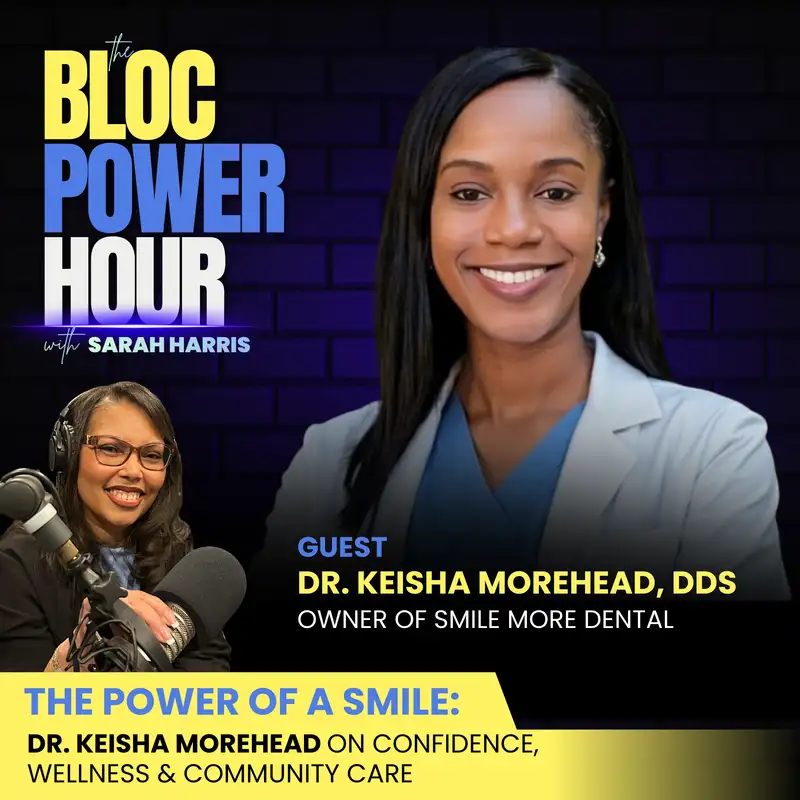
The Power of a Smile: Dr. Keisha Morehead on Confidence, Wellness & Community Care
Download MP3Yeah. Sarah Harris. Turn the mic up. Turn the power up. Welcome to the block.
Speaker 1:Turn the mic up. Mic up. Mic up.
Speaker 2:Welcome to the block power hour. I'm your host, Sarah Harris. Thank you for joining us for another awesome show that we're about to have. We are presented by the Black Business Association's media division, which is Elevate Media Collective, and we thank our ongoing sponsor US Bank for making it all possible in everything that we do at the Black Business Association. If you resonate with the conversations that we have in this ongoing program, you wanna support it, check us out at bbala.org for sponsorship information or also to donate.
Speaker 2:So our conversation here today is on the power of a smile. It's about our confidence and it's about our wellness. And we have in the studio today, Doctor. Keisha Morehead, owner of Smile More Dental. Welcome Doctor.
Speaker 2:Morehead. Thank you so much. It's such a pleasure to have you here today. Again, it is something that we all have is our smile, and that leads to our confidence and our self esteem and and also our wellness, our our health, and and being. And so I think this is a conversation that anybody and everybody can identify with.
Speaker 2:So welcome to the Block Power Hour. I'm looking forward to learning more about you as well as your practice. Absolutely, I'm excited. Excellent. Okay, so you decided to go into the dental field.
Speaker 2:Was this something from an early age or how did you get to the point where you said, okay, dentistry is what I'm about?
Speaker 3:Yes, it was a very early age that I decided to become a dentist. I believe that it's a calling on my life. So I just knew right away that I wanted to become a dentist. So I come from a long lineage of medical professionals. My sister is a medical doctor, a pediatrician, my parents, my mom and dad owned a medical laboratory growing up, so they had it for around forty years.
Speaker 3:So I grew up in this environment, a host of other, you know, nurses and so forth. So I knew that, you know, medicine was something that I definitely would gravitate towards. And then I realized how much I like working with my hands to create something. So I think it was in the ninth grade that I participated in a bridge building contest, and we would just need to make a bridge out of popsicle sticks, and there were certain measurements that we had to adhere to. Okay.
Speaker 3:And the bridge needed to be beautiful. And I remember I placed pretty high with that and I think just taking those, activities that I really enjoy and turn into a career is how it all came about.
Speaker 2:I love those experiences, especially if you're a creative person and you get to have some type of project or opportunity like that and it just opens up your mind to all of the possibilities and realizing what it is that you love to do. It seems to me with that project that you are a detail orientated person as well.
Speaker 3:Okay, I'm not sure if it's detailed or a little OCD. Okay. But definitely I pay attention to detail a lot and it's definitely helped me in the field to be so meticulous.
Speaker 2:I'm sure you get inside somebody's mouth, they want you to make sure you see everything about it. Okay, perfect. So you knew at an early age, basically this is your field and you have family members basically in medical practices as well. So what was your experience like at UCLA and then on to USC? So what was your experience like while you were getting studies and your degrees and stuff?
Speaker 2:What was that like? Were you dreams of just one day getting to that practice? Tell us about your experience when matriculating through this system.
Speaker 3:I have to make one clarification. It's not USC, but UCLA.
Speaker 1:Okay, Okay.
Speaker 3:I have love for them too.
Speaker 2:Okay. Got it.
Speaker 3:But, no, I I remember my first year in college. I did wanna major in psychobiology, but that came about because I started to have an anxiety condition myself. So I had my first chemistry exam at UCLA, and I just couldn't remember anything. I blanked out. And I went straight to psychological services because I didn't know what was happening to me.
Speaker 3:I felt this impeding amount of fear. I couldn't breathe. And so in that process of, you know, realizing what was happening with me with my anxiety, I really knew I wanted to go into psychobiology.
Speaker 1:Oh.
Speaker 3:And that has really helped with dentistry. I think that there's two main reasons why people kinda stay away from the dentist, and it's anxieties and fear.
Speaker 2:True.
Speaker 3:Are, you know, they're worried about the finances of it. But I think that, you know, having that history of being able to, you know, desensitize people to their anxieties of the dentist has really helped for people to become more comfortable in my chair.
Speaker 2:So was this a minor part of it? Like the psycho,
Speaker 3:what was it? Psychobiology. Psychobiology?
Speaker 2:Okay. Did not know. That's a whole new layer level to this, but you're so right because we do tend to approach dentistry with all of these kinds of emotional entrapments to it. So what was the catalyst that kind of helped you to get out of that anxiety mode with the exams or what have you?
Speaker 3:I mean, to be honest with you, I did have to go on some medication temporarily. I continued to study really hard and then I just worked with a therapist, you know, to get me through that process.
Speaker 2:Okay. So I love your resilience and your resourcefulness and you continue to persevere on. So from there you went to, I don't know if in dentistry it's called a residence or what have you, but to practice under someone?
Speaker 3:Yes. So I attended Harbor UCLA, which is a general practice residency. It's a one year after graduating dental school, you can take another year to get additional work in the hospital setting. So that was very critical for me to feel comfortable treating medically compromised patients. The rule is always do no harm.
Speaker 3:So Mhmm. Although I'm treating people's oral health, how that combines with their overall health, was very important for me to hone in on. So at the residency, a lot of the patients, they may have, you know, had HIV or they may have had uncontrolled diabetes, or they may have been hypertensive and how I medicate those patients, whether or not it's giving them
Speaker 2:the
Speaker 3:anesthesia or how I treat them with prescribing them medications became very critical and the residency definitely helped with that.
Speaker 2:Excellent, so I figure that all the while you have dreams of your own practice during that time?
Speaker 3:Definitely. It's funny, I would have a picture of what I wanted my office to look like when I was in dental school and I had a little journal and I would
Speaker 2:always I believe at in visualizing, right? I believe in that.
Speaker 3:Yes. Okay, go ahead. And so ironically, I mean, that was so long ago before I actually found Smile More, but I went back to look at that picture and it looks so similar to The Office Now. So that was shocking, Was
Speaker 2:meant to be, right?
Speaker 3:I think so.
Speaker 2:Was meant to be. So what was the process of getting your own practice? There's some things that you had to learn to be able to open and things that you really didn't think that it was something new that came to you that you didn't even think about?
Speaker 3:No, it's been a very challenging journey. I didn't have any family members that were in the dental field, so I'm the first one. Mhmm. And I think that that does help if, you know, having someone that can kinda hold your hand and guide you through the process. But I just kinda made my own grounds myself.
Speaker 3:And so the first step was I think associating with other offices. So I worked for thirteen years just as a partner at different offices and just learning their systems and what worked for them, what didn't work for them. I then could take that on to Smile More Dental.
Speaker 2:I love the name, that you chose Smile
Speaker 1:More because we all need
Speaker 2:to smile more, especially in challenging times. But for me, it's one of the first impression kind of things that people, when they first greet you or meet you, a lot of times it is your smile and how important is that?
Speaker 3:It's very important. It's interesting. Some people what is the directionality of the smile and the emotions? So some people feel as if you feel happy and you feel the emotion and then the smile results from that. And I would argue that it could be the other way around.
Speaker 3:So even if you don't feel, you know, on your A game or, you know, super happy, but just put on a smile, force it, then the process actually releases dopamine and different, enzymes that'll make you start to feel happy. And I feel as if if you're already critical or, you know, embarrassed by your smile, maybe you're missing teeth, maybe you feel like your teeth are not aligned correctly, maybe you don't like the coloration of them, then you're gonna hesitate to smile and put your best foot forward. And so I really wanna, you know, change that. It's interesting you mentioned the name. The name, is very close to my heart because, it is a continuation of my parents' business.
Speaker 3:So their, medical laboratory was called Doesmore. And so I wanted to kind of continue that on. My dad did an amazing job, mom and dad. Oh. So dad's not with us anymore.
Speaker 3:May he rest in peace, but I know he's looking down on me and pushing me on.
Speaker 2:I love that, thank you for that insight and I kind of also figured that it had something to do with Morehead, Doctor. Morehead in the house. We have Smile More Dental, okay, I love that aspect of it. It's interesting that you bring up your parents and your family, evidently definitely a influence on you with that. So anything else that you learned from them having your own practice?
Speaker 3:It's amazing every day. I don't think a single day goes by that I don't say something and I just have to catch myself. I'm like, that's my dad. My dad would say that. So I think being such a young daughter watching him and how he navigated, so his medical laboratory did business all over The United States.
Speaker 3:And so it was based in South Central Los Angeles on Crenshaw, Manchester for a very long time, but we had satellite offices all over. And so just to see how dad would interact with his employees and how he always kept a smile on his face and I try to mimic that. Mhmm. Yes.
Speaker 2:As best you can.
Speaker 3:As best I can.
Speaker 2:Well, it's always good to glean something from, you know, your parents or whoever that is like your mentor that you look up to, I think it's great to be able to have those memories and experiences to draw on. So we have more to talk to you about. We're going to get into a bit about the different types of procedures and opportunities and how you do your practice.
Speaker 3:Okay.
Speaker 2:Okay, so we're looking forward to that. So again, this is the Block Power Hour. I'm your host, Sarah Harris. We do want you to look us up and follow us on Instagram and other socials at block power hour. That is b l o c power hour.
Speaker 2:Also follow me, Sarah Harris, CEO underscore. Okay. And we'll be right back. We are back. This is the block power hour.
Speaker 2:I'm your host, Harris. Thank you for tuning in and staying with us. We have in our studio, doctor Keisha Morehead, owner of the Smile More Dental, and that is on Sepulveda, right?
Speaker 3:Yes, it's on the corner of Manchester and Sepulveda in the Westchester Medical Plaza.
Speaker 2:Awesome. Great central location. And we're talking about the connection between oral health confidence and overall wellness. So we're able to learn a bit about Doctor. Morehead.
Speaker 2:And now we're going to talk about how people can separate dental health from overall health. A lot of times we focus on other parts of our bodies, but we neglect our oral health. So tell us how you feel like people kind of do that and how you engage them to really start to think more about their oral health.
Speaker 3:Now that's an excellent question, Sarah. I find that a lot of my patients, when I tell them different conditions that are going on in their mouth, they tend to respond by saying, well, I don't have any pain, so I must be okay. That's typical response.
Speaker 1:Yeah.
Speaker 3:And I try to explain that you don't wanna wait until you feel pain in your mouth, that it's already too late. And you want to try to avoid getting to the point where you have to have root canals or have to have teeth taken out or infection that sets up. So early care and prevention is one thing that I definitely stress.
Speaker 2:So what are the common dental issues that you see?
Speaker 3:You know, gum disease is huge. We call it periodontal disease or gum disease and it's when you have the loss of gum tissue attachment that actually proceeds to affect the bone. And so the more you lose bone, the more the teeth want to get loose and then fall out. Why is periodontal disease so important? Well, those with gum disease have an increased risk of stroke and Alzheimer's disease.
Speaker 3:It's actually linked to gum disease and breast cancer. There's a close tie with that. You know, you're also more susceptible to having respiratory infections. In addition, preterm or low birth weight babies can result with gum disease. So there's something with when the mothers are pregnant, they have what's called pregnancy associated gingivitis.
Speaker 3:Just means that their gums are going to bleed a whole lot more during the And so I really try to get the mothers in early because as the pregnancy goes on, they can actually start to lose teeth and it's not safe to have to do the extractions and so forth, you know, when they're in their third trimester.
Speaker 2:Never really thought about dental health and pregnancy in that way before. So with gum disease, do you feel like most times it's just the neglect of not really seeing a dentist regularly or what do you feel is the main reason why we have gum disease?
Speaker 3:Well, I try and I'm sure a lot of other dentists try not to say this because it takes some of the responsibility off of the individual, but there is a huge genetic component. I would be remiss not to start right there. So if, you know, I ask my patients, was there a parent that lost all of their teeth early? Usually, if I'm seeing, you know, a large amount of periodontal disease, they say, yes. You know, my mother had, you know, full dentures by the time she was 30 or 40.
Speaker 3:And so there's the genetic component. There's also the component of, you know, bad habits. So tobacco smoke is very much linked to periodontal disease. And then there's just hygiene. So we stress, you know, regular visits for that six month cleaning for a reason is because we can get down in those areas that you can't get at home.
Speaker 3:And so every six months at least just keeps you right on target to not have the gum disease set in.
Speaker 2:And so we were talking earlier about the mental part of it. So how does oral health impact confidence, you know, in our mental wellness and even in our professional situations?
Speaker 3:A 100%. I've seen so many patients that due to, you know, not having all of their teeth, they feel discouraged, they don't want to go to job interviews. You know, unfortunately, it is an indication of someone's socioeconomic status When you see that they're not able to replace missing teeth, when you see that they have loose or failing dentition, you know, and it makes people shy away from wanting to talk to other people.
Speaker 2:Mhmm. I'm pretty sure that once you're able to do the procedures on them to help their smile become more beautiful and everything, you could see the transformation in people I'm sure.
Speaker 3:Immediately, immediately and it really warms my heart. I mean, there's definitely been times where I've just had to cry because you know, it's so immediate when they see the mirror and they see their new smile, you know, they feel empowered.
Speaker 2:I was going to ask you if you recall any kind of a particular patient or something that just like really touched you or anything like that?
Speaker 3:Yes, yes. I have a patient that comes to mind and he had a lot of fractured teeth and so he believed that by doing the bonding or a composite to fill in the broken areas that it wouldn't last, it wouldn't stay. And I told him, no, you know, I believe it will, let's go ahead and do it. And, he said that he had gone to other dentists and that it didn't last. So sure enough, I was able to, restore all of his front teeth with fillings and bring it back and he was just, he was so happy.
Speaker 2:I bet you he was just like in amazement because before it sounds like he just was kind of lost a little hope on being able to restore that. I think that is such an important work that you do is really what I want to say. Because again, it is one of the first impressions that we have of people I've said before, as well as just the whole internal theme that we do behind our smile. So kudos to you in that, because I also see like you were recognized with a distinguished dentist award. So how was that being recognized?
Speaker 3:It's always amazing to be recognized by your peers. You know, there's competition in the dental world. Even in my one building, there's tons of dentists. And so I think when you can separate yourself in any kind of way as far as, you know, the different procedures that I love doing and that I excel in and then be recognized by that, I call myself the queen of crowns. I've coined that phrase.
Speaker 2:Okay.
Speaker 3:Just because I love doing crowns and I love seeing, like, the restoration of it to a completely broken down tooth that could have been hopeless prognosis, but then turning it around to now it looks like nothing ever happened.
Speaker 2:Well, we're getting back to that bridge that you built. What grade were you in when you built the bridge?
Speaker 3:I was in the ninth grade.
Speaker 2:In the ninth grade. So yeah, we're getting back to the experience and the joy that when you you built that bridge. Now you're building crowns.
Speaker 3:That's right. That's right.
Speaker 2:Okay. I mean, there's a direct correlation there, you know, so it's, it's, get that kind of same satisfaction, satisfaction, but but it it also also tells you who you are and what you really excel at. And that is part of that detail. How are you on that? Because to me it seems as though, like you were saying about this issue is connected that issue and you really have to be on top of all of the things that's happening in a person's mouth and why that is.
Speaker 2:So how do you navigate through that process?
Speaker 3:You know, the main thing is listening to my patients, getting a complete history of what their dental history is, what their medical history is. I like to think of it as, kind of like a tipping point in essence. So our bodies throughout our lifetimes are having different insults. So we have viral attacks, we have bacterial attacks, we have all these different attacks, autoimmune disorders, and we get to a point if our body is constantly fighting infection in our mouth. So if you were to spread your gums out, it will come up to about the surface area of the palm of your hand.
Speaker 3:You don't see people walking around with their palms bleeding, but yet people are walking around with their gums bleeding and they think that it's normal. Oh, yes. I get butt when I floss, but isn't that normal? And it's not. So your body is constantly trying to fight this infection in the mouth.
Speaker 3:It's there. There's bleeding and swelling, that's infection, that's called inflammation. And so our body has this immune system that's saying, hey, I wanna go attack it because I wanna get well, but what about the other insults? So you reach this tipping point where then your body unfortunately goes down a huge cascade of other issues that can come up like unfortunately cancers and other autoimmune disorders and so forth.
Speaker 2:Does it also kind of affect things of the brain or what have you? Cause it's in your head, I guess.
Speaker 3:You're absolutely right.
Speaker 2:Thinking, you know?
Speaker 3:No, they used to, now this is an interesting story. They would measure the progression of Alzheimer's disease by the white matter, taking scans of the brain and looking at the white matter. Ironically, periodontal disease has been a better indicator now of the progression of the disease and how likely you are than these scans of the brain. What? Yes.
Speaker 3:Fascinating.
Speaker 2:All right, so all around, you know, check-in with your teeth because it has more wide ranging effects than what you really, really realize on that. So we are going to be transitioning next to our next segment here, but I wanted to know if there was any particular, one particular procedure that you'd like to do over the other. Well, you said crown, you did say crown, That I forgot was one of my questions though. Okay, we're gonna come back and talk about much more. So when we return, we'll discuss more about the entrepreneurship side and representation in healthcare and how you, Doctor.
Speaker 2:Morehead, are building trust and impact through your work in the community. So this is the Block Power Hour. Again, I'm your host, Sarah Harris. Please stay in tune with us at Block power hour on our socials, and also check us out at bbala.org to learn more. We'll be back.
Speaker 2:Welcome back to the block power hour. I'm your host, Sarah Harris, and our guest in the studio today is doctor Keisha Morehead, owner of Smile More Dental, which is on Sepulveda near Manchester. So we are delighted to have you in the space. We've learned a bit about your background, also about the common dental issues that most people have. So right now I want to kind of get into your entrepreneurship journey and then also to your work into the community and then also to how you represent in the healthcare space.
Speaker 2:So what has the journey of business ownership been like for you as a dentist and an entrepreneur?
Speaker 3:It's been very challenging. I am happy. I would not change it for anything, even with all the different hats that I hold, but it's it's not for the week. Of course. It's not for the week.
Speaker 3:You know, it really stemmed from me working at other offices and not being able to control the different materials that I'm able to put in patient's mouth or the different procedures that I feel, you know, is the best for the patient. I get it. Everything is economic. So if you're working for someone else, the bottom line and they want you to make sure that you're meeting that bottom line. And I just found that I was having conflict with a lot of the owners and managers of those offices where I was not the CEO.
Speaker 3:That's And what really said I have to kind of step out and, you know, get my own office.
Speaker 2:And so it's having more control, like you said, and ways, practices in a way that you wanted to do. And when I first talked to you about coming on as our guest, you said that you were looking forward to talking to us about your holistic approach to dentistry. So tell me a bit more about that because it seems like you learned a whole lot of what you don't want for sure from other practices.
Speaker 3:Definitely. So the holistic approach really is taken into account all the different intricacies of someone's overall health and how that's going to impact what I'm doing in their mouth. And you know, a lot of times dentistry does become a drill and feel, you know, you see the problem and you fix the problem, but coming from a more holistic approach would be how can I make sure that this problem doesn't happen? For example, I have patients that, they have multiple implants, let's say in their mouth, but the implants are starting to fail. Well, I'm not going to just wait until they fail, I'm going to jump in and, hey, let's put you on this rinse.
Speaker 3:Let's try to do these different measures so that we don't get to the point where we have a serious problem down the road.
Speaker 2:Excellent. And so you opened your practice in 2007, right?
Speaker 3:No, I graduated dental school in 2007.
Speaker 2:Okay, that's
Speaker 3:what And I I opened Smile More in 2019.
Speaker 2:Oh, gotcha. Okay, okay, wonderful. So with that, what was some of the things that you had to learn about The Way About Opening Up A Practice?
Speaker 3:You know, there's so many different components that I didn't, take serious, as serious as I should have. So the human resources side has been one that I'm still grappling with. I have my work ethic and other people come into the business with different work ethics. Let's kind of
Speaker 2:talk about that just for a second because like you said, you have your work ethic and the kind of attention to details and going about things and having your systems and stuff. And it's like when you can do things faster than you can train them, I think that that's a lot of founders kind of have that kind of particular issue and it's hard to delegate in a way.
Speaker 3:I agree with you wholeheartedly on that but I'm trying to force myself to step out of that role from just doing it all myself and then just taking more time and patience with the training. Know, just screening my teammates the best I can before bringing them to life.
Speaker 2:I mean, because you can't do it all. Right? And you do have to practice more about delegating and whatnot, and that it is the better for you. But the struggle is real. That's what I'm trying to get across.
Speaker 2:It's like if any of the entrepreneurs out there listening, you know who we're saying, you're dealing with it too, but the struggle is real for that. So I just want you to know that you're not alone. Thank you for that. But also because you're in a medical building, right, with other practices, is that something that has been helpful to you to have kind of, is that a community within the building or are you kind of on your own silo? Do you work
Speaker 3:for In your some sense, you know, there is the comradery. If, you know, if I run out of a material or if my neighbor runs out, we come next door, Hey, I need this. And so that's definitely there. But I'll tell you this. During the times of COVID, I didn't want all of the patients to be in the reception area at the same time.
Speaker 3:I wanted to have that control. So I have a, a ring doorbell outside so that when you come up, you know, you let me know, and that way I can, you know, bring somebody to the back. So this is a funny story. During the COVID times, people were waiting outside, and I guess times were rough for everybody. Mhmm.
Speaker 3:And so the other doctors would try to take the patients. They would say, you don't
Speaker 2:have to wait.
Speaker 1:No. Stop. What? You don't have
Speaker 3:to wait for doctor Morehead. Come on over here to us. But they said, oh, no. It's okay. We'll wait for her.
Speaker 3:So
Speaker 2:That's hilarious. Because, unless it's like a first timer or whatever. Mhmm. If it's a return patient,
Speaker 1:I'm like, no. I want my Doctor. Morehead, are you kidding me?
Speaker 2:Yes. Okay, all right. So there is some competition,
Speaker 1:all right.
Speaker 2:It's community and competition.
Speaker 3:There you go.
Speaker 2:Yes, all right. And so what are your connections in terms of into the community and what do you do in that regard?
Speaker 3:I'm wanting to get a whole lot deeper into it. So I am a part of some programs right now that allow the community to come in. I'm a part of the military readiness program. So before, the soldiers are gonna be deployed, they come in and get their checkup in my office and they don't have to pay anything. And so that's a great program.
Speaker 3:It's nice to meet these young men that are, know, ready to go out and serve the country. Exactly. I did recently also started with the Medicaid program. I figured that with changing times, things are difficult for everybody and so I want to be able to be more inclusive for that. I'm also, starting to work now with the prison systems.
Speaker 3:So what goes on now with dental care, there is obviously dental care that's available, but a lot of the dental care that's available in the jails and prisons are more of just extraction, pull the tooth out. Once there's a and then they come out and then they you know, again, we that confidence in being able to get a job afterwards and so forth. So I'm really, working with some private owned facilities right now to get oral hygiene in there, some more kits, education, and pamphlets so that we can prevent them from having a lot of dental issues when they're released.
Speaker 2:That is so interesting that you bring that up because it's all about the rehabilitation and making sure that they have opportunities when they come out and so again, we go back to your appearance and your smile and how that affects things. And so kind of having the forethought about having that to be an option that you can service there. That's kind of interesting. So thank you for bringing that up. Of course.
Speaker 2:And thank you for your service into the community and all that you do. You're welcome. So how is the healthcare space for you? What are you facing within just the whole industry itself?
Speaker 3:You know, the industry itself with the insurance companies, and I'm sure this is similar to a medical field as well as with dental, but unfortunately the reimbursements are really low. So we're not able to provide the type of care that we want as practitioners when a lot of times the reimbursements don't even cover our sterilization bags or, you know, most dental offices run on about a 50% overhead. And so dental work can be very costly, but it's because we have a lot of costs as owners that we have to take care of. So I think that that's probably my biggest challenge right now, it is working with the different reimbursements.
Speaker 2:Okay, if there is something that, well, you say reimbursements, but if there is something that you could really fix or do or what have you, what would you want to happen better in the healthcare industry?
Speaker 3:I guess there's more access, you know, for more individuals to get the care that they actually need. And what do I mean by that? So if you look at some of those programs that was mentioning before that I am trying to be more inclusive with, there's even restrictions with that. So a lot of times, you know, an extraction will be okay, but then you don't have a tooth. But what about getting more implants approved for patients that need to chew, you know, and not have to worry about a partial that'll be flopping around, that they can't eat properly?
Speaker 3:Wait times are huge, so a lot of times their pre authorizations are needed and we don't get the pre authorizations back for months and months at a time and in the interim, the patient is in pain. So if I could do anything, I'd probably work towards improving that.
Speaker 2:Excellent, so it seems like you've had to, a good number of people that you aren't able to provide service for it and turn away Okay, on we are continuing to dive into some of the things related to your practice and all of the things that you experienced. We're gonna talk a little bit more about your entrepreneurial journey. So next we're gonna begin to close out our message on what you do, but I'm enjoying our conversation and meeting you and learning about you and everything. So I appreciate our conversation here today. So we'll come back in just a moment.
Speaker 2:This is the Block Power Hour. Again, please follow us at Block Power Hour and also check us out at bbala for information on supporting our program. I'm your host, Sarah Harris, and we'll be right back. Welcome back to the block power hour. I'm your host, Sarah Harris.
Speaker 2:And in the studio today, we have Doctor. Keisha Morehead, owner of Smile More Dental. Again, that's Smile More Dental. Tell people how they can find you.
Speaker 3:Start with my website, which is www.smilemoredental.com. You can schedule appointments online there, and then you can also reach us via telephone at (310) 645-8777.
Speaker 2:And give the website one more time?
Speaker 3:Yes. That's gonna be smilemoredental.com.
Speaker 2:Excellent. And she is on Sepulveda off of Manchester in the Westchester Very Medical convenient for a good number of us folks. Okay, so before the break, we were talking about your entrepreneurial journey and experience and some of the work in the community and I was just reminded that you also are involved with an organization like Give Kids a Smile. What is that about?
Speaker 3:It's where we go in and work with children specifically. So, I'm not a pediatric dentist, however, I have worked extensively with children and the idea with children and going to the dentist is that it can set them up for either a really positive experience for the rest of their life or a horrible one to where now they want to avoid the dentist. And so with Give Kids a Smile, we start with a very pleasant experience, you know, desensitize them to all the different sounds and materials and everything so that they can have that first great experience.
Speaker 2:Excellent. Always glad to see the wonderful work that people are doing in the community and those are important, especially for young kids to be able to start off early to know proper dental hygiene. Let's kind of like debunk some of the myths and whatnot. Do we need to brush our teeth for two minutes?
Speaker 3:Yes. And I like for the kiddos, they have these toothbrushes that have a timer on it or have a sewn and helps them to keep track of time because they don't know, they're like, oh, I did it and it was really quick.
Speaker 2:Right, that's a good technique, yeah, for the song. And then is it better for like the rotary type brush or just a straight brush, is that good enough, is that fine?
Speaker 3:That is contingent upon the individual. It really depends, there's not a blanket answer on that. Some people that have a lot of dexterity issues, for sure, the electric toothbrush will be better. But some people, they have too much force. So the amount of force that you should use with your toothbrush is the same force that you're holding a pen.
Speaker 3:So how you would hold a pen and you're signing your name, that's the same force that you should use with your toothbrush. And some people, have the electric going, the electric brush and then they're forcing the brush into their gums and they're causing more damage. So for those people, I say, hey, go to a manual, because you have a little bit more feel for what you're doing and you have more control.
Speaker 2:Okay. All right. Well, makes sense. And then what's always intrigued me is the Waterpik. Does that work?
Speaker 3:Yes. The Waterpik is really good. However, you cannot use it solely as a replacement of flossing. And that's what a lot That's
Speaker 2:what a lot of people do. Okay. Okay. I waterpig, so that's good enough. No.
Speaker 2:So so would you recommend both?
Speaker 3:Definitely use it as an adjunct. And what I do sometimes, depending on the gum issues that my patients are having, I'll have them put a special antibiotic rinse in the reservoir along with water and so that it's really flushing out the areas that, the antibiotic needs to get to and reach.
Speaker 2:And so what are we doing wrong? Like say for instance, these teeth whiteners and stuff like that, what You guys can't see
Speaker 1:her face right now, but I can. So what, what, what about whiteners?
Speaker 3:Okay. There are so many different generic whiteners and brands out there. It confuses people, people aren't getting the results that they desire. I personally try to stay away from the over the counter whiteners. Reason being is again, you can cause more harm than good.
Speaker 3:Mhmm. So you're constantly putting the bleach on, then your teeth are becoming stained Mhmm. Because you're drinking the coffee, having the teas, drinking the red wines, then you're going back to use whitener Mhmm. And that's causing more sensitivity. Mhmm.
Speaker 3:So the acid is just stripping your teeth away, and now you're having problems having your ice cream or having a cup of ice with water. Mhmm. And so I say have the whitening done in a controlled environment in the dental office where we isolate your gums, we put the bleach on, you see the result immediately. Normally, it's a high percentage, so about 40%, whereas the over the counters is a very low, but it's a constant use of it.
Speaker 2:Mhmm.
Speaker 3:So and then I have the, the gels, the take home gels for my patients that they can upkeep that, the in office whitening.
Speaker 2:Sounds to me like a lot of it is basically about how you're applying it and we don't really know a lot of times the proper way and that that's how it really becomes not as effective or even harsh.
Speaker 3:Yes.
Speaker 2:Any other myths or something that you've heard of or had to deal with when answering questions or, with your patients?
Speaker 3:The big one is that the root canal hurts.
Speaker 2:Oh, okay.
Speaker 3:And a root canal does not have to hurt.
Speaker 1:Okay. That was the fart. Not have to hurt.
Speaker 3:Well, you know, it really depends on the scenario. Now the times when you have a root canal and there's a lot of pain is when the infection has not been controlled. Mhmm. So what I do for my patients is they come in and they're in a lot of pain, I say, hey. Let's put you on this antibiotic for roughly around, you know, fourteen days, ten days or so.
Speaker 3:Mhmm. Get the infection down, and then that allows my anesthetic to work better. Otherwise, if the infection is really great and I use the anesthetic, they're not getting numb and that's when they're feeling the pain. So sometimes it's a matter of, you know, putting them on an antibiotic, a one round, and then so that we can do the procedures comfortably.
Speaker 2:And again, that stems back to the whole mental part of it, how we react towards the whole thing, the pain, the pain, on that. Okay. So you do cosmetic dentistry as well?
Speaker 3:Yes. Yes. So, I do the Invisaligns, which are clear aligners for straightening of teeth. Veneers, of course, is really popular now. Crowns, bridges.
Speaker 3:Yeah. I really like cosmetics. But I give my patients options so that they don't feel that they have to do the veneer or so forth because, you know, you're shaving your tooth down and you're taking away tooth structure that you can never put back. So there's other ways that may not be as fast, you know, by the whitening and the straightening and we we can still get the same result, it just may take a little bit longer.
Speaker 2:Longer. Uh-huh. But I think that that is a big part of realizing that you're really just losing basically your tooth in it and once it's gone, it's gone. But many people are doing it. So what is the most popular of the cosmetic parts that you do?
Speaker 3:I would definitely say the crowns.
Speaker 2:Okay. Well, you are the crown queen. You're the crown queen, so we've established that already. Okay. Alright.
Speaker 2:So for that one, it's still maintaining your teeth, but you're putting that crown on it. Right?
Speaker 3:Yes. I'm just
Speaker 2:trying to make sure I got all of the different ones right.
Speaker 3:No. You're absolutely right. So you still are able to keep the tooth in your mouth, but we just shave it down so that we can put a cap on top. And most of the time that's for protection so that the tooth doesn't fracture in the future.
Speaker 2:And so these type of procedures, what kind of other maintenance or upkeep do you have to do? For instance, with the veneers or with it, you're basically filing the teeth away.
Speaker 1:Are you
Speaker 2:still dealing with cavities? Yes. Things like, okay. So it's it's not taken away that part of it. Right?
Speaker 3:I'm so happy that you brought that up because that is a huge misconception. They think, oh, I have a I have a crown or I have a veneer and so I can't get a cavity. And so yes, the cavity does, it can come back and so you have to make sure you maintain it by your regular dental visits and regular flossing and brushing.
Speaker 2:Such good information to know about, I tell you. Thank you for that.
Speaker 3:You're welcome.
Speaker 2:I've kind of want a survey, see if anybody else has questions. We're gonna get them in while we can now, but this is good stuff to know. All right, so I have some, quick questions and we'll rapid fire questions. Okay. Just want to kind of see because also too, there's some things I learned in your bio, it kind of deals with a little offhand.
Speaker 2:So here we go.
Speaker 3:Okay.
Speaker 2:So let's see. I guess this would be better for your teeth or or just personal, either one. But coffee or tea? Through a straw.
Speaker 1:We could do
Speaker 3:either one, but through a straw.
Speaker 2:I love the answer. Okay, through a straw. All right, all right. So recommend if whatever you drink, drink it through a straw. Okay, that really does help though.
Speaker 3:It does and then rinsing with water afterwards.
Speaker 2:Okay, perfect, perfect. So we kind of get into some of the things you like. You mentioned that you like suspenseful movies. Yes. So what is your favorite?
Speaker 3:I don't know. I'm a huge Tom Hanks and Denzel Washington fan. So I would say Philadelphia was
Speaker 1:a good one. Good one. Good one.
Speaker 2:Good one. I love, there's a Morgan Freeman one, but Shawshank Redemption was one of my favorites. Okay. Don't know if that's suspenseful or not, but anyway, it's a favorite movie of mine.
Speaker 3:All
Speaker 2:right, let's see. Tennis singles or doubles?
Speaker 3:Oh, singles. Singles?
Speaker 2:Okay. Are you into pickleball too?
Speaker 3:I haven't gotten into it, but I want to.
Speaker 2:I just saw this story with a young lady that is like the champion or whatever and she's earning millions of dollars in pickleball and recently got brought on by Nike. So pickleball is just a thing from what I can see. Okay, let's see one Well, you said that you love the Denzel and Tom Hanks. Let's see, real quick, what makes you smile more?
Speaker 3:Wow, that's a good one. I get a lot of reward from what I do and having success. So when I accomplish my goals, I typically set daily goals, weekly goals, monthly goals and I think when I reach those milestones
Speaker 2:I'm the same way, I'm the same way. I have a checklist, I love checking things off and getting to that finish line. So Doctor. Keisha Morehead, owner of Smile More Dental on Sepulveda Boulevard. Give them the website again real quick.
Speaker 3:Sure. Wwwsmilemoredental.com.
Speaker 2:This has been the block power hour. I am your host, Sarah Harris. Been a delight having you tune in. Please continue, and we'll be back for another show next week.