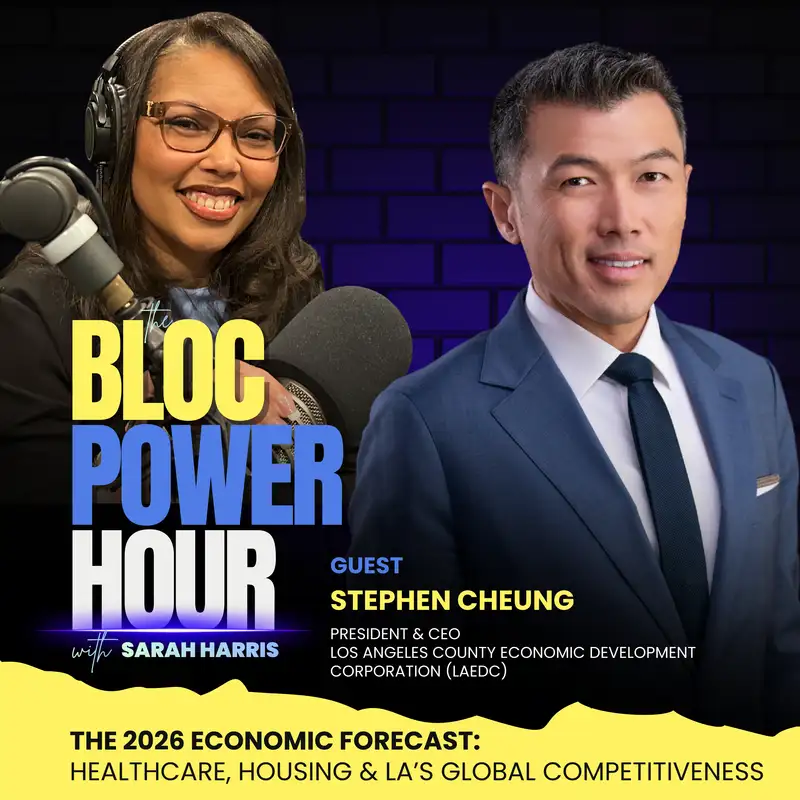
The 2026 Economic Forecast: Healthcare, Housing & LA’s Global Competitiveness
Download MP3Yeah. Sarah Harris. Turn the mic up. The power up. Welcome to the block.
Speaker 1:We on a rise to the power in the hour. The block ain't stopping. Every minute get louder. Stand tall. Stand strong.
Speaker 1:Let the whole city watch. This is where the people build. Welcome to the block. Turn the mic up. Mic up.
Speaker 1:Mic up. Welcome
Speaker 2:to the block power hour with Sarah Harris where we talk about business, culture, vision, grind. I'm Sarah Harris, and I'm honored to spend this hour with you breaking down the conversations that move Los Angeles forward. This program is presented by Elevate Media Collective, a media division of the Black Business Association. If you're listening on seven ninety k ABC, we're glad you're here with us. You can follow the show on Instagram at block power hour, connect with the Black Business Association at black business association, and learn more about our work at bbala.org.
Speaker 2:If you have enjoyed our shows and resonate with the conversations we've been having, we also encourage you to support this program with your sponsorship and or donations. And again, you can find information at bbala.org. So before tonight's discussion, we want to acknowledge the passing of Reverend Jesse Jackson Sr, a civil rights leader whose lifelong advocacy for economic justice, minority business inclusion, and corporate accountability reshaped opportunity in America. His work through Operation PUSH and the Rainbow Coalition helped elevate conversations about equity and procurement and access. Conversations that organizations like the Black Business Association continue to advance to this day.
Speaker 2:We honor his legacy and commitment to economic empowerment. So tonight we want to focus on the numbers behind our regional economy and more importantly, what that means to business owners, working families, decision makers navigating a rapidly shaping landscape. So for tonight, we have the Los Angeles County Economic Development Corporation, also known as LAEDC, is preparing its release on the 2026 Economic Forecast, a report that examines everything from the wildfire recovery and housing affordability to workforce trends, healthcare costs, pressures, and global trade volatility. Joining me to unpack what's ahead is Steven Chung, president and CEO of the Los Angeles Economic Development Corporation and president of the World Trade Center Los Angeles. Steven has spent years at the intersection of global trade, public policy, and regional economic strategy.
Speaker 2:And tonight, we're going beyond the headlines to understand where Los Angeles truly stands. Welcome Steven to the Block Power Hour.
Speaker 1:Thanks for having me.
Speaker 2:Let's kind of just dive in a little bit about you and tell me, because you wear so many hats, just kind of tell me what is that led you to where you are today with LA EDC?
Speaker 1:So, I'm an immigrant from Hong Kong, moved to Los Angeles region when I was about eight years old. Grew up here learning about the complexities of Los Angeles. I went to UCLA, got my degree in psychobiology. Didn't wanna be a neuroscience major, but, that's why I focus on, ran off to London for a year to be a headhunter, but came back because the weather was just not agreeing with me. Okay.
Speaker 1:But once I got back, I was really dedicating my life to the nonprofit sector. I work for a domestic violence shelter for women and children who are escaping domestic violence. Then eventually moved to another nonprofit organization called the Asian Pacific American Legal Center focused on giving the immigrant community some information about their rights. Decided to get into social work and got my master's degree at UCLA with a degree in social work. During that time, I met with, then assembly member Karen Bass, who I interned for because she was so much focused on foster care legislation.
Speaker 1:But after that internship, it really opened my eyes up to government. And so she connected me with the city of Los Angeles where I worked for the mayor of Los Angeles under mayor Antonio Villorgosa, then under mayor Eric Garcetti. In about eight, nine years, I had about 11 different positions doing a bit of everything, learning a lot about the city and eventually moving to the nonprofit, the World Trade Center Los Angeles, which is a subsidiary of LADC. So over the last ten years, I've been focusing on international trade and economic development. And so about three years ago, I took over as a CEO for LADC and the World Trade Center Los Angeles.
Speaker 1:So that's my not very direct path of getting to economic development.
Speaker 2:Wow. You know, I can understand I'm a multitasker myself, but that was a lot. That was a mouthful. But I do understand why LA EDC has chosen you as its head to lead the organization. It's been such a pleasure to make your acquaintance get to know you better ever since I've become a member of LAEDC myself.
Speaker 2:So in a couple of days, you have a major event, which is the 2026 economic forecast. So I have to say with that, I'm so honored that you're even sitting here today, taking the time to give us a preview as we are talking right now into what will be revealed in the next couple of days. So, but before we get into the numbers, tell me, how are you feeling heading into this year's economic forecast event?
Speaker 1:I'm a bit apprehensive because the numbers tell a very stark story for what we're going to be facing. At the same time, I'm hopeful because I think there's a lot of opportunities here. If we line everything up, I think we can actually have a pretty decent year from a overall economic development standpoint, but there are gonna be some challenging sectors and there are gonna be some challenges that our communities have to face.
Speaker 2:Wow. There's a lot there again. Okay. So when you sit down with the data each year, what do you personally look for first? Is it the risk, the opportunities, or something signals?
Speaker 2:What do you look for?
Speaker 1:Look for all of them, but really, I think our job is to find the connecting points, connecting the dots, and be able to showcase to the region some of the things that they don't see. Because when you're looking at the data, individually as step different pieces, you don't always see the full narrative. For example, this year, one of the things we looked at is how the federal government's policy decisions have impacted the state and how the state have influenced the local municipalities, the 88 cities in the county, and then basically what that means to our communities. And so being so large of an area in Los Angeles County, those impacts will be completely different. So I feel like our job is to identify those patterns and make sure that we connect the dots and make sure that our communities actually know what's coming.
Speaker 2:And then we'll get into a bit more about the upcoming report. But from last year, are you seeing any particular major shifts or changes from the the report that you had from last year?
Speaker 1:Yeah. Well, I think the beauty about LA and the challenge about LA is because our region is so diverse and I mean that many different way, and one from our demographics. Right? We have one of the most diverse population in the world. But at the same time, we also have very diverse industries.
Speaker 1:A lot of folks, when they think of Los Angeles, they only think of, Hollywood or entertainment. But in fact, we have dozens and dozens of other industries that support us. So overall, whenever you see, one economy or one economic sector is declining, other sectors grow. So when you look at the overall numbers, it looked pretty consistent.
Speaker 2:Mhmm.
Speaker 1:But that means very different outcomes for our communities. And that's why it's very important for us to dig down a bit deeper. So to your question, in terms of what we're seeing, the difference is that there are gonna be a couple of sectors that are gonna be very challenged. One is going to be the health care sector, knowing that one big beautiful bill, has a number of different provisions to cut Medicaid and health coverage. That's gonna impact our communities significantly.
Speaker 1:Another sector is actually the nonprofit sector. We have a very robust nonprofit sectors here, here, and we hire a lot of folks in that sector. But because of the challenges when it comes to funding that's coming from the federal government and impacting the local municipalities, I think some of those nonprofits need to start getting ready that the funding opportunities might not be avail available. Mhmm. So if there's gonna be another emergency situation like a fire or like a flood, then who are the community based organizations that have the resources to still deliver those services for our communities?
Speaker 1:So, those are the things that we're a bit worried about.
Speaker 2:And for the nonprofit sector, saying having to look for alternative funding and, resources, any particular advice or something that you would say that you could start to think about?
Speaker 1:Yeah. I hope that they have been thinking about it already and they have been working on this. One of the challenges is this, I think a lot of nonprofit sectors have previously relied on governmental grants. And as we're talking about, the federal government has cut those grants in many ways, and so this is now impacting against state and local government. So then folks start shifting to philanthropy.
Speaker 1:And if you look at the Los Angeles region, philanthropy have given up quite a lot to the fire recovery last year. So some of them are overcommitted, and they already have existing partnership that they have to fund. And so if any nonprofits are seeking new partnership, it doesn't happen overnight. So they really need to establish those relationships
Speaker 2:Mhmm.
Speaker 1:And making sure that by the time they're seeking funding, the funders actually know your work. They know who you are. So you're not just basically asking last minute. At that point, it's way too late.
Speaker 2:And with, as you said, in terms of partnerships, I love the fact that, really LA EDC, excels in that being able to provide an environment for organizations to partner, to come together and collaborate because you also provide different levels of support, access and opportunity. So I appreciate even just LA EDC of being in there to even help facilitate for that to happen. We're going to, break in a moment. When we come back, we will continue the conversation. And again, thank Steven Chung for, being our guest today.
Speaker 2:This is the Block Power Hour with Sarah Harris, and we'll be right back. Welcome back to the block power hour. This is Sarah Harris, and thank you so much for staying with us and tuning in. This is again, the block power hour. It is sponsored by the black business association, and you can find us at bbala.org.
Speaker 2:If this conversation resonates with you, this program has a meaning to you, we welcome your sponsorships and donations. Please find us again at bbala.org. We have our speaker today, mister Steven Chung, president, CEO of LA EDC, which is the Los Angeles County Economic Development Corporation. Thank you so much for joining us today. We're going to continue this conversation.
Speaker 2:It's a heavy one because it is regarding the future of Los Angeles County and the direction its economy is going and what that means to you and I. Before we kind of get into some more questions, I wanted to kind of level set in terms of what was revealed from the last year's report. And this came out right after the wild fire, but you can let me know. I don't know what kind of, you know, information was to be able to, put in there because I really didn't go in-depth in that. But we do know that since then that there was about 20,000 parcels affected in the Pasadena and Eaton fire zones and 1,400,000,000.0 on annual business sales inside of the burn zone I was affected and and 82,000 jobs impacted.
Speaker 2:There's a whole lot there. Also too reported was about housing affordability where only 11% of LA County households can afford a medium priced home. Wow. And the medium priced home being $939,609. So that requires an income of 238,000 a year.
Speaker 2:You know, there's a lot more and I don't wanna oversaturate on data, but this will air after the economic report is out. Therefore I feel like we're not going to be, you know, I feel like I hope I can ask you anything at this particular point. So just kinda tell me if there's any insight information on these particular things, especially like housing affordability. What has been revealed for 2026?
Speaker 1:Well, housing affordability has always been the challenge here in the region for the last decade or two decades, so it will continue. And, we're gonna start making a dent. However, the fires last year didn't make it easier for us. Mhmm. Because as you mentioned, there's about 19,000 parcels that were damaged by the two fires.
Speaker 1:And within those two zones, there are about 1,863 businesses operating out of those two burn zones. Mhmm. Then we actually issued subsequent report that identified and the surrounding regions, not just in the burn zone, but the evacuation zone, there's an additional 5,000 businesses that are also impacted because the disruption is so severe that sometimes people don't come back right away because of air quality, because of concerns about safety. So the recovery process is gonna be a while. And this is not just for the businesses, but, of course, this is also the rebuilding of the homes.
Speaker 1:So that's why as you're looking at the housing shortage, now you're having less parcels available throughout the Los Angeles region. Mhmm. And some of those people who are displaced have to move to other places within Los Angeles, adding to the demand. So this is why the the housing situation is gonna continue to be a problem here. Hopefully, with some of the new legislations that are moving through, we're expediting permit process, and there's gonna be more desire to basically build affordable housing and just more housing in general, and that will basically ease some of those pressures.
Speaker 1:However, it's not gonna be immediate. We're gonna have to deal with this, and this is why we need the community to come together to demand for this change to happen so that we can have housing affordability for this region.
Speaker 2:Yes, and I do like the fact that as a community, we do that well in terms of coming together, especially when resources and opportunities are continuously taken away, we go ahead and dive in and say, what can we do to make this work? So I do like what we do as a community. So if someone listening to this show, it can only caught the headline version of it. Do you guys have a subline theme or something to the report for this year? Like what is the overarching theme of the report for this year?
Speaker 1:It's hard for us to do one single theme. There are multiple themes. I think And and officially, I guess, the theme is there's still hope.
Speaker 2:There's still hope. Okay.
Speaker 1:There's still hope. Look, you know, I think Los Angeles as a region, we've we're so resilient because there's just so many amazing qualities and amazing attributes to this entire region. And some of the opportunities that are coming to us, is happening right now in this year. NBA All Star Game Yes. Is gonna be driving a lot of attention and a lot of economic possibility for us.
Speaker 1:And then you have the FIFA World Cup. You have the US Open Women's Championship for golf coming back to Los Angeles. That's all just this year. And this is just in addition to the ten, eleven professional sports teams that we have in Los Angeles County, not even including Orange County. Mhmm.
Speaker 1:So you have all these amazing sports entertainment sector investments that will be coming to this region. This is great opportunity for especially our small businesses and our diverse owned businesses, hopefully, to be able to secure a piece of the pie. And the more contracts they're able to get, the more spending they can have for the local community, and this is why I think there's still hope. And that's just this year.
Speaker 2:Mhmm.
Speaker 1:Next year, 2027, we have the Super Bowl, and then we're gearing up for twenty twenty eight Olympic and Paralympic Games. Looking how well, Milan went for the Winter Olympic games, I think a lot of folks are now super excited about Los Angeles. So over the next two years, you're gonna see this enormous concentration of attention being paid to Los Angeles. And if we are able to line everything up, we're going to benefit greatly for the next decade.
Speaker 2:Excellent. And the conversation is always about what's coming, what's happening. Mean, we just had an all star weekend and it was just fabulous, everything everywhere. But a lot of people are still always in their day to day grind and just kind of doing what they can do. Is there any particular, in terms of harnessing those opportunities, what kind of advice would you give businesses or people today to be able to take advantage of it?
Speaker 1:Yeah, I would say stay connected, stay informed. A lot of these opportunities are available, but you have to keep track of all those opportunities that will be listed. And when they come, it's gonna be very quick. So a couple of things. Looking at the resources that are available through either LADC, their partners over County Of Los Angeles, the city of Los Angeles, the city of Long Beach, the eighty eight cities that are here, they all have great opportunities that they're gonna be listing.
Speaker 1:So, if you're located in any of the cities or any of the jurisdictions, including LA County, then make sure that you're registered for the notification services through, say, the county. They have the Department of Economic Opportunity, for example. If you don't know it, go to their website, sign up for the notification. Mhmm. And another thing is that as we're getting ready for FIFA World Cup, they're partnering with something called the Los Angeles Sports Entertainment Commission, LASEC.
Speaker 1:Mhmm. And so they have something called Business Connect. This program allows small businesses to register. If they qualify for some of those procurement opportunities, they can be notified. So this is really important for them to know what those opportunities are.
Speaker 1:So that's step one, to get notified. But step two, they have to get ready because if those notification come, it's gonna be very quick that they have to deliver on those procurement. Are they ready to secure a major contract like that? Do they have the insurance that's necessary? If not, do they have the right partners?
Speaker 1:Do they have their bookkeeping in place so that they can prove their their their credit score and their ability to finance different enhancements or scaling up their operations, right? So those are the things that I think a lot of companies, in order for them to be ready, they have to do some homework in advance.
Speaker 2:Yes, and organization like the Black Business Association, in terms of getting ready and being able to scale to handle the contracts, is you can contact us at the Black Business Association. Also too, the Business Connect is a fabulous and an amazing resource as well. And for businesses who want to be registered and to be there for when contracts roll out, it's rampla.org. And that's rampla.org. So yes, it's all about knowing the resources, getting yourself set up, get registered and to be notified, right?
Speaker 2:So I appreciate that kind of insight there. So let's kind of revisit a little bit more about the recovery part and the housing and then we'll get more into the healthcare. So tell me regarding, as we're still navigating with the recovering rebuild, from your vantage point, does the economy feel like it's gaining momentum?
Speaker 1:In some sectors, again, was mentioning before that LA, we have so many different sectors. Certain sectors are doing well. Certain sectors are struggling a little bit. So when it comes to recovery, let's look at the fire recovery. I think that's, on top of mind.
Speaker 1:We had the fastest cleanup in history, of The United States. So the federal government, the state government, and the local government all got together to very quickly remove the debris. And so that allowed now for the next step, which is starting getting ready for the rebuilding.
Speaker 2:Mhmm.
Speaker 1:So a lot of, permits, have been issued already. Some folks are still going through insurance process. So I do think it's underway. Is it going as fast as a lot of us would like to? No.
Speaker 1:Definitely not. In comparison with some of the other fires. As part of the report that we mentioned earlier, we actually looked at some of the comparison with other fires like the Tubbs fire or the Lahaina fire. So to see how quickly they're able to recover and what they did as best practices. The good thing is, a lot of different partners throughout the entire region are so focused on the recovery that they've dedicated a lot of resources for that facilitation.
Speaker 1:So if folks want, their ability to move forward is there. There are gonna be challenges. Right? One, the process of getting your insurance and getting your your, permits is not gonna be always easy. Mhmm.
Speaker 1:And once you have it, the other thing is who will build? We need to look at the workforce. We need to look at the construction costs. Mhmm. And right now, last year, the other sector that we haven't talked about here, which is a major sector in Los Angeles, is the trade and logistics sector.
Speaker 1:The tariffs impacted this region Yes. So much more than some of the other regions because we have the Port Of LA and Port Of Long Beach as well as LAX, some of the largest ports of entry in The United States. So when the tariffs came, it also, affected pricing for a lot of materials. So that's why when it comes to rebuilding, I think a lot of folks just look at the lumber, and they look at maybe some of the other building materials. But you have to think about it from a comprehensive standpoint.
Speaker 1:When you build a house, you're gonna need your fixtures. Yes. You're gonna need your ceiling fans. A lot of this actually produce over in Asia that needs to be shipped over here. So if there's a ten, twenty, 50% increase in your tariffs, that will make the construction costs so much higher.
Speaker 2:Right. There's something that I wanna ask you. We do have to break for a minute, but when we come back, I do wanna ask you something regarding what you just spoke on. This is the Block Power Hour with Sarah Harris and we'll be right back. Welcome back, welcome back.
Speaker 2:This is the Block Power Hour with Sarah Harris and we have our guest, Stephen Chung, CEO of LAEDC. Welcome, Stephen. Thank you so much. You've been joining the conversation?
Speaker 1:Yes, definitely.
Speaker 2:Awesome. Well, you've touched on something in our last segment and I want to pick it up again. You mentioned about the effects of tariffs on the economy and for our business and everything and what the recent ruling that they were basically not instituted correctly, perhaps unlawful. Tell me from your perspective on what does that mean now? I heard someone ask about the possibility of refunds.
Speaker 2:So tell me about what you have to say on the effects of the new ruling.
Speaker 1:Well, so for folks who are not familiar, Supreme Court ruled last week on the twentieth that the emergency tariffs that the Trump administration has instituted is basically beyond their their authority to do so. It should go through, congressional power. So that means that the billions and billions of dollars that were collected as a part of these tariffs may have to go through a process of being returned. We don't know what that process looks like. It's gonna be a long time.
Speaker 1:I'm guesstimating that it's gonna be at least years before we can unravel that. So for folks who are expecting refunds, I think they need to tamper their expectation. They might not be getting it anytime soon because there's no mechanism for us to do so. Meanwhile, president Trump has announced that he's gonna try to look for other measures and other ways of actually instituting, tariffs. So this is gonna continue to be a struggle.
Speaker 1:And one of the things that I think we need to know as Angelenos is that because of our dependency on trade and logistics here in this entire region, we're gonna likely be more affected than some of the other regions. What I mean by that is this. When people think of Los Angeles, think a lot of folks think of our economy as being really tied in with Hollywood.
Speaker 2:Mhmm.
Speaker 1:But in fact, Hollywood is our third largest sector when it comes to employment. Trade and logistics is number one. We have about 902,000 jobs directly connected to the operations of trade and logistics. And if you look at induced and indirect jobs combined together for just LA County, there's about 2,000,000 jobs that are tied in with this entire sector. So you can imagine if there's gonna be an increasing cost and there's any slowdown for trade, that's gonna affect a lot of different jobs.
Speaker 1:And that's why this is such an important thing for us. So looking at that ruling Mhmm. We're looking at very carefully. Our hope is that right now, the potential of actually not having new tariffs come on
Speaker 2:Mhmm.
Speaker 1:Might actually eventually I say eventually. I don't know how long it's gonna take for the prices might maybe to to to go down a little bit. But right now, a lot of the tariffs, those costs have been passed on to the consumers. And that's why some people are hoping since they have been paying for that increased costs, they might be able to get the refund.
Speaker 2:Well, feel when people raise prices, even if they have the opportunity now to lower them, a lot of times that they continue to keep them high or keep them where they're at unless forced by competition. But in the current report, is there any consideration, the effects that tariffs have had on the economy?
Speaker 1:No. We actually did an analysis last year already on the trade and logistics sector sector. That's why we know the job numbers. And we actually did a couple of write ups about the potential impact. But because it's changing so much Mhmm.
Speaker 1:And constantly changing about, you know, what the percentage is gonna look like, any prediction will be out of date in two seconds. Yeah. So that's why for this particular report, we're not going to basically have the analysis in the forecast report itself. However, for those who are interested, if they're joining us at the academic forecast at Glendale Community College or they just basically go on their website afterwards to download the viewing. We have a couple panels, and then these panels will actually address some of these issues, and tariffs will definitely be a part of that conversation.
Speaker 2:Wonderful. And being able to access the report is at laedc.org. Right?
Speaker 1:That's correct.
Speaker 2:And so what happened with the tariffs and other things, a lot of what has been on business owners' minds is about uncertainty. Is there a factor in the report regarding what uncertainty does for businesses?
Speaker 1:Yeah, well, as part of the economic forecast, we look at it comprehensively. So the report is really looking at the numbers and the data that will basically provide some overview. Mhmm. And then we use the the panels and the keynotes, as well as our conversation as a way to list out all these other issues. So, yes, we talk about construction uncertainty.
Speaker 1:We talk about industry uncertainty. And I think for any business owner, uncertainty has been the bane of their existence over the last few years.
Speaker 2:Mhmm.
Speaker 1:Not knowing how to set their price. And when they set their price, Nelson, their changes, then their consumers are basically saying, wait. Why are you charging me for tariffs when the tariffs have gone away?
Speaker 2:Right.
Speaker 1:And then next day, the tariffs come back. And so how do you keep on adjusting your pricing?
Speaker 2:Mhmm.
Speaker 1:And then second, it's not just pricing to the consumers. They also have to order supplies and they their component parts from other partners as well. So a lot of these manufacturers need those component parts. They can't project because they don't know whether there's gonna be additional shipping costs, additional tariffs again.
Speaker 2:You have to have a crystal ball these days for sure.
Speaker 1:Yeah. Especially for the small businesses and medium sized businesses. It's been so challenging. So, unfortunately, there's no way as economic developers for us to basically give that crystal ball. Mhmm.
Speaker 1:All we can do is basically give the the data, currently as it is. The good thing is this. We also have regular quarterly updates so that we can update those forecast number to the public so they can at least on the quarterly basis understand what the changes are. Because, again, as we're looking at the the report from last year, as soon as we release it, things were changing so quickly that it could be outdated very quickly as well.
Speaker 2:So it's the facts, it's the facts along with some advice or insight, I should say, into what those numbers mean, right?
Speaker 1:Yes.
Speaker 2:To help you make your best decision possible. So let's switch now on to healthcare because one of the panels that you have is regarding healthcare. It's actually called the Healthcare Squeeze. Tell us a little about that and what the perspective is on health care now.
Speaker 1:Yeah, Sarah, don't want this entire segment to be so negatively focused, but there are challenges. So I'll try to keep it positive, be getting a list of challenges as well. With, again, the one big beautiful bill and the number of different federal initiatives that are coming through, we're expecting that there's gonna be cuts in Medicaid as well as, to some medical funding opportunities. And so for the Los Angeles region, as we're looking at some of our insured, we're expecting a lot of folks that might lose coverage over the next two to three years. In our current estimate, that number can range anywhere from six hundred to six hundred and seventy thousand people that might lose coverage or lose a portion of their coverage over the next few years.
Speaker 1:That's a lot of people.
Speaker 2:A lot. A lot.
Speaker 1:I think, you know, in Los Angeles, because we're so big that sometimes we forget. But when you talk about 600 or 670,000 people, that's the size of most major US cities. Can you imagine that? City losing coverage. That's what we're facing.
Speaker 1:And when people lose coverage, there are a couple of things that we need to look at. One is their health outcomes. And if they don't have coverage, sometimes they have to go to emergency services instead of their preventive care. And so that actually adds on to the costs because a lot of that cost will be passed on to the hospitals and the healthcare providers, which has to be absorbed somewhere. And then second, if you look at it from a business operations standpoint, when you're losing that coverage, you also have less folks visiting your hospital.
Speaker 1:Which business can stand to lose 20 to 30% of their revenue overnight? And so, what's gonna happen to those hospitals, especially community hospitals? The way that we're looking at it, we're estimating that there might be a health care squeeze in certain communities, especially South LA, East LA, Antelope Valley. Those are the regions that might be most impacted because of the health care cuts. So the question is, what do we do now to prevent that from becoming an issue?
Speaker 1:How do we make sure that they're gonna be anchor tenants that are stabilizing those communities in case any of the regional hospitals have to decrease their services?
Speaker 2:Mhmm.
Speaker 1:So those are the things that we're gonna look at very carefully, but really working directly with our healthcare providers to come up with a comprehensive solution. Because if we don't start planning for it now, by the time it hits us in two, three years, it'll be too late to act.
Speaker 2:I co chair on an advisory committee for Martin Luther King Community Hospital, and I've met with the president there, Doctor. Batchelor, and others where we get updates and stuff, regarding what the hospital is going through. Right now, they are trying to see if they can get additional funding through the county because there's great restriction and they're one of the most highly productive hospitals in the particular region that they're in, but get a lack of funding from there. And so it's always hard, not just in terms of the actual healthcare system and people not having it or what have you, but it is also too what's affecting around in the region that they are, the community that they serve and just the ripple effects going out from there. So it's so pervasive in terms of really when you start to talk about what happens when you pull away those kinds of safety nets for our healthcare and then how it impacts the hospital.
Speaker 2:One person they had is a young lady who lives across the street. She went into the Board of Supervisors to advocate on behalf of the hospital and she was talking about that if they weren't there, she doesn't know what could have happened. So it's the fact that even something just in that close proximity, having it there. What is the silver lining? What is the ray of hope that you have for us related to health care?
Speaker 1:The ray of hope is that folks are paying attention, folks are being proactive. You see the county of Los Angeles proposing to do a temporary sales tax to be able to support health care. Some folks might disagree with with approach. I'm not gonna get in the political side of things. However, there are folks looking at these issues, identifying what the potential solutions would be.
Speaker 1:Right? And so this will likely be voted on by the voters themselves, and they can figure out whether this is the right approach for them. But there are other partners to your point, some of the anchor institutions, whether it's MLK Hospital, Charles Drew University, Kaiser Permanente, AltaMed, and LA Care, there are all these great partners that are looking
Speaker 2:Mhmm.
Speaker 1:To start finding solutions. Because to your point, I think everybody understands that if there is a decline in health care operations within certain communities, as we've seen with food deserts, right, where there's no healthy food, it's gonna impact the community. Can you imagine if there's a health care desert, if there's an emergency situation that people need to travel an hour to basically get get service? Their life expectancy is gonna decrease immediately. So I think this is a matter of it's really about health care justices as well.
Speaker 1:Right? So you you can actually have that that access. So the silver lining is that our people are the ray of hope. Our communities coming together and start proactively addressing this on the local level, not basically hoping for the best from, you know, maybe federal changes or state changes. We're actually taking action locally.
Speaker 1:That gives me hope.
Speaker 2:Excellent. Well, we are going to come back and continue the conversation. This is the Block Power Hour with Sarah Harris.
Speaker 1:This is the Block Power hour.
Speaker 2:Hello. Hello. This is Sarah Harris, and this is the Block Power Hour. Thank you for continuing to stay with us and listening. We hope that you really are enjoying our program.
Speaker 2:I cannot believe this is about to wrap up our first month here on seven ninety ks ABC. That to me is an accomplishment and a milestone. I am enjoying myself being your host for the hour, and we are welcoming back our guest today, Mr. Stephen Chang, CEO of LA EDC and World Trade Center Los Angeles president. Welcome back.
Speaker 2:I have a couple more questions and we'll wrap up this discussion, but I do wanna remind people about finding us. You can find us on Instagram at block power hour or the black business association at black business association. If you miss our shows that airs on Mondays at 6PM, you can catch our podcasts on demand through our Block Power Hour page, and you can find all of our past episodes and stay tuned with us there. And don't forget, don't forget if this is resonating with you and want to look to sponsor our program or donate, you can find information at bbala.org. All right, let's jump back into the conversation.
Speaker 2:So, Steven,
Speaker 1:with
Speaker 2:all that we've discussed, I like to end things on a high note. So tell me about, you talked about sectors industries, give us a couple of examples of those that are thriving and some insights into that.
Speaker 1:Well, a couple of things is that the aerospace defense and space commercialization industries here in Los Angeles in particular has been doing really well. I think a lot of folks sometimes forget that we have such a huge aerospace sector here in Los Angeles since I would say the forties and the fifties, and it's never left us, but people don't talk about it that much because, again, Hollywood gets most of the attention.
Speaker 2:Right.
Speaker 1:But right now, if you look at places, in South Bay and Long Beach, as well as in Antelope Valley, you see vast space, relativity space, all these space company coming in because they see that launching satellites and the space commercialization is becoming a very lucrative market. And we have the talent pool here. And so those job opportunities are becoming available for our community. And this is where I think, it's becoming very interesting. Some of these sectors also are facing vast number of retirees that will be retiring over the next So few for our communities of color, I would highly encourage them to start looking at future career path into those sectors because they're good paying jobs, and they're gonna need the talent.
Speaker 1:And I think a lot of the times, we don't always think about those sectors as a potential for us. So I think this is where it's gonna be amazing for the Los Angeles region as a key highlight. Another key highlight, we touch on this a little bit, is not only the sports entertainment side. Right? When these major events are coming to Los Angeles, you're gonna have the world paying attention to us.
Speaker 1:Again, I'm gonna refer back to just the the Winter Olympics in Milan. Mhmm. How many news stations brought their camera crew from all over the world to talk about various aspects of Milan that we didn't know about if you just scroll through the channel? Well, that's gonna be happening in Los Angeles.
Speaker 2:Okay.
Speaker 1:Are we ready to tell our story? Are we ready to basically say, hey, we are producing these amazing products and services, and you need to buy from us. We're ready for you. We welcome you. So those messages, if you're ready for it, that's gonna be decades of new exposure, new markets, and new opportunities for our businesses.
Speaker 2:With everything going everywhere, the map is crazy about how many things are happening all over. And so how do you convince somebody to really move out of the LA proper area into all of these other areas to be able to participate at the different events going on. How do you do that? You do that by storytelling, by conveying what's happening there and back then story to that. And so that's a lot of what they're going to be doing is focusing on creating the narrative around each particular area going on.
Speaker 2:So I was just fascinated by that because I wonder too, how do you really, you know, get around where we're just so vast? I really feel like people come here, they're gonna be kind of shocked and amazed by, you know, having to get around and go everywhere. So I think that that's gonna be super, uber important. I appreciate you, putting a highlight on the different promising and encouraging industries we had on. One of a person was from works at Raytheon.
Speaker 2:She's a aerospace engineer, and she spoke about all of the great opportunities happening in that industry. So everybody listen up, there is opportunity out there, right? So I will say the last question for me, is there anything else regarding the 2026 economic forecast that you would like to convey?
Speaker 1:Well, the economic forecast is really a platform for us to tell that narrative, that story in terms of what Los Angeles really is about and really kind of break the mold and have people think about LA in a different way. So besides the report that we'll be issuing, which is gonna be always gonna be the basis and the anchor of what these events are gonna be focused on, now we have breakout sessions on construction, on health care. We're actually gonna have a fireside chat at the end with Isabel Guzman and Julie Chavez Rodriguez. Both were with the White House previous administrations, and so have that perspective of understanding what federal policies can mean for the local region. This is really a chance for us to be able to get the information out to Angelenos for them to think about it in a different way.
Speaker 1:Additionally, I just wanna plug a couple other things as well. Besides the economic forecast that happens every February, we also have our international event called Select LA Investment Summit coming up on April 28, and this is where we invite the rest of the world because we also run the World Chase in Los Angeles Mhmm. To Los Angeles so that they know how to invest, where to invest, and to what we're just talking about. When people come here, they get so confused. What's the difference between Hollywood, North Hollywood
Speaker 2:Mhmm.
Speaker 1:West Hollywood? Exactly. Why is there not a South Hollywood? Exactly. Exactly.
Speaker 1:Which one's the city? Which one's the neighborhood? Right? So if we don't know about it as Los Angelino's, can you imagine if someone's coming from Germany, how would they know that? Right?
Speaker 1:So this event, Select LA, that's coming up will basically help them figure out how to invest, and our hope is to bring them to invest in our various communities so they can see the richness that's here. In September, I do I do wanna also flag that, we're gonna have our 88 city summits where we focus on the 88 different cities that are in Los Angeles County. Even a lot of Angelenos don't know that we have 88 different cities. And, we have over 120 unincorporated regions within Los Angeles. For example, people sometimes forget that Marina Del Rey is LA County and incorporated is not its own city.
Speaker 2:Mhmm.
Speaker 1:So having all these rich resources, this is where we wanna make sure that it all ties in together. So, are the, events that are coming up. We hope that your audience will join us to basically get the information that they need to make their decision. And of course, have our regular economic, updates, that we have on a regular basis, on a quarterly basis, so they just have to sign up and make sure that they get notified at ladc.org.
Speaker 2:All right, so he said it, that's where you can find information about the economic forecast coming out, as well as the events and opportunities at LAEDC, which is laedc.org, laedc.org. And I'm going to ask you to tell us about the signature events of LAEDC, and you did kind of run through some of them. The other ones is the Eddie Awards later on in the year and stuff. Is there a golf tournament? Is there anything about golf?
Speaker 1:We have been asked to do a golf tournament. We're considering it. I think a lot of people would like something like that. We would like to put it together. Can you imagine if we do actually around the world in Los Angeles, every hole is sponsored by a different country.
Speaker 1:Oh. Okay. That would be a super fun event for folks to come to and, you know, again, showcasing Los Angeles. And I I do wanna go back to what you're saying, our economic development gala called EDDI Awards, economic development EDDI's. So it's November, the first Wednesday in the November every year.
Speaker 1:It's our celebration of basically celebrating all the economic developers and the partners that make economic opportunity available. So we're starting to announce our winners for this year already. I can't give you the preview just yet until it comes, but we have a very, very exciting group of folks
Speaker 2:It's
Speaker 1:who we're
Speaker 2:honoring this always an amazing time, always an amazing time that you can come out after putting in all of the work, but to be able to come in to kind of celebrate together and fellowship and build relationships. So I always love the Eddie Awards. Great job, always done on that. So, just something kind of light here with all that you do, all that you have going on, and you are amazing to me in terms of just what you keep in your head, all of the facts and everything going on, how do you relax?
Speaker 1:I sleep when I can. Once in a while, I like to hike. When I hike, I go on vacation where I am just trying to breathe and trying to survive and not fall off a mountain because that way it keeps my mind from We
Speaker 2:can't have you do that, Steven.
Speaker 1:But it's usually usually, usually I say. A couple of times I got into a bit of trouble though where I might put my life at risk, most of the time I'm pretty safe. But I go on these hikes.
Speaker 2:You know, you're the ones that I talk about when I hear on the news, like, okay, why did they put themselves out there when we got to go rescue them?
Speaker 1:So I promise you this, I won't do that anymore.
Speaker 2:Okay, thank you.
Speaker 1:But no, I just basically, it's my way of relaxing just to be able to get out in nature and, be able to see the world.
Speaker 2:Wonderful, wonderful. Well, you always amaze me and what I appreciate most is that your warm smile and your openness and coming in to LA EDC and welcome as a new member and everything. Just appreciate, you know, your welcomeness. And so with that, the time just goes by so fast. I will end by saying again that I do appreciate you being here at this particular time.
Speaker 2:You have a couple of days left to be able to give the report and so I know that it meant so much for you to answer my request to be here today. So Stephen, I'll be letting you go in just a moment and I will close it out. Again, this is the Block Power Hour. It's been such a joy bringing you these conversations. We welcome you back again for next week at Monday at 06:00, and always continue to stay tuned with us on our podcast.
Speaker 2:If you're not able to catch us live, block power hour at block power hour or catch us. This is Sarah Harris. It's been a pleasure to be your host today. We will see you next week.
Speaker 1:Innovation in our blood. Break the wind I strive. I win the message never dimming our pride.