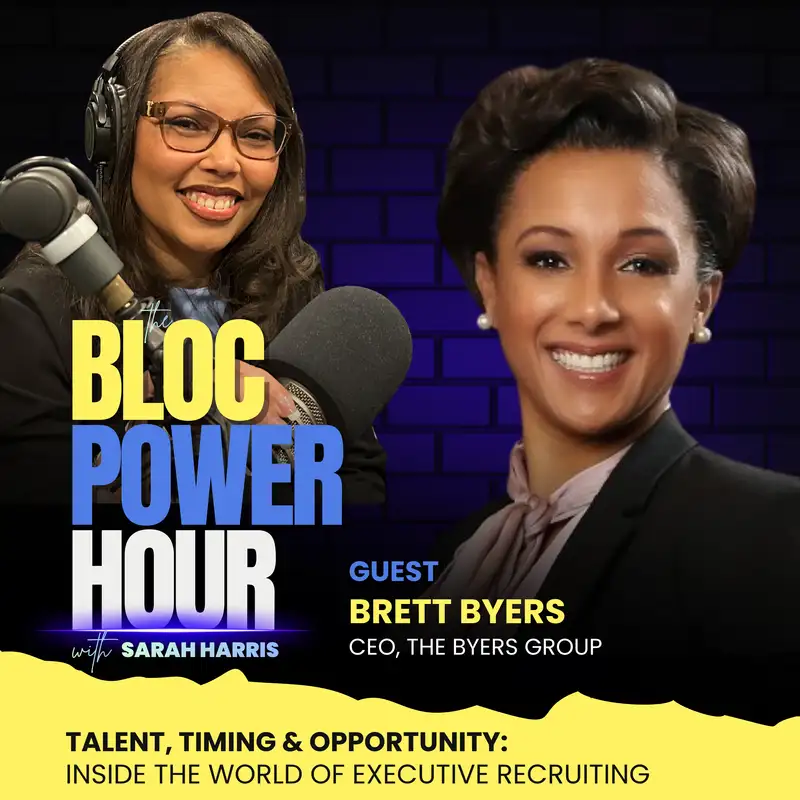
Talent, Timing & Opportunity: Inside the World of Executive Recruiting
Download MP3Yeah. Sarah Harris. Turn the mic up. Turn the power up. Welcome to the block.
Speaker 2:Turn the block power to the hour with Sarah Harris. We are bringing you conversations at the intersection of business, leadership, innovation, and opportunity. I'm your host, Sarah Harris, president and CEO of the Black Business Association, and this program is presented to you by Elevate Media Collective, a media division of the Black Business Association. And we are here wanting you to connect with this show by following us on socials block power hour on Instagram and visiting bbala.org to learn more about the work of the Black Business Association as we continue our mission of supporting business growth, economic empowerment, and expanding opportunity across Los Angeles and beyond. We do invite you to support this show, especially if it's resonating with you.
Speaker 2:You can sponsor or you could donate. Again, please visit bbala.org. Tonight's conversation, Talent Timing and Inside the World of Executive Recruiting takes us inside a part of the business world that most people don't see up close, but it plays a critical role in how companies grow and how leaders emerge. Behind every major organization is a search for the right talent, that right leadership, the right person at the right moment. And that's where executive recruiting comes in.
Speaker 2:Executive search firms work at the highest level of hiring, helping organizations identify and recruit leaders who can guide strategy. They build teams and navigate complex business environments. It's a field built on trust, relationships and a deep understanding of what makes leadership work. And at the same time, the workforce itself is changing. We have younger professionals who are approaching careers differently and companies are rethinking how they hire and retain talent and the definition of leadership is evolving right along with it.
Speaker 2:And tonight we're going to explore all of that from how executive recruiting actually works to how firms win major contracts to what professionals should know if they want to move into the leadership roles themselves. So with all of that, joining me for this conversation is Ms. Brett Byers, CEO of the Byers Group, an executive search firm that works with organizations to identify and recruit leadership talent. Brett, welcome to the Block Power Hour. Thank
Speaker 3:you, Sarah.
Speaker 2:So excited to be here. You. Yes, I'm so excited for you to be here today. I've always admired the work that you do with such finesse and grace. But before we kind of get into all of that, just kind of like tell me about how things are for you today.
Speaker 2:You do a lot of traveling with your business. And so in your traveling and especially with a lot that's going on today, tell us just kind of your experience as just being out and about doing your work.
Speaker 3:Oh my. Well, first of all, thank you very much for inviting me to participate in your talk show today. I also want to just give gratitude to the Black Business Association, which has been instrumental in how I've come to be in this business that I'm in today as well, as well as this has instilled quite a few values into me too. But having said that, I do a lot of traveling. I have a California based executive recruiting firm.
Speaker 3:However, the majority of my clients are outside of Los Angeles. So many of my clients are in Northern California, they're in Seattle, they're in Chicago, New York, New Orleans. I do work all across The United States. And so it's a lot. It is a lot, no doubt.
Speaker 3:But it's definitely a muscle that I've built over eighteen years that I've been in this business and plus, because before I got into the executive search firm that I've established for myself and the previous one that I worked in before, I did do a lot of traveling for my other company that I started in with Enrobes.
Speaker 2:Any secrets? Any secrets to what packing or just
Speaker 3:Oh gosh. I'll definitely say be sure to sign up for the credit cards
Speaker 2:to Yes. Get the Yes. Make sure you utilize that.
Speaker 3:You get the points, all the points on and make sure you book, you stay loyal to the airlines and the hotels that you like because the more points you build up, the better way that you can travel personally and get free nights and free points. It just makes moving around a lot easier. You know, another thing with those points is take advantage of those airline clubs. There are a lot of them that are coming online now, especially at LAX. Delta, shout out Delta.
Speaker 3:They have a nice Delta club there. American Airlines has one. So the clubs are definitely a benefit. And I would also say too on the point of clubs, because I do travel so much, you know, signing up for, like, professional clubs, spaces like a WeWork or the SoHo House, or I'm a member of the city club, so the invited clubs. It's also, you know, instrumental in the type of work that we do because we have a lot of meetings and they're business meetings and they're confidential business meetings.
Speaker 3:So you wanna be in a place that allows for that. But another thing, you know, about my travels is I really appreciate and enjoy being able to go to different places, experience different things, see different cultures, meet people. I'm in the people business. So it's very exciting and motivating, you know, and thrilling at at essentially for me to learn all about people and places and experiences and organizations. And so I'm really grateful that the work that I do affords me to do that.
Speaker 2:And I think from the side of those things that we get the benefits from, from our business, you know, I mean, you know, yes, for some people traveling can be a chore, but then like you just said though, being able to meet and experience different people and cultures and different locations, I think is a great thing. Well, thank you. I just kind of wanted to just like clear the air a little, you know, and just kind of like say, have you been up to lately?
Speaker 3:Man. Okay. Well, a lot. Okay. I have a I have a lot of great clients that I'm working with right now, a combination of public sector clients.
Speaker 3:So I'm working for an airport, San Francisco Airport. I'm working for a transportation commission, the Metropolitan Transportation Commission. I'm doing some work locally with LACASA, the Los Angeles County Affordable Housing Solutions Agency. And I have some local clients, nonprofits, community that I'm working with as well. So my little tentacles are in a number of different things.
Speaker 2:Well, they're getting larger and for sure. Are.
Speaker 3:I'm grateful.
Speaker 2:Let's kind of start off though, just kind of basically what led you into, recruiting?
Speaker 3:Yeah, I kind of fell into it and just enjoyed it. So I started off recruiting at the university. I went to UC Berkeley, go Bears. And I was recruited by the Black Recruitment and Retention Center to essentially make my decision on if I wanted to be a part of the UC Berkeley family. And so when I got to UC Berkeley, you know, I also became really involved with the Black Recruiting Retention Center.
Speaker 3:So what that organization does is they recruit students of color, and they're part of a coalition that does it, into the university, and they also work to retain those students, the Black students at the university as well. And so I was really involved with recruiting students all across California and really not only to recruit them to go to UC Berkeley, but also just to tell them the story about applying to college, whether you go to a junior college or to a four year university, just go to school basically. And so I liked doing that. And then at the same time, while I was at UC Berkeley, I also participated in INROADS, which is a national nonprofit career development organization that places students of color and fortune 500 internships with the goal of getting them a job when they graduate. So I was an in rows intern.
Speaker 3:My sponsoring company was Xerox. My major at Cal was a business focused on marketing. I went to the Haas School of Business. And, from there, I worked at Xerox, at the time, it was in the February, so that was in the initial tech recession. And so I did not get a job when I graduated, but EnRose was looking for a national recruiter, and so I decided to apply for the position.
Speaker 3:I knew the story of EnROADS. I was an intern, I'm an alum, so it made sense. I was hired on to be the national recruiter for the California Western Region for EnROADS. And my responsibility was really recruiting college students off of seven, you know, national campuses for them to be a part of the internship program. So I would travel to UC Berkeley, Stanford, Arizona State University, USC, University of Arizona, Cal State Long Beach, and recruit business students and engineering students into the EnROADS internship program.
Speaker 3:And then I just really got more intrigued because one of the board members on the En ROADS board in the office that I worked in, he had an it's had an executive search firm, and I was always just like so curious about what it is. It's like our business is so cloak and dagger and I totally understand why, but it really is. It's like having a cloak and a dagger, you know? And so I realized that I wanted to be in some type of staffing. I didn't know if it was gonna executive recruiting or temp staffing, but I just knew that I wanted to start my own I always always knew I wanted to start my own business.
Speaker 3:I come from a line of entrepreneurs. My grand my grandparents have had businesses, you know, both sides, my mom's and my dad's.
Speaker 2:Yeah. There's many of us. You know, I mean, yeah, have
Speaker 3:entrepreneurial It was just necessity, right? Growing up in, you know, black America, you know, your parents have to do what they have to do to survive and to create legacy and generational wealth. And so I do come from a family that has done that. And so I knew I wanted to be in business and I figured out I wanted to do something, so I called my mentor, Skip Cooper.
Speaker 2:Skip Cooper. You're not mine too. I claim him. I claim him too. Well, with that with that, I'm sorry because this is so good, but we do have to break for a moment.
Speaker 2:But we will continue this conversation on the other side. This is the block power hour, and we thank our sponsors like US Bank for helping to make this program possible. We will come back to continue this conversation. This is the block power hour with Sarah Harris. Welcome back.
Speaker 2:Welcome back. This is a wonderful, conversation. We have miss Brett Byers, CEO of the Byers Group regarding executive search recruiting. And with the Block Power Hour, we bring you amazing dynamic guests like this and having great conversations. If this resonates with you and it's something that you connect with and want to support, we welcome your donations, which you can find information or make the donation at bbala.org.
Speaker 2:Again, bbala.org. So Brett, yes, you were talking about our illustrious, amazing Mr. Skip Cooper, who is the current chairman and president emeritus for the Black Business Association. He served for forty six years out of the fifty six years now of the BBA's history. So give us, some of what you have to say about Skip.
Speaker 3:Oh man, so Skip, he's the beloved, the beloved, the beloved Skip. He is certainly an icon Mhmm. And a living legend here in the Los Angeles, you know, small black business community. He's touched a lot of people in a lot of many different ways. He's certainly an advocate, will always be, as well as a strategist for sure, as far as what getting things done, like as far as you getting financing, as far as you getting contracts, as far as you branding your business.
Speaker 3:I mean, Skip is definitely, I want to say like an encyclopedia. And while he's older, I appreciate the older perspective because it still works. Those foundations, those values are still applicable to this day. And so I just always appreciated getting wisdom from Skip. And so my relationship started with Skip because my mom was also a member of the Black Business Association.
Speaker 3:She was actually the board secretary and she would bring me to the meetings. And so eventually I became a scholarship recipient of the Black Business Association. I got an annual scholarship that supported my education at UC Berkeley. And then I also became an intern too. I would go work in the office.
Speaker 3:I I like doing office work. I just liked working, making money. Okay. Fast forward to when I was at INROADS and I told Skip, you know, I wanna start my own business. And he was like, I want you to meet two people, two members.
Speaker 3:He introduced me to a woman who owned her own staffing agency and a gentleman who owned his own executive search firm.
Speaker 2:And he
Speaker 3:was like, I want you to meet both of them and I did. And so I made sure that both of them became my mentors, I met with them regularly and they both told me to go into industry because you really do need to decide which one of these spaces, whether it's staffing or executive search, that you really wanna be in. Mhmm. And so I did. And so because he said go they go they both say go in the industry, I decided to go into the world's largest staffing agency, and I did.
Speaker 2:Go big or go home already?
Speaker 3:Exactly. Just go for it. And I did, and I was assigned to a major account. Myspace at the time was my account, and I did a lot. Yeah.
Speaker 1:I know. Myspace.
Speaker 3:Huge Myspace. Right? Alright. I was it was and, again, to the point about learning about organizations, like, I was responsible for staffing the contact center of Myspace. So that was a twenty four seven operation, and they were doing all kinds of things having to do with reviewing the images that were coming up that people were posting and making sure that they were acceptable or not.
Speaker 3:Right? So it was it was a good, experience for people who were in college or students because you can work twenty four hours if you were studying. You can come in for a couple you know, so it was a great time for young people to get involved in technology that way. So, anyway, worked in the staffing business for a while, and then I decided the economy was tanking at the same time. So recruiters are no longer popular, and so it was time for me to look for something else.
Speaker 3:And so I called my other mentor and I was like, hey, I think I wanna be in the executive search business now. And so he was like, okay, let's figure that out. And so I went to go work with him and, you know, a small black, you know, executive search firm here and learned the business and got, you know, really involved in identifying executive level talent, enjoyed it, built great relationships. It was just fascinating. It still is fascinating to learn more about people and more about organizations.
Speaker 3:And one of the things that I learned about myself actually when I went to school, when I went to UC Berkeley is that I really wanted to change the world. And one of my art teachers told me, she was like, you need to come to class instead of trying to be outside changing the world. And I was just like, I mean, but that's what I'm trying to do.
Speaker 2:That's what you want
Speaker 3:to do, right? So, you know, for me in my business, I know that I am doing what I am supposed to be doing. I am changing the lives of people one at a time and I'm changing the, you know, the environment and workplaces of organizations
Speaker 2:one And so at then you decided to become a business owner and created your own firm, the buyers group. And so now let's talk about the actual business of hiring leadership talent. Yeah. Okay. So when a company hires an executive search firm, what problem are they usually
Speaker 3:trying to solve? Oh man, it's a puzzle. It's definitely a puzzle. It's a talent puzzle. And you know what?
Speaker 3:A lot of times the client's problem really is initially they believe that, you know, they just need to find a leader who is going to lead this function, lead this strategy, lead this program, lead this process, lead something. Right? But a lot of times I think that they also find that they also are trying to ensure that their culture, their organizational culture is set up and is sustainable in a certain way. So it really depends on the organization. At the end of the day, you know, they're really wanting to solve the problem of a functional or operational
Speaker 2:Mhmm.
Speaker 3:Or a leadership problem that they have. But I think in going through the executive search process, what we do to uncover the needs of the client at that time, it's very revealing around other things that they need to address or solve the problem around, whether it's, you know, their internal organizational culture or if there are some gaps in an operation or an or process that they need to shore up as a result of having this leader leave and then you're finding that we there's a better way that we could do things. Mhmm. It it really does depend upon the organization and and the organization's evolution at that moment in time. But, you know, it's more than just the leadership or the talent puzzle.
Speaker 3:I think a lot of times, you know, there are other organizational opportunities that are presented when talent does transition or matriculate.
Speaker 2:So when organizations usually try to do this on their own, what kind of mistakes do they make?
Speaker 3:I would say that assessment, right? Assessing talent. Think assessing talent is a mistake that they make. I think also assessing the need is a mistake that they make. You know, in our business, this is something that we do all the time.
Speaker 3:Because we're a third party and we're not in the internal organization or the day to day function, we're coming in with a fresh set of eyes. And so, you know, we know organizations and we know talent and we know people, and so we're easily able to identify, you know, some things that they need to address. And so because they're internal, they may have a blind eye also to certain issues or challenges or people, right, that may not necessarily be contributing to the overall vision or strategy or focus or goal objective of the organization. And so I think a lot of times organizations, you know, miss because they don't necessarily assess the issue or the talent gap appropriately. And then on the other side, when it comes down to assessing candidates, they're not necessarily looking at the appropriate things.
Speaker 3:The way that we do our work is really competency based. So what are the competency areas that you need to have? Like, do you need to be a people leader? Do you need to be operational leader? Do you need to be a process or system leader?
Speaker 3:Do you need to be a strategist? And then again, from a organizational culture, a soft skills perspective, like, you know, what are the cultural norms that are here? And if you're internal to this, you might not necessarily realize that there are cultural norms that an organization is subscribing to that you just don't realize that you actually need to assess when you're thinking about candidates coming
Speaker 2:And is to an that kind of like a moving target,
Speaker 3:you know,
Speaker 2:where it's just constantly evolving and changing?
Speaker 3:It can be, It can be. But most importantly, a lot of times when you're talking to multiple people within the organization, when you're doing your assessment, you find a lot of themes and a lot of the cultural norms do come out in those kinds of conversations where you can really identify what the culture is, especially at the executive level.
Speaker 2:Okay. And what separates one candidate from another that, you know, that you can tell that is leadership ready?
Speaker 3:Yeah. That's a good question. I was talking to a client about this the other day. At this level, because again, we're at the executive level, so we are looking at C suite executives, any position that's our director or above. And what sets a candidate apart is basically what have you done for me lately?
Speaker 3:You know, like having a proven track record of transformation is really at the end of the day, what sets apart a candidate from another one. And a proven track record around, you know, solving some of the challenge of business problems or challenges that the organization might be facing, moving an organization from one level to another, so change, facilitating change management or change, really being able to communicate and tell the story about how you've done it very clearly. However that comes you know, just being clear in your narrative about how you've done it, and having backup to support it in the referencing is definitely how you're gonna be able to set yourself apart. You def you have to have some credible stories around your transformation journey.
Speaker 2:Wow. Because that often will paint the picture for you as the recruiter and the company to really get to know this person. Right?
Speaker 3:Yeah. Yeah. Because you're evaluated on your past performance. Like past performance is going to be able to give us a clue on what we should anticipate that you could do within this type of organization. So having talent, being able to work with people, to lead people, having a way cultivating relationships and teams, mentoring and developing people, that's also important, especially right now in the moment in time in the workplace that we are right now.
Speaker 2:Okay. Once again, we need to break, but we're going to continue conversation where you can learn more about the process of becoming a candidate. This is the block power hour. This is Sarah Harris, your host, and we'll be right back. Welcome back to the block power hour.
Speaker 2:I'm your host, Sarah Harris, and we have our guest today, miss Brett Byers, CEO of the Byers Group. We're having an amazing conversation. We've had so many wonderful guests come on the Block Power Hour. If you want to catch some of the other shows, we do have them on demand and podcasts. You can go to Instagram, Block Power Hour, and see the link where you can be able to download and listen to them on podcasts.
Speaker 2:Welcome back again, miss Brett. Let's continue on with this conversation. So for candidates who are you typically recruiting, is there like a typical range or something for salaries that you are usually recruiting for?
Speaker 3:Yeah. So because, you know, again, we're in the executive level position, so that's any director level role or above within an organization, They normally start like around $175,000 depending upon the size of the organization. And they typically go anywhere north of $400,000
Speaker 2:Awesome. So it's good opportunities for in terms of these positions. Absolutely. Can you give us some examples of recent recruitment that you've had?
Speaker 3:What do you mean an example?
Speaker 2:Well, I mean, are presidents and
Speaker 3:Oh, sure, sure, sure, sure, sure. So I have recently done a couple of searches for some foundations, a chief operating officer, a chief financial officer. Those salaries were both north of 200,000. Let's see, done some CEOs recently too, you know, same, North Of 200000. I've done some work in public safety recently.
Speaker 3:Okay. Civilian oversight for police and that's, you know, North Of 200000.
Speaker 2:Those are some great examples of the kinds of recruiting that you are doing. What is the typical length of the process
Speaker 3:for that?
Speaker 1:Yeah. You know, cloak and dagger, you know, it's a lot
Speaker 3:that happens behind the scenes in these processes, and it does take a while. Mhmm. Because, know, we wanna get it right. Right? So and haste makes waste.
Speaker 3:Mhmm. So a typical executive search process takes anywhere between three to four months, could take five months. It really depends.
Speaker 2:That's pretty quick to me. Yeah. Seems
Speaker 3:like. It really depends on the client and it really depends on schedules because that's a lot of what we're you know, we're dealing with people and that's one thing that we can never control is people. So it definitely depends on the schedules. Our timeline is predicated on other people's schedules.
Speaker 2:Does your work continue even after the hire? Like, is there some type of what? It does. Transition period or something?
Speaker 3:I will say that it's kind of informal. Right? A lot of times, you know, obviously we keep in touch with our clients. We keep in touch with our candidates. You know, many times our clients contact us for advice around all kinds of different things just because we're in the people and organizational development and research, I would say business, you know, we just have we know a lot about best practice.
Speaker 3:And so our clients do come to us for advice on all kinds of different topics. A lot having to do with just talent and personality and setting up structures and things like that. And also, I will say with the transition, what we do do is many times we suggest clients and candidates get coaches because we want people to be set up for success.
Speaker 2:I definitely have seen that, being a trend where, yes, bring on coaches to be able to carry them through that process.
Speaker 3:Yeah. And the process of search is a strategic choice. Again, like I said, it's about putting the pieces of a puzzle together and there is no perfect candidate, right? So, you know, you can get the majority of what you really want, but then there could be some areas that a candidate might need some coaching around and it's fine. Everybody could use a coach, especially with a major transition, especially if a candidate is going from like as a high potential candidate, for example, and they're going from like a, you know, assistant director to a director and actually now on the executive leadership team, you know, they might need a coach around that transition of maybe and they're scaling.
Speaker 3:Right? So they may have a larger team. They have more responsibilities. They have more budget. There is some executive level decision making that they need to influence and carry forward.
Speaker 3:And so a lot of times you might need someone to just check yourself with, and coach you through some really difficult situations that you may not have never encountered before, and a coach can help you with that. And so our clients are also very open to making that type of an investment in talent right now because talent is talent and you want to be set up for success and you want that person to feel like your incoming organization is wanting to make sure that you're successful as well.
Speaker 2:And with, executive search firms, there's a lot of trust that needs to be there because they're pretty much putting in your hands somebody that's gonna like take on these roles that really have, can really make or break a company, in other words. So what is it like having that responsibility for that level of trust?
Speaker 3:Oh man, so in our business, you know, you're just as good as your last search. So, and just with anything, you know, you wanna make sure that your candidates and your clients always have a great experience and that you're adding value every single step of the way. And so that's something that we ensure, right? That the candidate experience is amazing, that the client experience is amazing, and that they're going to want to come back and work with us again. You know, I am grateful that a lot of my clients, I get them based on referrals, either from other clients or from candidates who I've worked with and they've, you know, loved and enjoyed working with me and my team.
Speaker 3:So this is a partnership. Right? So our role is the facilitators of the process, right? And the facilitators to identify and evaluate the candidates with the client. But this is definitely a partnership.
Speaker 3:We are like an extension of our client. We really get to understand their internal story really quickly and are gonna have to communicate that to enroll candidates and the possibility of joining this organization. And so, you know, we're partners and we work with our clients to design the process, to design the job description, even to design our strategy of where we're gonna go and look for talent. So it's not only us that's participating in this, but it no doubt really a large responsibility. And so that's why we do spend a lot of time with our clients upfront, really getting to know them, getting to know their team, getting to know internal organization to make sure that we are coming back with candidates who really meet their needs.
Speaker 3:And you know, at the end of the day, I'm always excited to have a client say to me, Oh my God, this is a really hard decision that we need to make between these two sets of candidates.
Speaker 2:That means you did your job, you did your work. So with that, do you get, because you recruit, you go out and search, but I imagine that you get a lot that come to you, a lot of candidates that want to be considered. How do you manage that or is that like, what do you advise or what do you give those people who are candidates who are seeking and want to be in the position to be recruited?
Speaker 3:That's a good question. So let me take a one step backwards. So in the executive search business, especially in the retained executive search business, you know, we're like talent scouts. We're like NFL scouts going out to go find recruits. And so we work on behalf of our clients.
Speaker 3:And I just wanna be clear that clients pay us to go find talent on their behalf. Candidates do not pay us Right. To find a job. And I wanna say that explicitly because I think there is definitely the idea, their perception that candidates pay us to find a job on their behalf, and that's just not how it works. And so we get candidates in a number of different ways.
Speaker 3:You know, we research, we have a whole research team that goes out and based off of what our clients are looking for, it's custom. So we go find the talent that they're looking for. And then we do have a database and, you know, we'll go into our database and take a look at people who we know and who we're familiar with and talk to them and get them to see if they know someone or if they're interested. We definitely mind LinkedIn, that's a part of our research strategy. So I would say any candidate who wants to be
Speaker 2:That's that's first level,
Speaker 1:that's base.
Speaker 2:Make sure you have your LinkedIn profile together.
Speaker 3:Make sure that it's attractive, make sure that it talks about, like I said, what have you done for me lately? What have you done? What are your accomplishments? What's your transformation journey? What are you known for?
Speaker 3:What is your reputation? You know, please, that's incredible to have on your profile. I would also say, you know, talk about the various conferences that you've been at. You know, high make sure that when they say, like, the algorithm is real on LinkedIn and the commenting, all that stuff is real. It it makes a difference.
Speaker 3:It does bring more attention to your profile, because we're wanting to find talent who are standout, top notch, who have a great reputation of getting something done. I'm not saying like a great reputation of just talking. I mean, like actually producing something. Exactly. Yeah.
Speaker 3:So LinkedIn is another way. You know, you can contact a recruiter absolutely out of the blue. Mhmm. If we're not working on anything at the moment where, you know, we are gonna basically recruit you for a position, we'll certainly There's
Speaker 2:nothing wrong
Speaker 3:with that. There's certainly nothing wrong with reaching out to us and letting us know that you're open to opportunities and wanna be a part of our community. I like to call, you know, not my database, but my community because we are creating, we're building a community of talent essentially with the work that we do.
Speaker 2:Amazing, amazing. So, we're going to have to go to another break again, but when we come back, we'll kind of just talk about some workforce trends and kind of wrap this up. But I've been enjoying this conversation and I have a a couple of questions, and I wanna make sure I remember them. So I'm a write them down. But this is the block power hour with Sarah Harris, and we will be right back.
Speaker 2:Welcome back to the block power hour with Sarah Harris. That's me, your host, and our guest today, miss Brett Byers, CEO of the Byers Group. We are talking about executive search firm recruiting and I wanna know in terms of the trends, we have an older workforce population, right? That the younger ones is not really entering. So give us your perspective on the younger professionals and what's happening there.
Speaker 3:Okay, this is a big conversation now, Sarah. So I want to take it globally first, right? So the moment of time that we're in right now, and I don't know if everybody really realized this, but we have five generations that are in the workforce at this Five.
Speaker 2:Five. Okay. Did not okay. So that's all the Gen Zs, x's, and the millennials.
Speaker 3:We still got some baby boomers.
Speaker 2:Baby boomers. Got baby boomers.
Speaker 3:We got some young baby boomers. Okay. And I love them. Mhmm. I do.
Speaker 3:The gen x's are representing hard as we all know. We're the ones that are leading the workplace right now, I would say. And then we have the millennials and they're coming up into these, you know, management and, you know, senior level executive roles for sure, especially the high performers, high potentials. Then we have, gen Z.
Speaker 2:Mhmm.
Speaker 3:And gen z is starting to come into the workforce, you know, and then we got the alphas, the little baby alphas. The alphas? They are. That's the dope.
Speaker 2:Do we have a gen y in gen y? I
Speaker 3:don't know.
Speaker 2:Okay. I'm
Speaker 3:I'm just throwing it the in the workforce. Yeah. And, you know, and so all of these generations have different ways that they work. Yes. Different ways.
Speaker 3:Different ways because we were all brought up in different times. I wanna say, Gen X, we're probably the most adaptable and agile and, you know, we we see we see a lot. Right? We're like the translators. We're the ones who understand what the baby boomers are talking about and have empathy for them.
Speaker 3:You know, we sit in our own spaces and are driving things, and then we also understand and can relate to the millennials because, you know, it's the lower end of the Gen Xs that are closer to the millennials. And so and many of those Gen Xers do have kids who are millennials too. Right? So they understand from that perspective. And then, you know, we got the Gen Z that are coming in who are totally coming in at this heightened innovation and technology time, have a total command of, you know, the digital generation and era that we're in right now.
Speaker 3:And they they do have a lot of value. They do. No doubt. We also are dealing with the fact that we've just coming out of a pandemic where, you know, the majority of us were working remotely.
Speaker 2:And that changed the whole landscape too. Changed the
Speaker 3:whole game. So that made a lot of us adapt to all this technology that were coming on board really quickly, especially the baby boomers and the Gen Xers. And then with the millennials and Gen Zers, you know, we're kinda like aloof about being around people anyway. They're comfortable, you know, not necessarily working in a work environment, but when you go to work, you gotta work with people, you know? So what I'm finding is that we have a multigenerational workforce and the older generation is definitely now having to bring the younger generation along when it comes to the social soft skills of being in professional work environments.
Speaker 3:We still do have, you know, a level of a culture, that we are wanting to continue to create around communication and just the social moments that we need to have in getting work done, relating to one another. And communication, especially when you're texting and you're tech slacking and you're doing emails, a lot of times things can get lost in translation and so you gotta pick up the phone. And so I'm also finding that a lot of my clients who are, you know, having predominantly remote kinds of work environments do see a lot of conflict as a result of their not necessarily being always the human interaction regularly.
Speaker 2:Right.
Speaker 3:So that's something that I'm noticing. But, know, at the same time, I would say that the young people entering into the workforce, they have to be patient too, because again, you know, we all have our roles. We gotta show and prove, check and verify. You know, you gotta do something. You have you absolutely have to prove yourself in these work environments that you're working into in order to continue to grow and to change.
Speaker 3:It's moving fast. And another thing that I would also say about our multigenerational workforce that I do really appreciate is now we're having multigenerational teams. And with the increase of AI coming into the workforce, having a multigenerational team is is definitely a benefit and a value to the overall organization because, you know, the millennials and the Gen Z are learning to use AI really fast.
Speaker 2:Mhmm. That gives them a competitive edge. Absolutely.
Speaker 3:It does give them a competitive edge. It does. However, you know, we also know that AI can hallucinate, right? So it hallucinate. And so the older generation, baby boomers and the Gen Xers, you know, on those teams, the role for us is to check it, like just to say, oh, doesn't sound right, this doesn't look right, this is not factual, these sources are incorrect.
Speaker 3:You know, so having, I mean, there's no doubt that AI is here to stay and it is certainly helpful in removing a lot of like the transactional and robotic tasks that we do and just writing things, right, or strategizing about some things, just getting some things down on paper to start with initially. So it's great for the new generations that are coming in to do that initial kind of research and initial type of, you know, talking to chat or talking to Claude. But it is incumbent upon the older generation, Genexus and baby boomers, to just review and think about it and point out the insights and the revelations that AI is making, but also check the hallucinations that AI is making too.
Speaker 2:Well, with that, for resumes, are you seeing a trend with AI generated resumes?
Speaker 3:Yes. You know, AI generated resumes are here and, you know, they're not going anywhere and it's okay. Like, I mean, you know, but someone who's looked at resumes for the past twenty years, you know, we could tell when an AI resume is being generated. So I would just say, especially
Speaker 2:As long as you have constructed it right and it has the real information and stuff, it's not a bad thing, But like you said, you want to make sure that either hallucinations or just, you know, straight out leaving it to AI to do it for you. No, no,
Speaker 1:no. Yeah.
Speaker 3:And I mean, and you gotta have the facts to back it up, right? So once you send your resume and then you get into a conversation with a recruiter or hiring authority, you gotta have the stories to back up what's on that resume because if you don't, I mean.
Speaker 2:Right, so with your recruiting, and again, is executive level, so that means that there has to be some experience there, right? But we do have a lot of dynamic, amazing, outstanding young people that do amazing things. So, can be the possibility for that. So having said that, what age range does that skew for you? Is it still for older candidates or is it, you know,
Speaker 3:a good question. Varies, like, you know, we have candidates who are in their late thirties, you know, mid thirties, you know, and above. It runs the gamut, you know? And a lot of times to this point about high potentials, high performers, and the next generation of, you know, executive leaders coming through, I'm definitely a supporter because I am that person and I have been. I've been the youngest person in the room for a long time.
Speaker 3:But we do a lot of times tell our clients to hire, you know, for talent. It depends on the position. Don't get me wrong. It really does depend on the position, but we definitely are wanting to hire for the future, right, and the ability to take this organization to the next level. And a lot of times, you know, our clients do make that decision.
Speaker 3:It does come down to hiring for talent and for the runway.
Speaker 2:So for you and your business, what is it that you seek or looking for in terms of your next client or have them find you or?
Speaker 3:You know, I would love to get some more philanthropic foundation clients. That's one aspect. I'm also down to support small private organizations.
Speaker 2:Totally
Speaker 3:love my social justice, community justice organizations and my public sector clients too. You know, have a practice that really involves doing work on behalf of the public good.
Speaker 2:So tell them how people can find you.
Speaker 3:Yeah, so my website is well, the company name is The Buyers Group. My website is www.buyersgroupca.com.
Speaker 2:And that's byegrsroupca.com.
Speaker 3:My LinkedIn page is the buyers group.
Speaker 2:That's the best way find me.
Speaker 3:Yeah. Alright. Wonderful. And and on those pages, you know, you'll see the different types of searches that I have going on right now and the ones that I've done in the past.
Speaker 2:Mhmm.
Speaker 3:And I'm always interested in meeting new candidates and I'm always interested in meeting new clients who could use our help.
Speaker 2:All right. Well, you know what? This has been a full conversation. We're just about the end of our show. We usually do a block fire segment, a round of just some quick questions, but it seems like we're kind of out of time, but I will say that it's been such a delight talking with you today, Brett.
Speaker 2:We've always called you the young rising star coming out of the BBA, but thank you for that. This show has been made possible from one of our sponsors, LADWP. We thank you for making it possible. Also too, for anybody that wanna join in and support, we welcome your sponsorship or donations. Please check us out at bbala.org.
Speaker 2:Again, that's bbala.org and listen to this show on podcasts. Go to Instagram at block power hour. I am your host, Sarah Harris. This has been the block power hour and we will look forward to having you join us again next week.
Speaker 1:This is the block. Our, our, our. We talk business, culture, vision, and grind. Opportunities align when the community shines. Dreams get bigger when the people connect.
Speaker 1:Moving with the purpose and demand and respect. Innovation in our blood. Breakthrough when I stride.