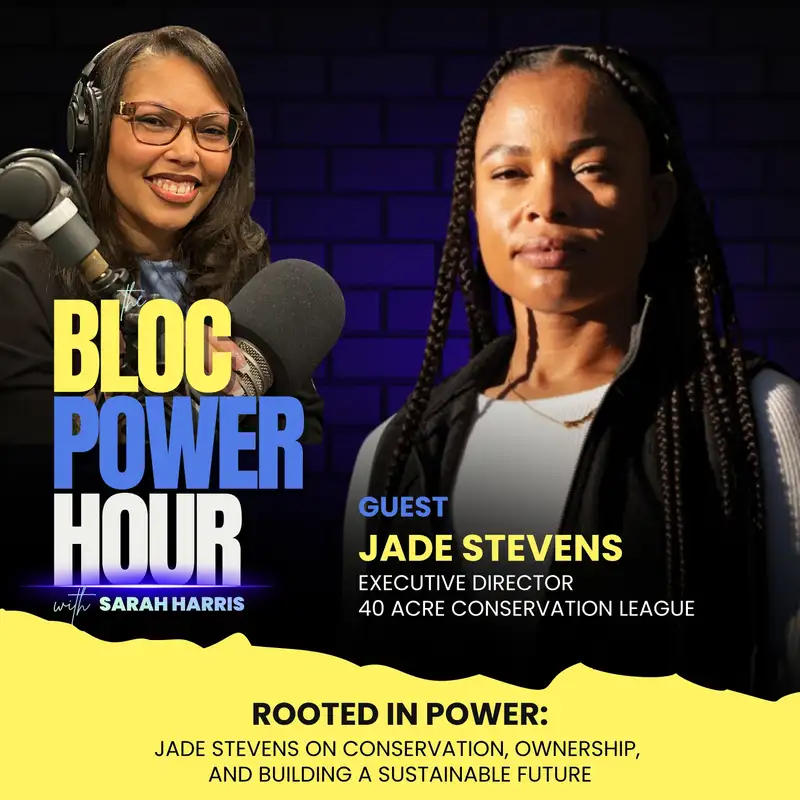
Rooted in Power: Land, Legacy & Environmental Stewardship – Jade Stevens on Conservation, Ownership, and Building a Sustainable Future
Download MP3Yeah. Sarah Harris.
Speaker 2:Turn the mic up. Turn the power up. Welcome to the block.
Speaker 1:The block. Turn the block up. Bike up. Bike up. Welcome to the block power hour.
Speaker 1:I am your host, Sarah Harris, and welcome back to another amazing impactful show. We have someone so special today. I've been waiting and waiting to be able to have her as a guest, and I just cannot wait for you guys to learn more about her. Our show is Rooted in Land, Legacy, and Environmental Stewardship. And so our guest is Ms.
Speaker 1:Jade Stevens, Executive Director of forty Acre Conservation League. And this show is about an organization that is committed to protecting land, empowering communities, and advancing environmental stewardship with the intention and purpose. So as we do on the block power hour, we bring you shows that bring you stories and bring you things that impact our economic mobility, our upward mobility for communities, and this show will not disappoint. Of course, the block power hour can be found at block power hour on Instagram, and this show is presented to you by Elevate Media Collective, a media division of the Black Business Association. Also, we are so appreciative to our generous donations to make this show possible by US Bank.
Speaker 1:If you are continuing to find our conversations here at the Black Power Hour to be insightful and engaging. Please consider a sponsorship or donation. You can find us at bbala.org. Again, that's bbala.org. And so now to our show again, Ms.
Speaker 1:Jade Stevenson, how are you?
Speaker 2:I'm great. Thanks for having me.
Speaker 1:Again, I've been so extremely excited to have you on the show today. You are an impressive person. I have watched you over the years since we met. I believe you were working for Yes. Ambassador Really And there's a myriad of times I had to come in and interact with you and I always was just impressed by just your initial engagement with me.
Speaker 1:And then since then it was just learning about really what drove you, what your passions are and what you were inspired by, and then to see you now with this 40 acre conservation league. So we'll get into that. And partly because we, you know, we're in April now, which is Earth Day month, environmental justice month and all that. We thought it was a timely subject matter. But before we get into that, one thing that I'm excited about, one thing that I'm excited about, and anybody knows me, I love music.
Speaker 1:I'm excited about the Michael Jackson movie, which is coming out on April 24. I decided to, for these next few shows to kind of dedicate a certain song. So I guess I would pick human nature for this episode to dedicate for, this episode. But I want to ask you, what is your favorite Michael Jackson song?
Speaker 2:Oh, so many. I think I so you making me go back. I'm thinking about when I play And what
Speaker 1:era, right? Which one is it?
Speaker 2:Is it
Speaker 1:the young Michael? Is it the Michael of the eighties or is
Speaker 2:it a little bit later? I mean, there's so many, but there we go. The one I'm gonna choose is because I play it on Wii when we're playing the Michael Jackson dance game, and it's keep it in the closet. The dance choreography to it is amazing. So that song, whenever I'm plead it up or if I have time to play on the game, that's my go to song.
Speaker 1:Wonderful. Okay. That's a new one for me. That's a new one for me, must admit, but I love hearing everybody's, tell what they pick in and also too from which era would they pick their song in. But yeah, the movie premieres on April 24 and so I had put in to my story some of the trailers.
Speaker 1:Oh, I'll have check it out. Yeah, yeah, I think it's pretty neat. I think it's pretty cool. Anyway, so from that now onto the subject matter at hand, Ms. Jay Stevenson, of course, again, we are talking about environmental impact.
Speaker 1:We're also talking about economic opportunity. We're talking about who owns land and who benefits from it and who gets to shape what sustainability looks like. And so I want you to kind of tell about what drew you into starting or being instrumental in the Conservation League.
Speaker 2:Yeah, so I would say that growing up really, I had an opportunity to be a part of Girl Scouts and being able to do a lot of outdoor activities when I was younger. So being a part of my troop, we would go and camp and learn, you know, basic wilderness life skills and really just kind of explore campgrounds around, you know, San Diego, places in Los Angeles, even camping on the beach, learning how to surf. And those are some of my early memories of enjoying the outdoors. I also haven't shared recently, but have been reflecting on the work that we've done. My family has reminded me that we have family, we have land in our family that's in Shreveport.
Speaker 2:And for those that are in the area, it's actually closer to Haynesville. And it's a place that we would go visit on Mother's Day to go and celebrate everyone in our family, but also learn about the land that is currently held by all of us. We all have this personal stake in the management of that land. And those were some of my early memories of enjoying the outdoors and kind of understanding how important it was to have land in your family. Fast forward to, you know, 2020, everybody has been told that they need to stay inside.
Speaker 2:And there's something about being told that you need to be inside that makes you wanna go outside a little
Speaker 1:bit more. So
Speaker 2:I took up cycling and had the opportunity to explore all of Southern California. Once I got a bike, I couldn't get off it. I was cycling from Downtown Los Angeles down to San Diego to have my first century ride. I rode to Santa Barbara also from downtown, from Downtown LA Union Station specifically to Downtown San Diego. It's about 122 miles.
Speaker 2:So I was hoping to get a 100 and, you know, just went for the gold and got some extra credit. And then a friend of mine wanted to do a ride for her birthday and we called it the SUNY century. And we rode from Downtown LA to Santa Barbara and that was also another century. And I just thought that being able to see the outdoors on your bike is something that you just can't put into words.
Speaker 1:I imagine, especially in California. Yeah.
Speaker 2:Riding along the coastal lines, riding through the forest and being able to see all these beautiful things. And like, I only saw me, like when I'm talking about me, I'm like black women on a bike riding like that. And it was earlier. I hadn't really found, you know, a cycling community like I have now, but I just thought like, why aren't there more people out here like doing stuff like this? It's free, it's fun.
Speaker 2:It's a great way to like clear your mind. It's great for the mental. But whenever I would talk about it, they would be like, girl, we don't do that. That's everybody else's thing. Us.
Speaker 2:And so it was odd to me that there was still these like myths or like feelings or attitudes towards going outside, but I just had some really great experiences starting out. You know, I was just reminded again of just these perceptions and things that we were reading in the headlines, right? When we were making nicknames for every instance, Backyard Becky and Homeboy in New York that couldn't do bird watching, right? And that was like, there's just this contrast between what I enjoy, but like what the reality is for people of color. And so that coupled with my love for the advancement of the black community, I was like, there's gotta be something here, right?
Speaker 2:Like when we're thinking about how we can continue to move other generations forward, I found at the center of all of it, it was land ownership. What we need in order to build wealth, what we need to continue to move forward is some type of ownership. I think land is really what's critical to that and not just home ownership. And that's what really kind of got my brain thinking that yes, homeownership is one way, but like what if we were able to own land outright and curate these types of experiences? Not having a background in conservation, I later learned that this is what land trusts and conservation organizations do, but essentially it was rooted in finding ways to create more opportunities to increase access to the outdoors.
Speaker 2:And I think the main way to make that happen is having the land in your ownership to be able to curate the type of experiences that you want. And so that is what really gave us the spark, the idea of what forty Acre Conservation League is. How do we create more opportunities to enjoy the outdoors, to increase access, but doing it in a way that still protects the outdoors, it protects our environment. And so again, fast forwarding to like late twenty twenty, late twenty one, it was just the perfect time. You know, there was a national reckoning of how we were all dealing with George Floyd, but there were so many different groups that were focused on how can they invest more in bringing more voices up and bringing more people
Speaker 1:to And the not only with just nature period, it was also during the pandemic. And so it was a time where people were really kind of tuning into nature. Paying attention. Yeah, paying attention to these things, especially when the streets were laid bare and we just saw growth, we saw animals coming out,
Speaker 2:we saw, you know. People were seeing insects for the first time. Was a real, you know, beautiful moment for some, but others were like, woah, what is But even that, like thinking about, yeah, like we do live in different types of environments and, you know, being in LA, sometimes I think we forget how beautiful some of these open spaces are that we have. And so in that time, there was the launch of the 30 by 30 initiative, which is the California's goal to protect 30% of the state's land and water resources by 2030. And there was a surplus in the budget because of the pandemic that allowed the governor to put a certain amount of money aside to go towards making that mission possible.
Speaker 2:And so we were able to really build relationships in the state legislature. Assembly member Mike Gibson has always been a champion of our work, but we were able to show that if we were able to acquire land and be able to curate the type of experiences that we know we need to see that meets people where they are, we can do two goals, which is one, protecting the outdoors, being true land stewards and taking care of our natural resources, but doing it in a way that is respectful that can also increase access and get others more interested in the outdoors. And that is what allowed us to secure $3,000,000 to acquire our first site acquisition, which is in immigrant We'll
Speaker 1:get into that because we're coming to the end of this segment here. We got so much more to unpack. So more when we come back. This is the block power hour with Sarah Harris. Welcome back to the Block Power Hour.
Speaker 1:I am your host, Sarah Harris, and we have our amazing special guest today, Ms. Jade Stevens. She is the executive director of forty Acre Conservation League, and she is talking about conservation ownership and building sustainable future. This show is Rooted in Power, Land, Legacy, and Environmental Stewardship. So welcome back again, Jake.
Speaker 2:Thank you.
Speaker 1:So we were talking, you were starting to get into, you know, some of the ways of starting to form the league, but before we kind of dive a little bit deeper into that, I want to kind of touch upon the name itself, forty Acre. It carries deep historical meaning. And so I just kind of wanted you to talk about that and why you made the connection.
Speaker 2:Yeah, so the forty Acre Conservation League, the name was inspired by the idea of 40 Acres and a Mule, which was the promise to formerly freed slaves of, you know, receiving 40 acres of land and a mule upon freedom. We know that that was never actually fulfilled. And as a result of that, we have seen a astronomical amount of what I would say is land loss in the form of almost, I think it's a little over $1,000,000,000 on the conservative side. You can check that, but you know, just understanding what land ownership means that we could have fulfilled through being a farmer or really participating in the agricultural economy, building, you know, their own businesses on this land that was never provided. And while there are multiple ways that we are trying to reconcile that, we like to think about the 40 acre conservation league as the promise fulfilled.
Speaker 2:We are able now to acquire land where we're now managing upwards of six seventy six acres to really bring back to the forefront how important How many acres? Six seventy six acres.
Speaker 1:Six seventy six. Are you able to kind of give us and like compare that, what that looks like, what
Speaker 2:that equates to? You know, I've been asked that before. Someone was like, is that how many football fields is And you know, I'll have to check that. I'm not sure how many football
Speaker 1:Maybe fields
Speaker 2:it's between four to five. I know it's huge. I don't know that we can really quantify that with football fields. I
Speaker 1:imagine eventually you will be able to have a comparison to that. But to me, just the massive six seventy acres to be stewards of that kind of landmass and then taking care of that. But it's all built into also just your mission and what the purpose is of it anyway. That's the point, right? That kind of stewardship and being able to have ownership and then also how we can utilize and what we do with it.
Speaker 2:So
Speaker 1:talk a little bit more about your vision for the utilization.
Speaker 2:Right, so our mission is to increase Outdoors For All and we measure that by trying to increase the participation of underrepresented groups in the outdoors. And there has been a lot of research and observations and surveys that we've put out and gotten real time feedback to really understand why it is that people of color, more specifically black communities are less likely to participate in outdoor recreation activities in their backyard. California has the most parks in the state, but me and my homegirls and friends are taking girls trips to go to The Caribbean to do things that you can do in California free. We're going to South America, Mexico, all these places, getting on the horse for a first time, white river rafting, zip lining, when you can do that here. And so we really wanted to dig deeper into that.
Speaker 2:And what we found is that there are quite a few barriers that exist when it comes to getting people of color outdoors. And there are many arguments that have talked about, for example, cost, proximity being some of the barriers. And that is true. But I would like to think about us as maybe not a monolithic group of African Americans. You know, there are groups that if they were given access to maybe a travel stipend or just being closer to some of these places, they would be more likely to do it.
Speaker 2:But like I was saying, like going on these girls trips, going out, there's this, you know, what I would say an invisible black middle class that is ready to go out and explore the outdoors, but there are not culturally relevant experiences there to welcome them the way that they feel at home in The Caribbean or in other places. And so we really rely on a lot of that feedback, understanding that in order for someone like us to go outside, when we're talking about camping and we talked about this a lot, like when you think about camping, some people think, you know, I'm gonna rough it, I'm gonna go on the outdoors. I'm gonna maybe take a blanket, maybe a tent. I'm trying to be in my sleeping bag looking at the stars. That's not everybody's experience.
Speaker 2:Some people think camping is glamping where we got AC, wifi, floor structures, security, and I can choose to engage in the outdoors when I want to, but when I've had enough, I can go inside and close the door and enjoy what I'm comfortable with. So there's a range when it comes to understanding what is going to get people comfortable to go outside. So we relied on this to really think about what our vision is for this site, which we call Gateway Park. And that is the vision. So with the six seventy six acres of land that we have for proximity, it's in Northern California, It's about an hour from Sacramento and is the midway point from Sacramento to Lake Tahoe, if anyone has made that drive.
Speaker 2:And our vision there is to really put some of those data points as to what is going to make more people comfortable with going outside to the test by curating the type of experience that we want people to see. So Gateway Park, it is intentional to be the gateway for people who are looking to enjoy the outdoors. This group, we like to call environmentally curious where you've had maybe one or two interactions with the outdoors. Maybe you loved it, you went with the group, but maybe you don't know all that you need to know to invest in becoming an avid hiker, an avid camper. With Gateway Park, the goal is to bring a completely immersive experience that will be at the entrance of our site and we'll have a nature center.
Speaker 2:It will have a trail network that will connect people on our site to our neighbor, which by the way is the Tahoe National Forest. We'll also have cabins and tree houses. And also on our site, we have a 30 acre lake that will also be available for people to rent equipment to fish, canoe, paddleboard. And it's all intentional because we've heard that there needs to be again, supervision, facilities, opportunities for people to engage with the outdoors as they feel comfortable and using that as their stepping stone. And so we hope that when people are able to come to Gateway Park, they will love it, they will enjoy it, they will take advantage of all the amenities, but it is really meant to give them the confidence that they need so that they can go out and go further into Tahoe National Forest where they will feel confident to either stay in a cabin or pitch a tent.
Speaker 2:Either way, they're more comfortable with the outdoors coming to our space.
Speaker 1:And so this is a new destination basically for California, Open to all, right? And what stage are you in with Gateway Park?
Speaker 2:So we are in the planning phase. The goal is to have Gateway Park available as early as 2028, early to mid summer twenty twenty eight. And to give a little background on the site that we acquired, again, we're a Lantrust. So our first priority is to be land stewards and protect the outdoors. What we inherited was an area that was at risk for being developed.
Speaker 2:It was in an area that is considered a high wildfire risk zone. There was not a lot of management on the property prior to. So the owners used it for timber harvesting, but did not, to give you a visual, kind of like clear out the forest in a way so that there wouldn't be flammable materials on the ground. So when we arrived, the forest was dense. You couldn't see through the forest to see the lake, for example.
Speaker 2:We saw abandoned vehicles. We saw, you know, burnt out places from potentially cannabis farmers on-site. There was a, and still is a mound of gravel that was crushed to be used on the freeway that borders our property to use to do more renovations on the freeway. So what we inherited though, it's beautiful. There was still a lot of work to do before we could bring Gateway Park to the site.
Speaker 2:So we spent, and we're still doing the work now, but have made a amazing amount of progress. I'm so proud of my team that they were able to do a lot of what's called fuel treatment forest restoration, where they were able to clear out a lot of the smaller and sickly trees that are competing for resources for healthier trees. They removed that. Also cleared out some of the abandoned vehicles and, you know, leftover
Speaker 1:From previous fires, abandoned vehicles?
Speaker 2:I think it's just people in the area that were there because it wasn't supervised, you know, twenty four hours. And so they did a great job of clearing that out, removing the vehicles, and really doing a solid assessment to understand what is the health of the forest and how do we get it to its healthiest state. And so they spent all of 2025 and the end of 2024 doing that work. And you wouldn't even recognize it if I could show you a before and after from how dense it was to how open and clear it is that you can walk into the site and see the lake through the forest. It's so beautiful.
Speaker 2:But that was intentional because we were able to then get a sense of what we can bring for Gateway Park. So the nature center, the cabins, the tree houses, the trail network, all of the things that I mentioned to you are not meant to bring more disturbance or impact to the forest. We're really letting the forest tell us what can it sustain, where can we put things that do not disrupt the growth of these healthy trees that we've already made space for. So imagine a tree house that will be anchored to a very mature tree that will be used as the main beam to attach the tree house to. The nature center is in an area that was already cleared out and so it is not competing or removing resources that the trees and the other plant life rely on.
Speaker 2:And so it's been very intentional from the start to hear what people are looking for and what they want, but also listening to the forest to tell us what we can, you know, set up in place around the site.
Speaker 1:Wow, I just love your vision. I love the fact that there's a new kind of destination opportunity for us and there's so much more to unpack here, but we have another segment that's coming to the end, but we want to be able to carry this over. So when we come back, we will talk more about Gateway Park as well as some other things with miss Jade Stevens. This is the block power hour with Sarah Harris. Member to engage with us at block power hour on Instagram or go to the black business association at b b a l a dot org.
Speaker 1:We'll be right back. Welcome back to the Block Power Hour. I am your host, Sarah Harris, and we're here with our guest, Ms. Jade Stevens, executive director of forty Acre Conservation League. We're having such a dynamic conversation.
Speaker 1:I'm having a good time. I know you're having a good time listening and always tuning into the block power hour. If you continue to resonate with our conversations, we invite you to support our show. Become a sponsor, or donate. You can find information at bbala.org.
Speaker 1:Bbala.org. And we appreciate your support and tuning in. So again, block power Hour with Sarah Harris and our guest today is Ms. Jade Stevens. Welcome back to the Block Thank you.
Speaker 1:Wonderful. We are having a great conversation and in the break we were talking about how many six seventy six acres represents and we finally got a number of five twelve football fields or also two since this is March, we're over March madness now. Okay, I guess whatever. Still is in that same vein, it is 6275 NBA basketball courts. That is a lot.
Speaker 1:Insane. Insane. And put into context for all of that, there's just such a massive, amazing project that you have taken up. And I love when we just find inspiration where it just comes from anywhere, out of nowhere. You've taken a bike ride up the coast that's over a 100 miles.
Speaker 1:Oh my God. That there right there, how it is reminding me of Forrest Gump when he ran across the country. You know, gotta keep going. I mean, I can just imagine you getting to where you were going to and then you say, well, turn the right way. I gotta go.
Speaker 1:That's right. That's exactly it. But I just commend you on just getting out there and doing it. I love that living life and not having any regrets and going forward.
Speaker 2:Thank you.
Speaker 1:So as part of that, tell us about how you were able to get the support that you needed to get this off the ground. So kind of tell us your journey on that.
Speaker 2:Yeah, it definitely was not easy and definitely required a lot of refining and helping people to understand the long term vision. And I'll say if we, you know, went back into time when we officially were incorporated in 2021, we had a variety of meetings with honestly anyone that would listen. And that would vary from, you know, state legislators, community organizations, people who are already working in land conservation. And I would say again that assembly member Mike Gibson was someone who also has land in his family, just kind of understood how important it is to have land ownership. And so it required a lot of conversation where we were sharing what it means to be a land trust, to own land and the opportunity that would come from that.
Speaker 2:And so we see our site as being the catalyst for really anyone that is looking to tap into the outdoors. What guides our work is three main pillars, which is environmental justice, economic justice, and entrepreneurial justice. And so the idea here is that we are looking for people that are either interested in the outdoors and may not be aware of what the opportunities lie within when it comes to workforce and economic mobility, but also getting people to understand that whether you are someone who enjoys recreation or see it as an opportunity to build a business in the outdoors, you will still respect and honor those that are doing the work regardless. And so having a stake in the outdoors, whether you enjoy it or if you're invested in it in some way, you will understand why it's so important for us to do the work of land stewardship, why it's so important for us to support policies that come in that talk about protecting the outdoors. And I think having those conversations early on and really talking to people that could see it through those two lens, whether it's increasing access or seeing the pathways of creating honorable work in the outdoors is what gave us the spark and and opportunity for people to want to support it.
Speaker 1:And so you were able to garner how much in support?
Speaker 2:So that turned into a $3,000,000 earmark that the legislature set aside for us to go after our first acquisition, which is Gateway Park in Emory Great Gap. Yay, yay.
Speaker 1:I love that, that this means that you can find a way to make things go forward, right? Find the support and that there is opportunity. And so I heard you kind of, I don't know if it is or not, but when you were talking, I heard something that maybe is like opportunities for business owners to be able to collaborate or have some way for businesses to come in and to collaborate with you. Is that possible?
Speaker 2:That's right, absolutely. So what we see our work being is really the catalyst. And we think that through something like Gateway Park, there will be opportunities for concessionaires, businesses to be a part of the nature center, for example. We'll need a food vendor, we'll need a equipment rental vendor, we'll need someone that is doing security, right? There's so many different opportunities that we will be able to create through careers and job opportunities come the opening of Gateway Park.
Speaker 2:But even before that, right, I was so amazed to learn about my friends and colleagues that have a background in environmental science that have helped us with doing a lot of the scientific research and planning to understand what we can do with the forest, for example. And so I've been exposed to careers from scientists, to foresters, to loggers, to timber operators, and it's not that diverse in that area. And I'm willing to say, even maybe throughout the state. And so through some of the tours that we've had, we've been able to bring people that are either women or people of color that have been able to talk to our guests to really show them that there's work in every step of the way. We have a woman led architect firm that helped us design the cabins, for example.
Speaker 2:We have black registered forester who I believe is the only one at the time in California that was able to kind of give us some advice and insight on the work that we're doing to create our forest management plan. We've also worked with quite a few Hispanic led organizations to give us insight and feedback on our work. And have even, you know, consulted and made relationship with the indigenous tribes in the area. So there's just so much to learn from different cultural backgrounds. And I think that what we have learned is that there's so many different ways into how we define nature and how we have built that relationship.
Speaker 2:And so we are doing it now and definitely see opportunities to bring more people into this industry come the opening of Gateway Park.
Speaker 1:Awesome, awesome. So in terms of like, if somebody wants to get involved, how could they work with you on that?
Speaker 2:Yeah, so I would say we have on our social media page, we have a link where you can sign up to get more information about ways to get involved and also volunteer or come to our next event. Our handle is 40acreleague, but it's spelled out. So F 0 R T Y, Acre, A C R E, league, L E A G U E. If you follow us there, you'll be able to tap the link in our bio to get plugged into a variety of different opportunities that we're offering. You can also visit our website, which is fortyacreleague.org.
Speaker 2:And the email is also on the website, but it's info,INFO,@fortyacreleague.org.
Speaker 1:Wonderful, wonderful. So everybody please, if you want to find out more information or if you feel like you may have a good fit as a business or what have you, please check them out. I'm kind of curious to know, because it seems like it's a good opportunity to be able to have like a club, like, you know, I don't know if it is maybe a hiking club or if it's some type of wellness club something like that, are you kind of curating those kind of
Speaker 2:experiences Yeah, so if you are someone that has an experience in hosting groups for hiking tours, if you do outdoor yoga, for example, photography, anything that you are doing currently in the outdoors, we welcome you to reach out to us because what we have done is hosted community tours where we've been able to bring people out from Nevada. I think we had someone come down from Las Vegas and Reno and then Southern California. And they all came up to Sacramento to come on a tour with us. And, you know, they were all looking forward to a curated like experience where we brought them on a tour to kind of show what we've done in terms of building Gateway Park and what we're doing. But we, you know, closed it off with our registered forester.
Speaker 2:He helped people learn how to like chop wood and do activities that I guess are like a competitive sport. But
Speaker 1:we've got Woah. Sport competitions.
Speaker 2:Yes. Yes. So chopping wood I learned is another archery, all of those things. That is like a whole outdoor competition. So that was a part of one tour.
Speaker 2:Another time we, again, we're talking about what was coming with Gateway Park, but we did a snow play day because the snow had fell a couple days before. Snow. And we've gotten requests to do stargazing and bird watching and even identifying some of the different pollinators like bees and butterflies that are in the area. So yoga, all of those activities are something that we love to pair with our tours so that people can understand the impact and the work that we're doing, but also do something fun that can support your mental.
Speaker 1:There is so much to unpack here. Much opportunity. My mind is just exploding with the different things and ideas that you I can do know, right? All right. So we have another segment here to go and we just have so much more to talk about.
Speaker 1:Isn't this just a a great conversation? I love miss Jade. She's just on fire. We'll come back for more conversation. This is the block power hour with Sarah Harris.
Speaker 2:This is the block power hour Our.
Speaker 1:Welcome to the block. This is your host, Sarah Harris. We have our guest, miss Jade Stevens, executive director of Forty Acre Conservation League. And this conversation, I know. I know.
Speaker 1:You've been digging it. I know that you have been just enthralled and can't step away. So we're gonna have a little bit more conversation here. But again, we just have these kind of amazing dynamic conversations with the Block Power Hour. And if you want to support us, we invite you to visit bbala.org and donate today or consider sponsoring.
Speaker 1:Again, that's bbala.org. Ms. Jade, this is our last statement here. We're going to try to get in a little bit more. You were speaking about coming up in June is Black Conservation Month.
Speaker 1:Kind of tell us a bit about that.
Speaker 2:That's right. Yeah. So, you know, earlier you were asking about who supported and how did we build the support that we did for the first acquisition. And a lot of it is rooted in what we do for Black Conservation Week, which is held every year. It happens during the week of Juneteenth and will be on Thursday, June 18.
Speaker 2:Eighteenth. We will be in Sacramento in the capital, talking with legislature about policies and really just bringing more visibility to those who are communities of color, but are also doing work in conservation. And so we are, you know, looking for organizations that are doing the work. I'd love to meet you to join us to really just kind of bring more visibility. I think there is power in numbers and being able to see not only the forty acre conservation league, but the many orgs that are doing something through outreach, workforce development, youth development, or really anything that is pushing us forward with getting us into the outside and enjoying the environment.
Speaker 2:This is an opportunity that we look forward to doing every year. And so if you are interested, again, you can reach out to us at infofortyacreleague dot org. We'd love to meet you, find more ways to create a convening and really a space for us all to just know who's who and build a network that we can rely on together.
Speaker 1:And you just, you had touched on something that was running in my brain and then you said it and it was workforce development. California Jobs First initiative has a lot of the different initiatives within the project itself that deals with one of it is environment and I was just saying is that in terms of being able to collaborate and work with these different groups, I don't know if there's opportunity in that or have a mind in terms of doing that as well, but I can see how there is a workforce development plan within this, Absolutely. You Yeah, and also to the California Conservation Corps and partnering with them and whatnot. So do you have any kind of scope on that?
Speaker 2:So we've worked with the California Conservation Corps on work. They have come out to do what are called spike trips and they spend about either a week or two weeks on our property to do a lot of the forest restoration work that we have on-site. And so it was so great to see, you know, women, men, black, Latino. It was just a great diverse group that was out there learning and getting the skills that they need to work in forestry. And so we have done, I believe two to three projects with them and continue to work with them.
Speaker 2:So they've been really, integral to our forest restoration work.
Speaker 1:I kind of figured so. Mean, it'd be a no brainer that they would be a good partner for you. Amazing. Yeah. Yeah.
Speaker 1:So what does success look like for your organization over the next three to five years? I imagine the opening of Gateway Park, but what does that kind of look like, like five years down the line?
Speaker 2:Yeah, I think that success looks like a multitude of things. One of course is launching Gateway Park and really showing the sustainability in that model, because essentially we wanna copy and paste that idea of creating a space for public access in different areas throughout California and eventually nationwide, where we can find ways to acquire land that is better off being protected, but finding ways to bring more people outdoors to appreciate what we're doing. Right? We don't want the work that we're doing to end with us and we don't wanna have to be the first all the time. We wanna create a space where more people can come into this industry and learn more about ways that they can contribute.
Speaker 2:And so that success could look like, you know, more acquisitions statewide and eventually across the country where we are able to bring more people either through our curated experiences or providing the resources and knowledge and advice for others to create their own organizations or create their own type of entrepreneurial venture, you know, right? Like it doesn't have to be a land trust. We need everybody from those who are curating these hiking groups, to those who are working with youth, to again, all the vendors that we need for, you know, something like Gateway Park. So success for us looks like us not saying we're the first anymore.
Speaker 1:Okay. Good, good, good. So, and we've talked a lot about Gateway Park, but as we mentioned before that there is so much more land, give us a scope of what's going on with the rest of the land that you
Speaker 2:have. Question. So yeah, so we recently acquired the 26 acres, which gives us the six seventy six acres that I mentioned, but we are also actively pursuing land in other places throughout the state. If you are familiar with Calaveras County, it's in an area that's about an hour from Stockton. That is about a 102 acres that we're going after and will be eventually closing on by the end of the year.
Speaker 2:The state legislature also allocated us additional $5,000,000 actually for us to do another acquisition in Southern California. So that will be in the Mojave Desert area. Hot. Yes. I love the desert.
Speaker 2:So there will be, you know, more news coming out about that acquisition. And we have had landowners who really align with our mission who have donated land to us. So we recently had about 30 acres donated to us that is partially in Palmdale Lancaster area. And then an additional of the thirty, twenty is in Lancaster Palmdale area, and then another 10 in San Bernardino County. So we have quite a ambitious acquisition strategy and we wanna continue to keep doing that just because we really believe in our vision of creating this type of experience that allows us to do two things at one time, which is protecting the outdoors and bringing people outside.
Speaker 2:So yeah, we have our hands full with just new acquisitions that will be coming very soon.
Speaker 1:Very, very much so. Very ambitious, but you are very, very capable, which you have demonstrated yourself to be. So I think maybe in one of our conversations you had mentioned something regarding agriculture. Was there like any type of farm So
Speaker 2:aspect to that is another element of the forty Acre Conservation League. Outside of the acquisitions through our land trust, we have received funding to create what we're calling a farmer in residence program. And this is meant to address what we're seeing in the ag industry of the just decline in farmers overall. It's expensive. It is very unpredictable.
Speaker 2:And the average age of farmers, not even black farmers, but the average age of farmers is 60 years old. Right? So that means that the kids and the grandchildren of farmers who have been able to make a living off of it are not seeing this as a viable future for them. So that needs to be addressed because someone has to provide food.
Speaker 1:Someone has to. Someone has to grow food. And as our world is just like changing, all kinds of things are unpredictable or whatnot, a lot of the things that built countries, built the world, we need to pay attention to because it's really what sustains us most overall. 100%.
Speaker 2:And so this program is really meant to address some of those stats that we see. It's imperative that we figure out a solution to build more people into that pathway. And so there are those that are farm workers now that would love to be a farmer and have their own land, but are limited because of the cost of acquiring land. So we, through this program are really looking at different ways to address this by offering either zero or very low interest land leases so that farmers will have the opportunity to get access to land, to start to grow their crops. But even more so what we've seen is that some farmers just need a more like wraparound support service to understand how to be successful with their business.
Speaker 2:So being able to support them with, you know, admin back end support, but also thinking about where's your market, you know, right? Like you wanna grow these crops, but is there a buyer that's ready to buy your crops upon harvest? Do you have the resources to build those types of connections? And so sometimes it could be pretty overwhelming to do that on your own. And so this farmer in residence program is really the early stages to understand what are some of those barriers that are preventing beginning farmers and farm workers from becoming a farmer and finding ways to create almost like a coalition, if you will, or an association where they can share the resources that they need and focus primarily on growing the crops and being successful.
Speaker 2:Wow.
Speaker 1:So much here, so much here. Please remind everybody again how they can reach you.
Speaker 2:Yes. So please follow us on social media. It's spelled out forty Acre League. So F O R T Y, Acre League, A C R E L E A G U E. You can also send us an email at infofortyacreleague dot org.
Speaker 2:And I can't wait to hear from you all.
Speaker 1:Wonderful. Please reach out. You gotta be a part if you got something to contribute, or if you just want to learn more about what Jade Stevens is doing with forty Acre Conservation League, then please reach out. This has been an amazing conversation. I could talk to you on and on and on.
Speaker 1:It's been great. Yes, it has, but we will have to keep it here. Again, this has been the Block Power Hour. I'm your host, Sarah Harris. We want you to stay in touch with us on Instagram at block power hour or the black business association at bbala.org.
Speaker 1:And we're so grateful for in part to the support and sponsorship of US Bank that make this program possible. And we appreciate you. So don't forget if you want to support us, reach out to us at b b a l a dot org. I am Sarah Harris, your host. This has been the Block Power Hour and another amazing conversation to be had, and we hope that you enjoy it.
Speaker 1:Come back next week or also find us on our podcast. See you next time.