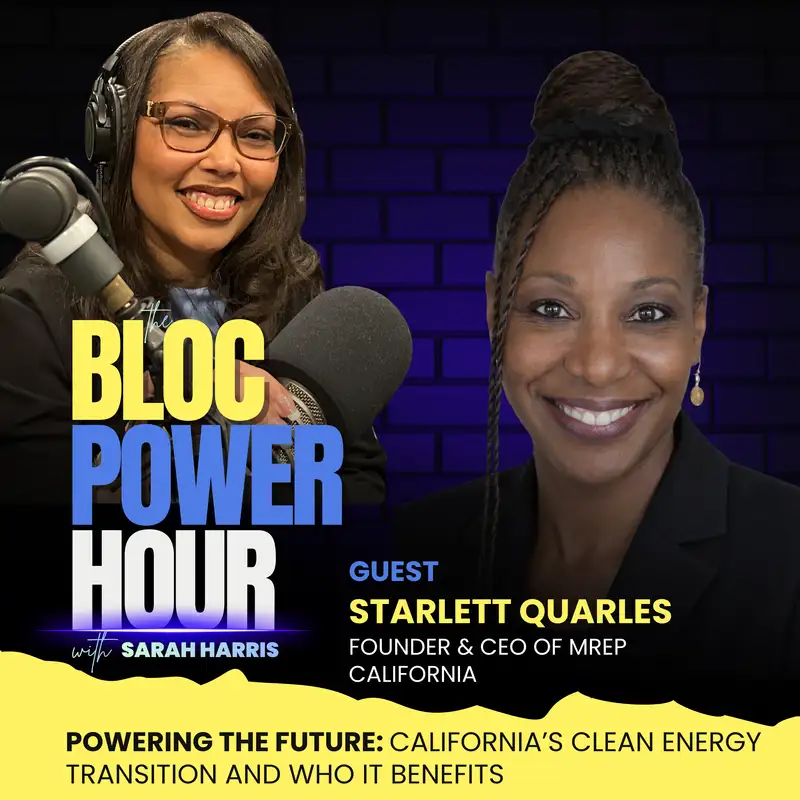
Powering the Future: California’s Clean Energy Transition and Who It Benefits
Download MP3Yeah. Sarah Harris. Turn the mic up. Turn the power up. Welcome to the block.
Speaker 1:Welcome
Speaker 2:to the block power hour with Sarah Harris. We are back with you again. We thank you for tuning in. I am Sarah Harris, your host, and this is the block power hour. We come to you by way of the participation of the Black Business Association, specifically our Elevate Media division of the Black Business Association.
Speaker 2:And we are bringing this programming to you to be able to elevate the voices in terms of business, culture, community, and the grind. And we are here with another great show. Part of our theme has been during March being women's history month. We have another amazing woman to bring to you as a guest, but also it is alluding to next month, which is related to Earth Day and environmental issues. So this is going to be an illuminating conversation and I'm looking forward to the discussion.
Speaker 2:If you are resonating with this show, you are digging what we are bringing to you. You can visit the block power hour online at block power hour, Tune in, find out our other shows, be able to download those and check them out on podcasts. Also check out the Black Business Association at bbala.org to be able to support us with a sponsorship or donation. Again, that's bbala.org. Now for today, again, I am super, super excited to introduce our guests.
Speaker 2:We have here in the studio. Hey. Ms. Starlet Quarles. Yes, yes, yes.
Speaker 2:She is founder and CEO of the minority renewable energy project of California. And she's going to break down California's transition to 100% clean energy and what it means for creating pathways into California's green economy. So welcome Starlet.
Speaker 3:Hello, hi Sarah. Thank you so much for having me.
Speaker 2:Wonderful, I'm so glad to have you in the studio. Before we get into the meat of what we're discussing today, I just want to kind of give people a little bit lay of the land of who we have sitting in the seat. Yes,
Speaker 3:yes, yes, I have to.
Speaker 2:Because you are the woman, you are the I actually am kind of feeling a little bit intimidated because because you have media marketing background in spades. And so, tell, tell people a little bit about your background in that respect of, of the kind of things that you've been up to.
Speaker 3:Hello everybody. Startup Quarles here. Past is from, working in the real estate development industry, with my dad, which is where we met. And you know me from the marketing space because when I started working with my father, I didn't know anything about the real estate development industry. So I started my marketing firm, UrbanX Marketing, probably back in 2010.
Speaker 3:And the reason for doing so was to be able to create pathways and to have events here in Los Angeles around real estate development and seeing black developers and creating pathways for young professionals to be able to transition to the development industry. So using, you know, my creative skills and outreach skills and networking skills, I was able to help shepherd in a generation into the urban planning landscape here in South Los Angeles. Just taking those skill sets and just transition right on over to the green economy girl.
Speaker 2:Oh, see, I too am a person that wears many hats. Yes, you do. And can multitask and do many things in that regard. So I'm not surprised in terms of you transitioning into the renewable energy space, but still staying with where your background in terms understanding the community and in the development space and seeing what is transpiring. What what are you feeling like when you see the new kinds of developments, especially when we talk about affordable housing and because what I see is a lot of boxes boxes shooting up and, you know, give me your assessment on
Speaker 3:what What is considered affordable housing in California?
Speaker 2:Well, that too.
Speaker 3:Right? It's very expensive and we don't have to skirt away from gentrification happening in our community. I don't have to tell you the black population were not as large as we used to be fifteen, twenty years ago, but I also say who's gentrifying who? Right? We're selling our communities out.
Speaker 3:We're not maintaining our family homes. We're not keeping our assets, and we're not passing down those conversations about succession planning when it comes to the asset. So when different cultures come into Black Los Angeles, then we're just selling out to them. So the change in landscape, some of it comes from our own doing, right, not really seeing the value in our assets in South Los Angeles and being able to, you know, I would say not necessarily sell out for the dollar, but yeah, you know, they'll come in, they'll pay, they'll ask more over asking, we'll sell for the dollar versus the culture. But then when you see that in other cultures, it's not that gentrification doesn't happen in other communities, it's a cyclical process, right?
Speaker 3:It's part of the real estate development landscape. There's always going to be some form of gentrification. It's just when you go to other communities, they just tend to replace that homeowner with someone that looks like them, where we just, you know, we're just not that committed or intentional when we do sell our homes, and there's nothing wrong with selling our homes, but that being intentional about who we're selling our homes to.
Speaker 2:Right, and so part of this conversation still equates even in discussion about succession planning and the development in terms of where are we in these spaces, development and new emerging technology and, you know, and how are we relating ourselves to the environment and what role do we all play in that? And so I just think that it's relevant across the board in terms of us being in tune with what's going on and how it affects us. But also too importantly, how can we have an opportunity, take opportunity in these spaces? So I thank you for giving us your perspective.
Speaker 3:Of course. And it's just my perspective y'all. It's just my thing. You know. But I'm very passionate about it because I don't see us in this space.
Speaker 3:And a lot of it comes from just a lack of education and a lack of misrepresentation on the opportunity and the benefits. This is an industry where you either make money or save money or both, right? So being able to be intentional and LA County and the city of Los Angeles, they both have sustainability plans that speak specifically to the racial disparities in this particular industry. And I'm talking about the state of California. People always talk about, well, what is Trump doing?
Speaker 3:Federal I'm not paying attention to what's happening on the federal level as much as I'm paying attention to what's happening in my own backyard. And since, I believe, 2016, there's a bill called SB 100. Like, that has been California's goal, is to go 100% renewable energy by 2045. So this train has been moving for quite some time. Oh, yeah.
Speaker 3:And I just think it's now our time to be able to pay attention, one, and to be able to find our lane. I practice what I preach, right? So I'm transitioning my own personal skills from marketing and from real estate development into a new economy. Right. Right?
Speaker 3:This is a new economy, supply and demand, and it's only not just in Southern California, it's all of California.
Speaker 2:So now you're touching on that. So what was the emphasis of you going from the development, marketing and all of that into this space now? What hit you that made you want to transition open to the renewable energy space?
Speaker 3:Well, speaking of marketing, I had a young solar developer reach out to me, a little bit before COVID, and he wanted me to help him with his marketing for his residential solar company. As I was sitting there talking to him, I was thinking about, you know, because I pay the bills, my mom was incapacitated at the time, so I was taking care of a lot of house bills for my father, and I just recognized how high our energy bill was. And so I talked to my dad about getting solar panels on the house and ended up connecting him to this young gentleman. And then as we started using our panels, I had a car accident, right? During quarantine, somebody hit my car and I wanted to get a new car.
Speaker 3:So I'm like, you know, I'm tired of these gas guzzlers. So I invested in an electric car.
Speaker 2:Electric car.
Speaker 3:So I got an electric car. I didn't get a Tesla. I got an Audi and I just loved the experience until I experienced range anxiety for the first time. So if you know anything about range anxiety, I tell people all the time it's worse than a hot flash, you know, because you are sweating to try to get to a charger. And I just recognize that there weren't enough in my community.
Speaker 3:Like I'm seeing these EVs, you know, all throughout South Los Angeles and Southern California, but they weren't in my community. So I told my father, we need to get into this space. And so at that time we started Bedford Energy Solar and we partnered with this young gentleman and we did what's called a microgrid. So we created a custom solar system for a manufacturing. It was 1.5 kilowatts or something like that, but it was a scatter sites.
Speaker 3:It was a manufacturing company and they wanted to be able to not only save money, but they were having some productivity issues every time there was a power outage. So they were losing money, losing money, losing staff time. So that's where I really started to see the opportunity. More specifically in the EV space, I'm very passionate about just the opportunities in the EV space.
Speaker 2:I
Speaker 3:just was experiencing as a consumer. There weren't enough chargers. There were only 10 fast chargers at the Fox Hills Mall. I still call it Fox Hills. Fox Hills Westfield, but it's Fox Hills to me.
Speaker 3:And there just weren't enough chargers. The line was long because I live in Inglewood. Was trying to find some chargers that were local to me. There was another brand that only had four chargers, but I just, you know, where I saw the void, I also saw the opportunity. And then I just recognized just as I started matriculating into this industry and going to events where there's a plethora of just community organizations that are in the workforce side or the development side, we weren't there.
Speaker 2:Well, we've got your back story, right, on what the impetus of all of this is for. Right? So what we're gonna go into is gonna dive deeper on it. Okay. On the other side, come back for the Block Power Hour with Sarah Harris and our guest, Starlette Corals.
Speaker 4:This is the Block Power
Speaker 1:Hour.
Speaker 3:Hour.
Speaker 2:Yes. This Yes. This is is the the block Black power hour. I'm your host, Sarah Harris, and we're back with our guests, Ms. Starlet Quarles.
Speaker 2:She is founder and CEO of the minority renewable energy project of California. And this show is about Powering the Future California's Clean Energy Transition and Who It Benefits. Okay? So we're gonna get into this discussion. But first, I want to say that if you are following us, make sure that you are checking in timely at Block Power Hour or the BBA at Black Business Association online and stay in touch with us.
Speaker 2:And we thank our sponsor of US Bank for making this show possible. So Starlet. Yes. Alright. Let's kinda set the stage.
Speaker 2:Okay. Alright. So in terms of what's really happening in clean energy, it is that the goal 100% clean energy, in California by 2045
Speaker 3:and '35 in LA
Speaker 2:LA County. So what does 100% clean energy mean?
Speaker 3:That's an excellent question. And I think that's part of the challenge when it comes to the black community specifically, it's how it's being taught to us. So for me, I say, how do you not get in an industry where you're monetizing God's energy? Right? The sun has been coming up every single day since the beginning of time.
Speaker 3:So when you talk about renewable energy, the sun, that energy renews in the morning. So during a power outage, who do you wanna power your house? God or Southern California Edison? Okay. Right?
Speaker 3:Because your house is definitely gonna keep that power going. Right. Just like his love, eternally. Mhmm. So I think for us to be able to better understand how solar energy works, the benefits of it.
Speaker 3:I mean, have a cousin, for instance, who lives in Menifee, and here in the state of California, is a title 24 part six, which states that all new construction and ADUs have to have solar panels on their homes. So she moved into a new community, and it was a new development. She had to get solar panels. What they didn't educate her on was the benefit of the backup battery. So when the Altadena fires happened because she was on Southern California Edison's grid, they turned off her power for four days, unbeknownst to her about the backup battery because that's where the miseducation has been.
Speaker 3:Right? When you get the solar panels, you gotta store God's energy at night. Right? You got to get off the grid at night and we have to be able to educate ourselves on becoming our own independent power source. So because she wasn't educated on the back of battery, yes, she lost $700 worth of groceries and she didn't have any power for four days.
Speaker 3:So I think the miseducation when it comes to us is the, not only the benefit of solar, but the benefit of having the backup battery and how you save money. So during the day, of course, you're going to be using the grid, but at a certain hour when power costs most, you're gonna use your battery to be able to power your house or to power your car, specifically if you have an EV. So I think when it comes to the renewable energy, clean energy, green energy, whatever you wanna say, I say God's energy. God's energy. It just makes it makes sense to me when it comes to that particular industry.
Speaker 3:This is the last time I'd say that, you know, minority communities, black people specifically, are going to have the ground floor on a new economy because the train is leaving. Right? This is gonna happen with or without us. In our
Speaker 2:We've been saying the train is leaving for a while now.
Speaker 3:For a while.
Speaker 2:So the train is really
Speaker 3:The train has gone.
Speaker 2:Gone, and it's it's in motion.
Speaker 3:But the train but now it's impacting our utility. Now it's impacting our quality of life. Mhmm. Ask the people in Altadena. Ask the people in Palisades.
Speaker 3:Global warming is real. Right now, it's like, what, 80 degrees, and it's supposed to be spring. First of all,
Speaker 2:I'm sorry. Let me stop right here because the shift in weather has just been freaking me out. Correct. It's freezing cold one moment and then it's hot as h e, double l, l. Absolutely.
Speaker 2:And I and, you know, we talk about, just not really making it real about global warming and the effects of things. But if you feel one way or another, I know when you see your bill. Absolutely. Because either you're turning on the heat or you're turning on the air conditioning and that bill is no joke.
Speaker 3:That bill is no joke and people don't realize as much as we're using AI, as much as we're using chat GPT, all that is pulling on the grid. So if it gets hotter, yes, we're going to turn on our AC more, we're going to leave it on for longer and with all these people on the grid, it's going to break. It can only take so much. So why not be able to use your solar energy to be able to power your home, to be able to save money and to be able to live, you know, more sustainably, right? Because when you're talking about putting these solar panels and these backup batteries on your asset, instead of saying, I'm gonna say your asset, then it provides value for your kids' kids.
Speaker 3:We have to think intergenerationally when it comes to our homes. That's where our wealth starts. Mhmm. Right? As soon as, you know, slavery was over, what did they give us?
Speaker 3:They gave us real estate or what are they supposed to promise us? 40 acres and a mule. So we need to be able to, you know, teach that that's where our wealth lies. Our wealth lies and our legacies lie in our home. So why not protect it?
Speaker 3:Why not keep it sustainable for generations to come?
Speaker 2:And so what does that look like for utilities? I figure that they're making the transition along with it too, but what does that mean?
Speaker 3:For the utility companies? I think some of these utility companies, like for instance, someone was telling me about a lot of these data centers. A lot of these data centers are taking up a lot of energy. And so it's not that you're not gonna not be on the grid and it's not that these utility companies aren't going to be able to make money off of your power usage. It's just that you're not giving them all your power.
Speaker 3:And there have been programs where you can sell your power back to the grid, right? This net metering. The power that you're saving in your backup battery at night, you choose not to use it, then you can sell it back to the grid. But if you don't have your battery, right, then it's more expensive at night. So you're, you're in, even if you have solar panels.
Speaker 3:So we have to be able to educate the community on just the benefits of incorporating solar on our homes, as well as the utility and the benefit of the backup battery. Now, when it comes to careers, I mean, I don't know if you want to transition to that part of the conversation when it comes to economy, because it's not just a monolith, right? I mean, I'm talking to homeowners, but there's also opportunities just on the career side, from the trades to small businesses, to the C suite. You have a lot of these executives that are losing their jobs in the oil refineries, but you still have skills. How do you transition those skills into a new economy?
Speaker 3:There's a lane for everybody and this industry is wide open, right? For instance, we were talking about range anxiety in my car because you know when your car goes on zero in the EV, right, you're getting towed.
Speaker 2:Yes, I mean just being on E period with having gas and you can't find a gas.
Speaker 3:But you know how to push your tank on gas. On zero, I know how to push my tank, right? When my car starts bleeping at 30 miles and I never paid attention to my miles on gas, right? And so I say that I would say, you know, there's going to be someone or there's going to be, you know, an inventor who's going to be able to create something that I'm going to be able to put on my roof or they're going to be building these cars where something is on your roof is charging from the sun. You know how we can charge our phones, right?
Speaker 3:In our cars now, we won't be able to do that. So, but it hasn't been invented yet. Or the AAA of EVs. If you do lose a charge, I'm sure these are businesses that are emerging, right? But those are going to be the businesses of the future, right?
Speaker 2:So let's talk about the real opportunity, right? I know two young ladies who they started a company called Charger Health.
Speaker 3:And
Speaker 2:what I love about the way that they did it was not only just a company that is about maintaining, fixing charging stations, but what they did is one of the partners has a well versed background in workforce development and they actually implemented workforce development program in their company so that they can then train and hire the workers that would service the EV chargers or whatnot. So it was like two things in one, it kind of be, but it was like those are kinds of examples in this kind of new economy that you can there's all kinds of things that you can do. So kind of like give us your perspective on the real opportunities that
Speaker 3:are available. I don't know all of them. I know that they are aplenty, but I'll speak specifically to solar and EVs. I'm involved in this organization called Lacey Los Angeles Clean Tech Incubator and it is a nonprofit of the DWP And we're on this green regional partnership, right, this regional partnership to have 7,000 EV jobs by 2028. The problem is there aren't enough adoption, right?
Speaker 3:People don't have enough EVs. You're training these youth at TradeTech, for instance, on EV technology, and, you know, they have these certificates, but where are the jobs? So for me, it's all about being able to create this ecosystem in the black community. I call it my urban sustainability model.
Speaker 1:Mhmm.
Speaker 3:There's a process that we have to go through to full adoption because if we become full adopters of a green lifestyle, whether it's in our homes, whether it's our cars, whether it's in our ability to make our affordable housing projects or multifamily developments more energy efficient, we become the job providers. So if a pastor and I'm doing some work with churches because our churches are cash poor asset rich, A lot these churches are strategically located near major thoroughfares, but their parking lots aren't used six days out of the week. And if it is used on Sunday, it's not every single day. And a lot of our churches, you know, have a dying population. They have senior citizens mostly that are on fixed income.
Speaker 3:So this is another opportunity for churches to be able to get into another business model of putting EV chargers on their lot. A lot of churches back in the eighties were able to become affordable housing developers through their CDC, but why not repurpose your asset? Why not repurpose the church to be able to showcase what it's like to be a sustainable consumer?
Speaker 2:Not just like having solar panels or what have you on the church, right? But also utilize the parking lot with the EV chargers.
Speaker 3:Of course, when you leave SoFi, when you're leaving Downtown Inglewood, you pass right by Faithful Central, right? And some people, you are an EV consumer, sometimes you just want to get a charge to get over the hill. You may not live near, you may not be going to that particular mall, but you need a charge just to get over the hill or get to your destination to be able to either charge at your home. So a lot of these, and I'm not going to say just churches, but a lot of faith based institutions have these lots that can be used.
Speaker 2:Well, okay. This conversation is going so great, but we have to break. This is the Block Power Hour with Sarah Harris and we will be right back. To the block power hour. This is Sarah Harris, your host.
Speaker 2:Thank you for continuing to tune in. You are resonating with what we are discussing and talking about in the block power hour, we invite you to continue to support and to look us up at the black business association, bbala.org to donate or be a sponsor. Again, that's bbala.org. We are here with our guests, Ms. Starlet Quarles.
Speaker 2:She is founder and CEO of the Minority Renewable Energy Project of California. Welcome back, Starlette.
Speaker 3:Thank you. Thank you. So why don't we go ahead and you tell us why you started MRAP? I started the Minority Renewable Energy Project to address this racial disparity in California, but starting in my own backyard of Los Angeles County because I recognized that we weren't in these spaces. Not only were we not in these spaces in terms of the trades, but even from the real estate development industry, right, not understanding about title 24 part six and the need to be able to incorporate solar and renewable energy infrastructure into our development projects.
Speaker 3:But then I just also, just from just the community standpoint, recognize that there just wasn't there was a miseducation, and there wasn't an ecosystem in place in order for us to be able to really fully understand what renewable energy means, what clean energy means. So our urban sustainability model is a four part ecosystem. It starts off with education awareness. Right? You have to be able to have these type of conversations that we're having where I can break down, instead of saying clean energy or renewable energy, be able to talk to a group of minorities and say God's energy.
Speaker 3:Right? That makes more sense when I'm talking about the sun and using God's energy. So just making people aware, one of what's happening here in the state of California specifically, what it means to live by renewable energy, the benefits. So you have to make people aware. And then you gotta give them access.
Speaker 3:I mean, is LA, you know, this is a who you know town. But there are so many programs, there's organizations, there are civic departments all about sustainability. We have to be able to connect the homeowners, you know, youth who want to find jobs, like going to, you know, Charger Help, and I'm familiar with the great work that Charger Help does about these careers, right? So I have a summit, I'm sure we're going be talking about, where providing people access, just connecting the dots to the organizations that are doing the work and connecting them to a demographic of people that they have not traditionally been intentional about connecting to, especially on the South LA Side and more so on the Western Side, right? So some of these kids, they don't want to go to college, they but can come straight out of high school, and they can go over to grid alternatives, learn how to implement solar.
Speaker 3:Matter of fact, it's pay training, and they're training formerly incarcerated. They're training high school students on the trades. I grew up with the trades. Right? I grew up with the trades in high school, but this generation, they want to be either influencers or, you know, they want to make money, right?
Speaker 3:But they can, you know.
Speaker 2:What's the quickest way to get that?
Speaker 3:They can easily get into a new emerging economy and making 6 figures in a couple years, being a lineman, working with Southern California Edison, like we grew up with these opportunities where the trades become the small businesses of the next generation. So we have to do the whole state of California. There is enough for everybody. For instance, with these EVs, and I'm sure one of the reasons why, you know, Charter Help is so popular in such an emerging economy is because with the EV chargers as a consumer, when one of those chargers are down, right, all I'm doing is calling someone who's rebooting it. So the majority of this in terms of EV careers and EV infrastructure is software, and these kids know these phones better than we do.
Speaker 3:So that is a job of the future. So once you give them access to the opportunities or access to the programs and the benefits as a homeowner, then the third phase is application. Once you're actually experiencing the savings from your solar panels, once you're actually seeing that you're not paying as much money in gas because you have an EV charger at home and you're charging your own car, once you can actually apply it and see the benefit from it, then it's easy to go into adoption. Then it's easy to make it a lifestyle. It's easy to be able to incorporate it.
Speaker 3:So we have to take black people specifically through this ecosystem of awareness, access, application, and then adoption, then we can fight for laws. Then we can be more aware of the laws that are impacting us in terms of equity in this particular industry.
Speaker 2:So when applying the awareness, access, application and adoption to help make this transition, do you feel that it's still maybe a misconception or part of the barrier in terms of affordability for being able to get, I'm just speaking like a homeowner or something, being able to get the solar in the home or to be able to make that transition to that?
Speaker 3:No, I mean, there's all kinds of programs, there's small business entrepreneurs, there are larger companies that have come and have, I would say, taken advantage of, and I'll say that loosely, of senior citizens. There was a time when they were pushing all the incentives and all the rebates and all the benefits and yes, at a federal level, some of those things are going to go away, but are you going to care that you didn't get an incentive or a rebate when your power is out for a whole entire week? That's a one time payment, you know? So when you start talking about the benefits and the utility of it and the quality of life, and truth be told from an entrepreneur standpoint, who's moving into our urban communities? EV car consumers, they may not look like us, but they are driving EVs.
Speaker 2:They are driving EVs.
Speaker 3:And they're going to make sure that they're going to be able to charge their car on somebody's lot. And so I'm trying to educate us as, you know, this is where the opportunity
Speaker 2:What I'm hearing is the bottom line is education, right? Correct, education access, Wherever that's right, is basically the first level of and the biggest part of it because once you have the awareness and people really get and kind of understand this and then they start going through the rest of the process of the access and the application and everything, then it's already in motion.
Speaker 3:Correct.
Speaker 2:So we have to have a big megaphone, right, to continue to raise, this issue and make people aware of what it is. So tell me more in terms because also too, we're going to be talking about you're having an event coming up in April. What's the date of that?
Speaker 3:Saturday, April 18. It is the Urban Renewable Energy Summit. It's going be held in Inglewood. This is our second annual at Hollywood Park.
Speaker 2:Yay, Hollywood Park. Okay. So we'll get a little bit more into what is going to be happening on April 18, but tell us also too, in terms of the ecosystem of clean energy services and how does that work? For us, we want to be
Speaker 3:able to provide support in all of our phases of our urban sustainability model. So on the education side, we're looking to go into churches or into homes and just have these conversations that we're having right now, right, to be able to talk to congregations because a lot of the homeowners are still senior citizens, right, that own their home and we want to be able to educate because it's more than just recycling. What I don't want white people to think that the green economy is recycling. We've been doing that forever, right? Now we need to recycle God's energy.
Speaker 3:So really, so that's part of our service, you know, going out and educating the community and on the access, yes, our summit is one of our services where we are providing access to all the resources through our expo and through the conversations that we're having at the summit. An application, I'm going to be doing a pilot project with a church, right? To be able to actually apply, so we have a sustainable development arm that we're building in order to be able, and not just churches, property owners, right? So when I'm talking to my peers who are real estate investors and, you know, when I was encouraging them to be a multifamily developer and providing access to, you know, that particular industry, now I'm saying, Hey, go get a parking lot. Go get a parking lot and put 10 EV chargers.
Speaker 2:Talk that out though. When you, when you say put the EV chargers on the church's parking lot, what does that look like? Because I know a lot of them, they have gates up and everything. So what does that kind of look like and how that would operate?
Speaker 3:Well, you're speaking to the opportunity and also the challenge, right? So the challenge is convincing the church to do it because no one's done it. And in pulling together, I have a panel, I know we're gonna talk about the summit, and I'm having a panel on faith based institutions and incorporating this type of business model. You know how hard it is for me to find somebody in LA County, a church that's actually done it, right? I have a church that's going through the process, but it really is, it's like, if you see it, you can be it, right?
Speaker 3:So I'm sitting here, can talk to you till I'm blue in the face about the value of your asset and the types of potential money you can make and the ecosystem that you can create congregations of, you know, solar adopters.
Speaker 2:What is it? It's just that
Speaker 3:they just, know, no one has done it. You know, a lot of, you know, I've talked to some of these pastors and if they don't have an EV, if they don't have solar, right, they can't speak to what they don't know, right? If they're benefiting from it, then they can really argue for it, but it's just, you know, the fear has changed.
Speaker 2:Fears change, yes. It amazes me in terms of when we see change, when we see emerging technology industries or whatever, how can we be slow to act on it? How can Borders, Books
Speaker 3:or
Speaker 2:whatever, really Blockbuster is the one, right? How can it not see Netflix coming? Correct. I was watching this documentary, or it's a biopic or whatever, but it was related to BlackBerry and it was how it started and they were all on their keyboard and people loving the feel and the click of it or whatever and then lo and behold, what came along is the iPhone. Correct.
Speaker 2:And they got rid of the keyboard. And so they're sitting there still, you know, touting that and everything, but but, you know, Blackberry is no more anymore.
Speaker 3:Here's what I what I don't wanna say what I don't want to happen, which will eventually happen. Mhmm. Right? For instance, with solar and being trained in solar, right now, it's easy to get into. Right?
Speaker 3:There's easy you can go to TradeTech. You can go to Charger Help. You can get that skill set, you can build up your, you know, resume in terms of your experience. What I don't want to happen is five years from now and they tell me, or they tell the industry, you have to have a bachelor's to become a solar engineer, you have to be an electrician. And that's when the barriers start.
Speaker 3:Are there educational barriers?
Speaker 2:Because right now the trend is apprenticeship and like you said, the skill trades. So we want to still be able to
Speaker 3:And we want to be able to get in it while it's emerging before all the economic and the educational barriers prevent us from having access to it. So it's really about exposing, it's really about, you know, you can see this from three different lenses. You can see it as an entrepreneur, you can see it as a homeowner, or you can see it from a career pathway. It's wide open for us to be able to get in and find our lane.
Speaker 2:All right, so another segment is coming to an end.
Speaker 3:Oh my gosh. That was so quick.
Speaker 2:But no. But on the other side, we're gonna start digging into the summit.
Speaker 3:We'll get to
Speaker 2:learn more about what's going on April 18. This is the block power hour. I'm your host, Sarah Harris, and we'll be right back.
Speaker 4:This is the block power hour Hour.
Speaker 2:Welcome back. This is the block power hour. I'm your host, Sarah Harris, and our guest today is Ms. Starlette Quarles. She is founder and CEO of the minority renewable energy Project of California.
Speaker 2:And we're talking about Powering the Future California's Clean Energy Transition and who it benefits, right? And so now we're gonna get into how you, you listening, yes, you listening, how you can participate. On April 18 coming up is Starlette's Summit.
Speaker 3:I'm going
Speaker 2:to let her talk to you a bit more about what is happening on April 18.
Speaker 3:Thank you. Yes. It's our second annual urban renewable energy summit happening on Saturday, April 18 at Hollywood Park from 10AM to 3PM. Our first one was held at a organization called Alta C, which is in San Pedro, and that emphasis was to be able to not only congregate minorities in the space, but to be able to introduce aquaculture, right, the blue economy, because there's renewable in water. Right?
Speaker 3:Again, water, we're going back to God's elements. So, this is our second annual. We want to bring it, you know, closer to home to be able to access more, communities of color. So we're hosting it at one of the most sustainable venues in Inglewood, which is Hollowwood Park, and it consists of three panel discussions and an expo of small businesses and organizations that are in this space, whether they're electricians, we have some general contractors, we have DWP, some of these organizations that are career pathways, charger help, smarter help is going to be there.
Speaker 2:Wonderful.
Speaker 3:And so our three panel discussions, the first one is on, rebuilding Altadena for a sustainable future. And like I mentioned before, title 24 part six, you have to build new homes sustainably. So who is that workforce? When you're talking about workforce, and this is an example of homeowners becoming the job providers. If we fully adopt this particular lifestyle, then we're creating jobs.
Speaker 3:So we're having a conversation about how they're gonna be rebuilding Altadena sustainably. And the second panel is on faith based and churches and having those conversations that I alluded to about repurposing their asset. Right? And what does that look like? And the challenges of working with pastors and working with Mhmm.
Speaker 3:You know, faith based institutions to really get them to adopt and understand the value in their asset and talk about how to finance these things. And then lastly, EV careers, where we're going to be partnering with them or having conversations around, EV careers and EV infrastructures. Some of these charger jobs or EV jobs or EV infrastructure opportunities do require that you are an electrician, especially if they're level threes. So we want to be able to talk about all the different ways in which youth and, you know, entrepreneurs, electricians, transitioning professionals can get into the EV space.
Speaker 2:Wonderful. And so if someone was attending, what is the kind of takeaways for them? Are their job, career kind of a fair thing
Speaker 3:or is Not necessarily career fairs. There'll there? There'll be be representatives representatives. It is a free community event. You can RSVP at uresummit.eventbright.com.
Speaker 3:That's uresummit.eventbright.com, or you can visit our website. We have links on there. M rep, mrepca.org. So the takeaways for me is our sustainability model. Right?
Speaker 3:You're coming to get access. You're coming to get awareness, and hopefully you you see one of our solar vendors and say, hey. I wanna put that on my home, or one of our financing institutions that are going to be there. How do I finance putting these solar panels on my home? Or how do I get an EV charger?
Speaker 4:I have an EV. How do I get
Speaker 3:a charger at my house? So wherever your needs are, we're trying to meet all those pain points, right? In terms of just the plethora and the, you know, diversity of the opportunities in this space for everybody, for small businesses, for developers, for, know, young professionals trying to look for new career opportunities. I'm even telling youth now, like, you want to go to college, I'm a UCLA grad, I'm not even using the degree. A lot of our peers, we went to college because our parents told us to, right?
Speaker 3:And two, three, you know, decades later, we're doing something completely different.
Speaker 2:Exactly.
Speaker 3:But now I'm saying, hey, if you wanna go to college, you know, major in environmental justice, you wanna go to law school, do sustainable development, do urban planning, you know, with the sustainable emphasis. Like, these are the careers that we need to be looking at how to transition. I was looking at this website. There's this summit that's happening. It's been going on for years across the country.
Speaker 3:Mhmm. And I'm looking at their speakers, and they have major, corporations, and the representatives of the Coca Cola and the Toyota are their chief sustainability officer. Mhmm. These are gonna be the c suite jobs. How do you become a chief sustainability officer of a Netflix?
Speaker 3:Right?
Speaker 2:Right.
Speaker 3:Of a, you know, Walgreens or whatever? Because these companies know the cost to them when they're off the grid in terms of productivities, in terms of product loss. So a lot of these, you know, major corporations are quietly, whether they are MAGA or not or whether they, you know, see what's happening on the federal level when it comes to the rebates or any of those type of incentives, this is really not about the incentive as much as it is the utility in terms of their business and their bottom line and being able to keep the power on for their business when there is an outage.
Speaker 2:So there is a projection that you're working on. Can you kind of tell us what two or three years out looks like for you?
Speaker 3:Well, what I hope for two, three years out is that we've made impact. We've made movement. We've seen adoption. We see more urban youth transitioning.
Speaker 2:Definitely have some churches on board.
Speaker 3:Definitely have some churches on board. Right? Definitely, you know, being able to showcase, you know, some properties, whether it's multifamily developments where we've done some energy efficient upgrades, or whether we put in EV chargers, or are working with churches to be able to create a workforce development program for their youth in their congregation. So we're looking to just have an impact across not only just Southern California, but whatever we do here, can always take to Northern California. And it's enough for everybody, right?
Speaker 3:It's enough for everybody in terms of the whole state of California to be able to transition in some capacity, whether it's, you know, in your home or in your business or in your career into this new sustainable lifestyle.
Speaker 2:And so for business owners as well, right?
Speaker 3:Oh, absolutely. If you own your asset, if you own your commercial building and you're paying high utility bills, like, you know, going back to when I told my dad to get solar panels. I mean, it cut our bill in half, and there were even some months where we didn't even have an electricity bill. Mhmm. And our bill, because of the size of the house, is like $1,500 a month.
Speaker 3:Wow. So you can imagine having a zero Mhmm. Utility bill at home where you're used to paying $1,513,100 dollars a month. So once people start really seeing the savings and how it's impacting and helping them in their lives, then, yeah, you know, it's kind of like the telephone game. You're start telling everybody, And who tells, you know, who has more impact than pastors?
Speaker 3:So if these pastors are really talking about environmental stewardship and they're really mentioning that in their sermons and they're, you know, being examples of environmental stewardship by putting solar panels on the church to sustain the asset in the community, you know, then the congregants, right, can be able to see it and then now we're And telling
Speaker 2:they respond to that.
Speaker 3:And then they respond and then now, you know, you're seeing your neighbor across the street who has, you know, the power out because they didn't get solar panels, but you and your family, y'all still watching Netflix. Y'all still got groceries. Right? They wanna come over your house and get some heat. You know I'm saying?
Speaker 3:So it's just like, once you see it, then you can be it. But really, once you're experiencing either making money or saving money in this industry, then it will be easier for you to be able to tell your kids and your kids' kids, you know, about and it's healthier.
Speaker 2:Mhmm.
Speaker 3:Right? You talk about zero emissions, living off of a we don't get enough vitamin D. Right? We need to create more pedestrian friendly, you know, communities. Right.
Speaker 3:And you know, walkable communities. And this is a way for us to be able to live a healthier, more sustainable life off of God's energy.
Speaker 2:Awesome. So for you, I imagine that even with that, because we were talking about recycling a moment ago, you are someone who has a separate receptacle for your plastics and one for your trash?
Speaker 3:I don't. You don't? But I do recycle. Know, there was, you know, to be perfectly honest, there was a young gentleman who used to be, you I would see him in our trash cans, taking out plastic. So I would start saving up because I didn't feel like going to the recycling bin.
Speaker 3:And I would save them up and give them to him, right, for him to be able to go and use. But in terms of just full adoption, you know, no. You know? But as I evolve and even as I become a homeowner, I definitely want to be able to have solar panels on my I love the EV car as much as I have range anxiety. I've conditioned myself when to charge my car.
Speaker 3:I love my EV.
Speaker 2:But now do you have a map of, or knowledge of where to go or whatever? Locally, yes. You're more familiar and aware of your surroundings, right?
Speaker 3:Oh, of course. And my miles.
Speaker 2:And your
Speaker 3:miles. Absolutely. And if I'm going to San Diego or if I'm going to Vegas, right, I'm going to Google where the near, I'm going to map out my trip. This is just like when you go to Vegas from here, from LA, we're going to stop in Barstow to get some gas, right?
Speaker 2:So there definitely isn't a one trip kind of car from LA to Las Vegas?
Speaker 3:There is. Some of just my particular car.
Speaker 2:Oh, okay.
Speaker 3:Right? In terms of the mileage. But some of these Teslas, yeah, go 400 miles on a full charge, you know, and back in the day, can get a full charge, and I think it was like $30 How much is gas right now? Right, to be, and if you're doing it at home, I mean, you're saving more money on gas if you're charging your own car, you know, at home. But again, it speaks to the opportunity.
Speaker 3:I also recognize that there are not enough chargers in my community and I have to go outside of my community. If I go to the beach cities, if I'm going to Santa Monica, I'm going to Redondo Beach, they are chargers aplenty. Because I don't have a Tesla, I can't use a Tesla charger. So they're, you know, the commercial chargers, but I see them more in different communities, right? Again, a different form of economic leakage, right?
Speaker 3:Our dollars not recycling in our communities. Economic
Speaker 2:leakage, okay. Love that.
Speaker 3:Love that. I'm using that economic Economic leakage, the dollar does not recycle in the black community for longer than hour. We go outside of our community for our amenities, for our fine dining, for a lot of our experiences and we're seeing that What BV
Speaker 2:an amazing conversation today. We are, you got to the close of it. I cannot believe this, Thank you so much.
Speaker 3:Thank you so much for having me. Oh, I appreciate it's been
Speaker 2:a pleasure. So this is the Block Power Hour. You can find us at Block Power Hour. Look up for episodes or check us out at bbala.org. We love for your support.
Speaker 2:We love for you to donate again. Bbala.org. This is Sarah Harris. I am your host, and we welcome you back again for the block power hour. Thank you so much.
Speaker 2:We
Speaker 1:talk business, culture, vision, and grind opportunities align when the community shines. Dreams get bigger when the people connect. Moving with the purpose and demanding respect. Innovation in our blood. Breakthrough when I stride.
Speaker 1:Win the message never dimming our pride.