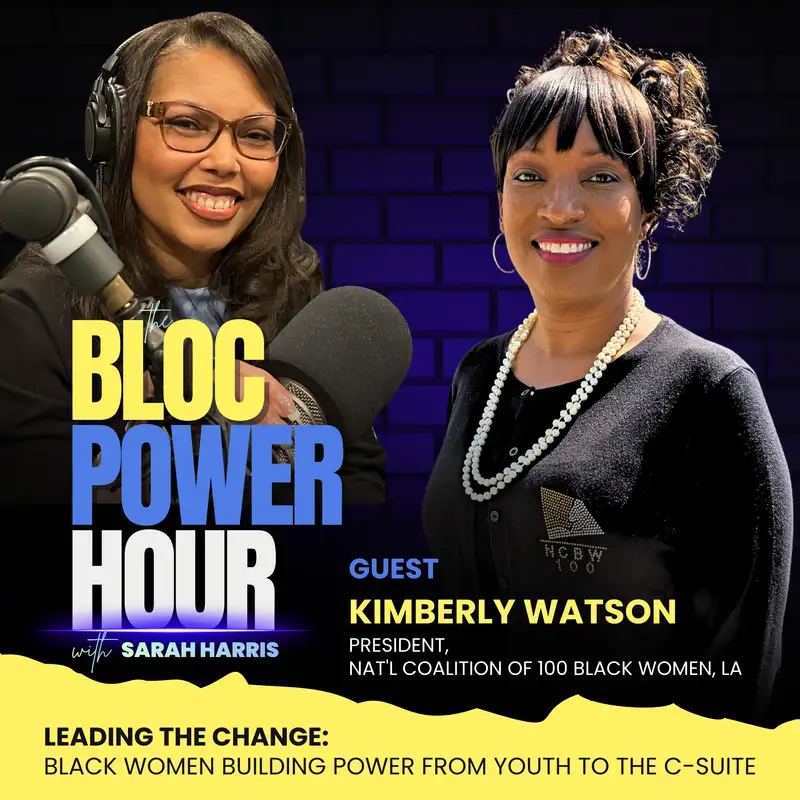
Leading the Change: Black Women Building Power from Youth to the C-Suite
Download MP3Yeah. Sarah Harris.
Speaker 2:Turn the mic up. Turn the power up. Welcome to the block.
Speaker 1:Welcome, everyone. This is the block power hour, and I'm Sarah Harris. Thank you for tuning in again for another show. We continue to celebrate Women's History Month, and today, I have such a dynamic person, a special person, and cannot wait to introduce her. But as we celebrate Women's History Month, we are focusing on what sustainable leadership looks like, not just titles, not just representation, but impact across generations.
Speaker 1:Because leadership is not only about who sits at the table, but about who shapes it, the policies behind it. And so with the Block Power Hour, you know that we are about economic mobility and culture and vision and grind. And we think that you enjoy our conversations. Right? And we want you to continue to follow us.
Speaker 1:So check us out at block power hour on Instagram or follow the Black Business Association, which this show is presented by. And we thank you for continuing to join us. So for tonight, we're talking about building pipelines from young girls discovering their voices to executive leaders shaping the workplace culture and equity across industry. And joining me is a woman who understands both sides of that equation, miss Kimberly Watson, president of the National Coalition of one hundred Black Women Los Angeles Chapter, and she is the Interim Director of Community and Continuing Education at El Camino College. Welcome.
Speaker 2:Hello, hello. Thank you for having me.
Speaker 1:It is such a joy to have you here today. We've been talking about this for a minute and part of that is I'm also a member of the National Coalition of one hundred Black Women. So this is my coalition sister here and she is leading the organization that advocate on behalf of black women and girls. And so I will let her talk a little bit more about that, but how do you feel today, miss madam president?
Speaker 2:I feel really great. You know, we are entering spring and March is my birthday month, so this time of year is always my favorite.
Speaker 1:Indeed. Indeed. My son's birthday is during this month too, so I love March as well in addition to it being Women's History Month. So let's get into a little bit about people learning about you. So before we talk about the titles and roles in this season professionally and personally, what does it feel like for you?
Speaker 2:You know, this season is really amazing. There are a lot of things going on, a lot of, new things that are happening. We are celebrating our fortieth anniversary this year. So the coalition was founded in 1986. So we're really excited about what's coming on the horizon.
Speaker 2:And then just personally, you know, my baby is having a baby. You know, I got a lot
Speaker 1:of new stuff going on. Isn't that nice? So with that, tell us about your personal journey within your career and then joining up with the coalition.
Speaker 2:So just for me personally, journey through leadership started at a young age. You know, my grandmother was my first influence in terms of leadership. And when I was in elementary school, she was the office manager. Mhmm. And so the office manager at an elementary school is like the COO of any other corporation.
Speaker 2:You know? Everything goes through her, the decisions, all the questions, everything and anything she had a hand in. And so I watched that for years, and I watched how she interacted with people. I watched how they interacted with her, and I just knew that when I grow up, that's what I want. You know?
Speaker 2:There was never a profession. You know how people ask you, what do you wanna be when you grow up? I always said, I wanna be in charge, and I knew that I wanted to be in charge. I knew that I wanted to be the one that you came to with the questions that you came to to figure out the difficult things because I saw that in her and I saw her really manage people, manage processes. And so I said, you know, it's really not just about understanding, you know, how to tell people what to do, but how to lead and guide.
Speaker 2:It was really about establishing culture, about setting the trajectory and understanding that you have to really be able to manage people in the process. So that was my first introduction to leadership and what it meant.
Speaker 1:Most of us, you know, we we, most of us have those strong, especially grandmothers, right? But those women who, take us and make sure we're in church, right? And not just church, but Sunday school and during the week, know, BTU and all of that And good so you cannot underestimate or undervalue the contributions and the work that strong women have in our roles, right?
Speaker 2:They are amazing when you have that and for a lot of us, we have it in our families, which is a wonderful thing, but when you have it in your social circle, when you have it in your friend group, that makes it even more special because it's that family that you choose. And when you can see leadership, when they can build you up, develop you, when you can see what it looks like in real time, you know, you have those women who help you to adjust that crown, those women that you can pour into. So it's always amazing to have really strong women, whether they're family members or friends or just associates that you know you can look to.
Speaker 1:And so that leads us to the coalition, right? For me, I never was a part of a sorority and I felt as though I found that through the coalition with this wonderful sisterhood. So tell us about when you joined and what that was like.
Speaker 2:I have been a member of the National Coalition one hundred Black Women Los Angeles for eleven years. Mhmm. And when I first I've actually, I lived in the Bay Area for thirty thirteen years and I heard about the coalition there. Mhmm. And so when I moved to LA, was that one of the things that was on my to do list.
Speaker 2:I need to connect to more women. I need to connect to professional women. I need to have that network. And so I found the LA chapter. And just being a part of this organization, there were so many different women, different ages, and I said, you know, this is my tribe and I wanted to just do more, be more, and it was about really being impactful and intentional about understanding community service, but more than just, you know, doing something that feels good, but doing something that really makes an impact in who we are and how we move, opportunities that are available, resources that are available.
Speaker 2:And so that was really what I wanted to get out of the coalition and ever since then, that has been a part of my mission to make sure that as women join this organization, they are able to number one see themselves, they are able to build that sisterhood and then they are able to really see how they impact the lives of black women and girls in our community and beyond.
Speaker 1:Wonderful, amazing. And I think that that is just so strong and what we all need to really express our value, our creativity and just have that pride and contribution. So I thank you for also your tenacity and everything and becoming now our president. So congratulations on being our president here. Thank you, thank you.
Speaker 1:And also in celebrating forty years, we will start kicking that off. I will ask you a bit about what we're doing regarding that, but I do want to get into a bit about why we're here today, which is partly about, again, with celebrating Women's History Month and what does that mean to you as we move forward in the activities that we have for this month?
Speaker 2:So for us, this month is really part of the culmination of our forty years. We are doing what we call 40 acts of advocacy and the 40 acts are everything in all of our program areas. So our mission is to advocate on behalf of black women and girls to promote leadership development and gender equity in the areas of health, education, economic empowerment, and public policy. And so these 40 acts are going to center around childhood and family obesity, addressing cancer disparities, financial literacy, home ownership, estate planning, voter education, and awareness because, you know, it's not enough for us to just be registered to vote. We need to be informed voters.
Speaker 2:So we create forums and fireside chats so our community can really speak to our elected officials and those seeking office so that they can ask their real questions and get some real answers. So a lot of the work that we do will center in those areas, and this event that's coming up, our leadership symposium is one that we've done. This will be our third year doing this symposium, and we're super excited to be working with the BBA and the Salute to Black Women's event. Mhmm. This event is just it's an amazing group of women.
Speaker 2:It's a it's a curated space where we are going to really pour into women. The focus this year is really around our human resources and leadership and really creating that space. But it's a little bit more than just human resources. That was one of the conversations we were having is how to make sure that, it's not just about finding a job or getting a job, but really we're gonna look at policies and we're gonna at the workforce development and how professional development is created. We wanna make sure that, you know, people understand that it's not the job's responsibility to build their leadership, but we're gonna talk about how to make sure that your job sees you as a leader.
Speaker 1:Right. Well, we'll get into breaking it down a little bit more. We do have to break for a moment. This is the Block Power Hour. You can find us at Block Power Hour on Instagram.
Speaker 1:Also you can see the link in bio for our podcast if you wanna catch any shows after they air. And, again, if you are resonating with our discussions and our shows, we implore you to visit the Black Business Association at BBLA to find out more information about sponsoring or donating. This is Sarah Harris, and we'll be right back. Welcome back to the block power hour with Sarah Harris. Thank you for continuing to listen with us.
Speaker 1:This show is presented by Elevate Media Collective, which is a media division of the Black Business Association, and it is sponsored today by the National Coalition of one hundred Black Women Los Angeles Chapter. Again, we have our guest today who is president. This is Ms. Kimberly Watson. Welcome to the Black Power Hour.
Speaker 2:Hello, hello. Thank you for having me.
Speaker 1:Hello. So we are going to get more into detail regarding what's coming up because it's in coordination with the Black Business Association Salute to Black Women on March 28 and this has been a partnership with the coalition that we definitely are delighted to have and we will talk about that a bit more, but I want to kind of stay with you, Madam President Watson, just in terms of, kind of like your journey as it relates to the chapter as well. So as president of the National Coalition of one hundred Black Women LA, what feels most urgent for black women in Los Angeles right now?
Speaker 2:You know, there is not one thing. We have so many things that are happening to us, for us, about us, and we really need to just kinda really keep our head on a swivel and be aware always. But I would say at the top of the list is financial stability and financial stability, if we're talking about, you know, the 300,000 black women that have lost jobs, we're talking about how we recover, we're talking about workforce development, you know, we need to make sure that these women, because women are still losing their jobs and we need to make sure that these Black women are receiving the retraining, They're receiving the upskilling that they need because going into the job market today Mhmm. Is so different than it was ten, twenty years ago.
Speaker 1:Yeah. Very much so.
Speaker 2:You know? I mean, even even five years ago. But we wanna make sure that that these women because a lot of them have degrees. They have two and three degrees. So they're not looking to go back to school.
Speaker 2:They're not looking to go and get another degree, but they do need skills. They do need to be retrained. You know, technology is moving at light speed. We have AI now and a lot of these women that have been in jobs for years have developed a level of skills that are not necessarily transferable. And so we have to make sure that we are creating opportunities for them to be retrained.
Speaker 2:We are creating opportunities for them to take their skills and go into consultant roles, go into entrepreneurship. And so we have several programs that we're working with that do that training. You know, we have programs that are offering certificate programs at El Camino. We have partnerships with the Brotherhood Crusade, the Vermont Slice and Economic Development Corporation.
Speaker 1:And I'm sorry, at El Camino, what kind of trend are you seeing through enrollment at El Camino?
Speaker 2:A lot of our students are older, a lot of our students are coming back, you know, and that's the beautiful thing about community colleges. Community colleges speak to students at every stage. It's not just the fresh out of high school, just getting started, it's people coming back to upskill, it's people who are looking to change careers, it's looking for something new, something to explore. And in one of my departments, we actually work with employers and we send instructors to the job sites. So we train employees at their sites and it's free of charge.
Speaker 2:So a lot of people don't really know about some of the programs that we have and how how they are helpful. So whether it's you looking to do personal development, if you're looking for professional development, if employer who's looking to train their employees, we offer all of that.
Speaker 1:And it's interesting that you say that it's skewing older, because I did just hear that that's pretty much how the workplace is being where it is a older trend to that and they're looking to seek more young people to come into the workforce. That's just interesting to me that you said that. And to me, it's still the same thing that those coming into the workforce, they have to deal with the new emerging industries and markets and stuff that's happening. Of course you said like AI and the other type of industries. I work with a group that is helping to create apprenticeship for those who can maintain and fix HVACs and EVs and not just the cars, but the stations, you know, the charging stations and stuff like that.
Speaker 1:So like there's just a lot of different areas and it's a new dynamic. So just saying that overall, a spotlight on women and how with the trend of losing jobs, it's more important than ever for us to, do everything we can to make sure that we help to bring back the jobs and create the opportunities for women. Right?
Speaker 2:Yes. Yes. And one of the great things about the Coalition of one hundred Black Women, we are connected to so many different industries, so many different resources, and we make a point to make sure that information gets out.
Speaker 1:Mhmm.
Speaker 2:Because I can't tell you how many grant dollars go unspent because people didn't know. And they say, oh, well, if I had known, I would have. And it's like, well, why you didn't know? Right. You know?
Speaker 2:But we make a point to make sure that information gets out there, that we're sharing with our partners, that they're sharing with the community because we don't want any of those dollars to go back. We want to make sure all people, whether you're looking to upskill or you're looking to start something new, you have the opportunity to learn those things that you may not have known or just try something new.
Speaker 1:Just try something new. So we were talking about your experience through your work, through El Camino and just in education period. What other kind of areas do you, you know, work at today that is important to you?
Speaker 2:You know, my background is in education. Education has been part of my life my whole life. And it's funny, it's like, you know, some people, find a path and sometimes the path finds them. For me, I think it was a combination of both. My grandmother, my great grandmother, my mom, they were all in education.
Speaker 2:And so it was a matter of where I wanted to go. And so I started this journey in the Bay Area. I went to UC Berkeley and I worked for Berkeley Unified School District. And so it was there and seeing how the parents interacted with each other, how those at home parents interact interacted with, we call them the drive by parents.
Speaker 1:The drive by parents.
Speaker 2:Yes. You know, you drop your kids off. Okay.
Speaker 1:You know, I gotta go. I gotta get to work. And that's a real thing. That is
Speaker 2:absolutely. Absolutely. Yeah. But advocacy was even parents at that level because those at home parents, they were in that driveline and they were on the side with the parents. The teachers were on the side, you know, pulling the kids out and they were saying, you know, okay, well, this is what's going on.
Speaker 2:This is what we're gonna be meeting about. This was happening at PTA. What's going on with you? Is there any you have any questions? Because, you know, the the, principal coffee is today at ten.
Speaker 2:And, you know, do you have any questions? Is there anything I need to bring up? Mhmm. And so they were making a point to make sure their issues and their questions got heard and they were seen because there was a community of these are our kids. It wasn't just about me and mine.
Speaker 2:It was us and ours. And so that advocacy started for me early on. And I said, you know, this is something I need to make sure that is in every piece of what I do. And so I create opportunities every chance I get to bring new people in, to bring programming in, to get the word out so that everyone knows about opportunities that are available because advocacy is about us making sure we take care of all.
Speaker 1:Advocacy is about making sure we take care of all. Part of what resonated with me, what you were just saying is that in our last show, had a discussion about workforce development and certain things that were impacting the workforce, but a part of that too was about workforce development. And so part of this is as we get into what the women's leadership summit that will be coming up at Salute to Black Women, the Black Business Association Salute to Black Women on March 28, there is a relation to that. And so let's kind of dive a little bit more into that. Again, the Block Power Hour, we focus on collective action, having power and so having this partnership between the BBA and the coalition is valuable and, having this summit as a way to be able to push out our work has been an amazing thing.
Speaker 1:So tell me about what you feel is going to be the most dynamic part of the summit.
Speaker 2:You know, this summit is so many things to so many people and that is what I love about it. So whether you are an entrepreneur, whether you are, you know, in the C suite of your company, you're just getting started, you're looking for a job, if you are open minded, there are opportunities, there's networking, there are going to be youth on-site at our youth forum and so they have an opportunity to see women who are doing the thing that they think they want to do, to be able to have real conversations about what is it really like to be an engineer? What is it really like to own your own business? What is it really like to be a doctor, to be a nurse? You know, it just, it's an opportunity to share, it's an opportunity to grow, it's an opportunity to network and you never know who's gonna be there.
Speaker 2:You know, I've seen so many people run into folks they haven't seen in years and they're like, oh my God.
Speaker 1:Right. You
Speaker 2:know? So it's a reunion for some and it's just an opportunity to really explore and you just never know. So I would say for everyone, come out and just be open because you never know what you're going to walk away with, but it's something for everyone.
Speaker 1:All right, well, we'll have to take another break, but when we come back, we'll dig a little bit deeper into this. This is the Block Power Hour and I'm Sarah Harris and we'll be right back. Welcome back to the Block Power Hour with Sarah Harris. This segment is sponsored by the National Coalition of one hundred Black Women, Los Angeles Chapter, and I'm so pleased to have the president here, Ms. Kimberly Watson.
Speaker 1:Welcome back.
Speaker 2:Thank you, thank you. You know, I love that song.
Speaker 1:Oh, you.
Speaker 2:Good song. I was just
Speaker 1:so Sometimes I ask my guests what they think, but I didn't have to ask you. I love
Speaker 2:that song from over here in the air. I was like, Hey, okay Sarah, I'll see you.
Speaker 1:Thank you, appreciate that. So we were talking about the Salute to Black Women Business Conference Vendor Fair and Annual Awards Luncheon that will be happening on March 28, presented by the Black Business Association. It'll be from eight to four at the Westin LAX Hotel and you can find more information about that at bbala dot org. And for the morning session part of it, which begins at 09:00, we have through our collaboration with the coalition, we actually have three amazing breakouts. We're going to talk about the other two, but we'll finish up talking about the Women's Leadership Summit, which is actually the major one because there's a lot of interest for the women that attend.
Speaker 1:And so for that day, we have a panel of speakers, but it is led by Doctor. Monica Caffey. Can you kind of, give a little introduction about Doctor. Monica Caffey?
Speaker 2:Doctor. Caffey, she is amazing. She's been a member of our organization for a few years and she has always, always been one who was ready and willing to jump in. Her background is in HR, but she is really bringing an open perspective to what that means. What is HR?
Speaker 2:You know, it's about human resources, but it's about vetting policy. It's about setting standards. It's about the culture of the companies. And so she has a network of women who are gonna be coming to share with us at the the conference and really talk about leadership from the perspective of how do you become that leader in your in your office, in your field, in your industry? How do you set yourself apart?
Speaker 2:How do you make sure that you are seen? Because we have a lot of folks that, you know, lead from the back. We have a lot of folks that are, you know, shy and don't necessarily wanna be that big personality in the room and so they get overlooked or they are the ones doing the work and they are they are every day, first one there, last one to leave, making sure that it happens, but then not getting the recognition for that work. And so this is gonna help those women to figure step out and step up, how to make sure that they are recognized for the value that they bring.
Speaker 1:And this is not just for, like, say professionals, but it's also for business owners. There's a lot attributes and skill sets that you can even glean to be able to upscale your business and to be a sustainable and thriving business, right?
Speaker 2:Yes, yes. Business owner and you know, it's funny because entrepreneurship is a field that people don't really get how much work is really involved, how many hats you actually wear. You know, it's not just about, okay, I wanna be the one to make the decision or I want all the money to come to me. You have to be able to manage every aspect of your business. You have to be able to understand how to pull a team together because it's never gonna be just you.
Speaker 2:And we as black women don't have that luxury of just doing one thing. Mhmm. You know, we are always gonna be doing everything and we have to really, really embrace having a team and having people to help, being able to delegate. But if we understand all aspects of the business, then we can know how to make sure the right people are in the right place and then that makes that work even even better.
Speaker 1:Even better, even better. So, needless to say, the Women's Leadership Summit is going to be a dynamic, not want to miss session during the Salute to Black Women. So I, again, if you want to learn more, go to bbala.org to find out more information about that. But for the other breakout sessions, one, we have a Youth Forum as well and you're going to be facilitating that, right? And so tell us about the Youth Forum because there's a collaboration out of that as well.
Speaker 2:Yes, So we are hosting the Youth Forum this year and that is going to be in partnership with the Holly J. Mitchell Girls Empowerment Leadership Institute and the California Black Women's Collective Empowerment Institute. We are super excited to have them. We are the official mentoring partner for the Holly J Mitchell Girls Leadership Congratulations. Thank you.
Speaker 1:Thank you.
Speaker 2:Thank you. But, you know, supervisor Mitchell has been amazing. She is unapologetically by and about the business
Speaker 1:of Yes. Oh my. Know? Unapologetic.
Speaker 2:Yes. Especially, especially black women. She has made sure that doors are open. She's made sure that resources are available and I love Kelly Todd Griffin, she has always been a mentor to me and I was in her, Leadership Institute last year And so just in that, just seeing people really develop and understand themselves and who they are. So we're gonna bring that to the Youth Forum.
Speaker 2:This year's theme is role model for success. And you know, I don't know how many people really see themselves as role models, but whether you see it for yourself and you know this, people are always watching. The kids are always watching. Yes. And they're learning whether you are intentional about teaching them something.
Speaker 2:They're learning what to do. They're learning what not to do. And so we really wanted to be intentional about cultivating this space. We wanted to make sure that the girls felt like this space was for them, not that they were sitting in the back in the corner of their mom's event. They wanted we wanted to make sure that they felt like we are empowering them.
Speaker 2:It's going to be very interactive. We're going to challenge how they see themselves and make sure that they are able to look at themselves as role models because these girls, especially the girls in the program that we're doing, they are amazing. Okay. These girls have come in, they're like, okay, teach me something.
Speaker 1:I'll be You're talking about them, how eager and how hungry and how ready they are. Yes. I think that that's amazing.
Speaker 2:It is, it is. And it's, you know, for better or worse, some of them are coming to us being one of few black women in their schools Mhmm. Or they are coming to us because they really don't have a lot of representation Mhmm. In their teachers, counselors, administrators on their campus. And so they are looking around like, okay, all these black women, okay, I'm here for it and we're here for them.
Speaker 1:Well, having said that though, I think it's so important for women and it regards if you think that you are in a leadership role or not, people are watching, people see you and so I just think that it's important for women to be aware of this and know that they have a responsibility to be that kind of a representation for those coming up after us.
Speaker 2:Yes, always. Always. And it doesn't have to be someone you are intentionally seeking out. You know, it could be the little girl next door, It could be that girl in the grocery store. Because I'm sure we all have stories about that one woman that we saw that one time.
Speaker 2:You know, I remember when I was a kid, my cousin's girlfriend, she used to wear these high, high heels. Were like three, four inch heels. And I was like, wow. So to me that was what it meant to be cute. Like you got to have your high heels on.
Speaker 1:Okay.
Speaker 2:And I didn't realize till later, and it's funny because they dated in high school, they're actually married and they have five kids
Speaker 1:now. Oh, wow. Okay.
Speaker 2:But she is all of about five four, five five.
Speaker 1:Oh, well that's why she was wearing those
Speaker 2:high heels. Yes. My cousin is six three.
Speaker 1:Okay.
Speaker 2:And I didn't realize it then, but to me, that really stuck with me. And I'm saying that to say you don't know what about you is gonna resonate with somebody, so you always wanna show up as your best self. You always wanna show up ready because people, these girls are watching.
Speaker 1:Yes, they are. They are. Is there a particular, young, girl, woman that, has stood out to you through any of the other programs that been working on, just put you on the spot with that. I know that you, you know, you have a lot of touches with, different young women and girls and so I just didn't know if there was any one particular story or person that you had that stood out to you.
Speaker 2:You know what's funny and I don't know if I've ever told her this, Kelly Todd Griffin has been in my eyesight for a few years.
Speaker 1:She's amazing. And she is always No holds barred.
Speaker 2:Yep. She has been everywhere and since I've been in the college, so I've been first vice president for like six of my eleven years. I've sat on national committees and so I've been able to bring some of the data that the California Black Women's Collective has brought to our organization nationally. Mhmm. I've been able to work with presidents of chapters of other organizations and say, in California, this is the data that we're collecting.
Speaker 2:In California, we have institutions that are really being intentional about finding out what's happening to black women and girls. We have different, resources, we have different organizations, we have Mount St. Mary's that does the, study for black women and girls. And so it's, it's a lot that's happening in California and we really take it for granted.
Speaker 1:Yeah. But
Speaker 2:I love that we have people like Kelly who are making sure this information is getting out, making sure that we know and holding people accountable.
Speaker 1:Kelly, yeah, Kelly is amazing and I agree with you and we have so many great, again, role models for us, right? And Kelly is one of them and of course, Supervisor Holly Day Mitchell is another one. We will continue this conversation on the other side. This is the Block Power Hour and this segment has been sponsored by the National Coalition of one hundred Black Women Los Angeles. We'll be right back.
Speaker 1:Have a little dance party over here. Welcome back. This is the Block Power Hour with Sarah Harris. I'm so happy to have my guest on today, president Kimberly Watson of the National Coalition of one hundred Black Women, Los Angeles Chapter. We have been having an amazing conversation talking about our collaboration through the BBA and the coalition, as well as just the mission and work of the coalition itself.
Speaker 1:There is one more breakout that we have and it's newly kind of developed, so we're still working out the fine tuning it, but it is surrounding around businesses and beauty industry and related to the health and safety of the products and stuff that is sold. And so can you speak a little bit about that as we are pulling together the details? But we have a lot of entrepreneurs and business owners in this industry and so it's a timely and it's something that's really needed to come around because we need to be rather careful of what we put on our skin, on our faces and just the whole body and everything and then how we conduct ourselves as a business owner selling these wares, these goods.
Speaker 2:I am excited that we are gonna be partnering with the Breast Cancer Prevention Partners and they have been really instrumental in working with us, helping us get information about the Safer Beauty bill and this is really saying, okay, what is it that we are using and why? You know, and we spend a lot of time really trying to educate women on the products that they're using because the manufacturers, they don't care. The FDA is saying, hey, is this going to make you die? No. Okay, good.
Speaker 1:Here you go.
Speaker 2:And we're saying, no, no, hold on, wait a minute. It is, you know, this product and it's a piece of the list of ingredients or it's how these things are formulated together. And we have actually had a couple of sessions with the FDA where we have asked them, you know, how are you determining what is safe? And have you looked at this list of products? And so we are always making sure that women understand what's happening with their sales because we are a billion dollar piece of that beauty industry.
Speaker 2:Right. And it's everything we wear. It's our hair. It's our skincare. It's our makeup.
Speaker 2:And we have to be very mindful that we have to advocate for ourselves. And these products we know are causing cancer, but they're not being taken off the market. And so now we're getting more diligent about making sure that products are labeled properly, making sure that we have apps that you can scan the barcode and see. And so now we want to shift that focus to business owners, women who are developing their own products, their own lines, and so that they get in front of this and they are making sure that they are intentional about the products that they're using, that they're safe. Mhmm.
Speaker 2:And that women know that as things start to change and evolve and the advocacy is starting to work, that they're gonna be accountable for what what's in those products. They're gonna be accountable for how those products are labeled. And so we wanna make sure that business owners are getting in front of that and they know that this is coming and that they can set themselves apart from some of the other brands that are on the shelf, and they can set themselves apart to be one of the products that's actually looking out and formulated for us and making sure that we are safe and our skin is is safe, that we are protected. So we wanna make sure that women see themselves here in this space, but that we are bringing the information to them directly from the source. So Breast Cancer Prevention Partners has been amazing.
Speaker 2:They hold a number of different forums throughout the year and they have resources available. So we're excited to partner.
Speaker 1:And the speaker, the moderator for that one is Doctor. Astrid Yes.
Speaker 2:Astrid has been in this space for a number of years and she is so knowledgeable. She's spoken at a few of our programs. So I'm excited to see Astrid. She is amazing. She is also one of my sisters at the Leadership Institute.
Speaker 2:So, it's gonna be great to see her again.
Speaker 1:We're surrounded by some amazing women, you Some amazing women. So, you know, watch out for the coalition because we're doing some amazing work and part of that is going up to the Capitol, right?
Speaker 2:Yes,
Speaker 1:You'll be we joining up to the Capitol.
Speaker 2:On Monday, Monday is our California Chapters Legislative Day. So we are one of six chapters in California. We are one of 63 across the country. And so every year we make a point to go to the Capitol to talk to our elected officials and let them know what's important to black women and girls in our community so that they make sure that their priorities align with our priorities because they are the voices for us. That's why we put them there.
Speaker 2:And when they cannot speak to and answer for those things that matter to us, then it's time for us to say, hold on. Wait a minute. What are you doing? Right. So, we're gonna be out there on Monday.
Speaker 2:So we'll be out there this weekend and we're gonna have all six of our chapters together. We have our public policy committees, but we have several members who we actually have a couple new members who are gonna be joining us. Yay. So it's not you know, this advocacy work is not just about public policy. It's about making sure that you have an education about what's going on around you because there's so much happening so fast.
Speaker 2:The world is changing.
Speaker 1:Very much fast paced, extraordinarily fast.
Speaker 2:So we're going to be there Monday and then we'll be back to share this information. We'll be back to, connect with some of our partners to share that and then, we're going to get back to our 40 acts of advocacy.
Speaker 1:All right, so let's kind of close out with that. So with the fortieth anniversary and the fortieth acts of advocacy, what's on tap to celebrate and commemorate the fortieth anniversary for the coalition?
Speaker 2:Well, you know, we have our annual women's economic empowerment tea coming up. That is April 18? April 18. Yes. Yes.
Speaker 2:Mhmm. And the focus this year is workforce development. Yes. So we
Speaker 1:We are pushing that. We are working it.
Speaker 2:Yes. Yes. And it's it's great because this actually, this event really is our scholarship fundraiser. Mhmm. And we have an intergenerational workforce scholarship, and this was created by one of our founding members, doctor Thelma Eaton, and she is 97.
Speaker 2:Wow. So we're gonna be honoring her. We wanna make sure that she is there in the house so that we can give her her flowers while she's here. Yes, love that. And then we also have, we have our inaugural Juneteenth golf tournament that is coming up.
Speaker 2:It'll be Juneteenth and it's for the ball.
Speaker 1:I wonder how many of the coal issues, I was like, God, we'll find out.
Speaker 2:Well, know what? And we thought about that. So we're gonna do it this year at Topgolf. So we have the green grass course for those traditional golfers. And then we have the Topgolf for those folks that just wanna come out and have some fun.
Speaker 2:And then we're gonna end the year with our gala. So we have our fortieth anniversary gala that'll be happening later this summer. It'll be, September. So it's gonna be, you know, fun, fun, fun. Mhmm.
Speaker 2:But we are always about the business of black women and girls, making sure that we advocate on their behalf, making sure that we are bringing awareness to our community. So it's a lot that's happening that is gonna be just fun. And then, you know, we are also having a meet and greet. So if you want to join the coalition of 100 black women, if something that we said really resonates and you say, you know what? I wanna be a part of this.
Speaker 2:I wanna figure out, you know, what are you guys about? Maybe there's something that aligns. We're gonna have a meet and greet on the twenty eighth also.
Speaker 1:Well, so in addition to everybody finding information at the bbala.org, tell people how they can find and know about the coalition.
Speaker 2:So our website is www.100blackwomenla.saywww.
Speaker 1:Come on now.
Speaker 2:Don't know. I'm telling my age.
Speaker 1:I'm telling my age. Right.
Speaker 2:So but we are on all socials. We are a hundred Black Women LA, and it's the number one hundred Black Women LA. So we're on Instagram, we're on Facebook, we're on LinkedIn and we really make a point to just just put that information out there. So if you wanna follow us and just keep up with what's going on, please do so. We have networks where we are sharing information, sharing flyers, sharing resources.
Speaker 2:So please, please follow us, check out our website and let us know that you're here. And the website again? 100blackwomenla.org and it's the number 100.
Speaker 1:That is it. That is it. This has been so amazing. Any partying kind of things or something that you may wanted to, say?
Speaker 2:You know, I'm just really excited because there's gonna be so much happening. We are working with these amazing girls, and I want to make sure that we are just creating opportunities for them to see and do and be. And then, you know, we can look for them to be a part of organizations like ours. We can expect them to be honored at events like the Solutes to Black Women. So that's my goal is to make sure that these girls who are coming for the first time and seeing this are, you know, in the next few years presenting and then even after that being the women that we honor.
Speaker 1:That we honor. Oh, so wonderful. So wonderful. So as we celebrate Women's History Month, it's not just about honoring legacy, it's about building infrastructure for the future, right? And so for the youth leadership development and to executive policy leadership In today's conversation, it was about that and I appreciate you.
Speaker 1:This has been a great conversation, but we have to end it here. This is the Block Power Hour with Sarah Harris. If it has resonated with you, please consider sponsoring or donating. Visit the bbala.org. And, also, we wanna thank our sponsor, the National Coalition of one hundred Black Women Los Angeles.
Speaker 1:This is Sarah, and we will see you next week.
Speaker 2:Innovation in our blood. Break the wind I stride. I win the message never dimming our pride.