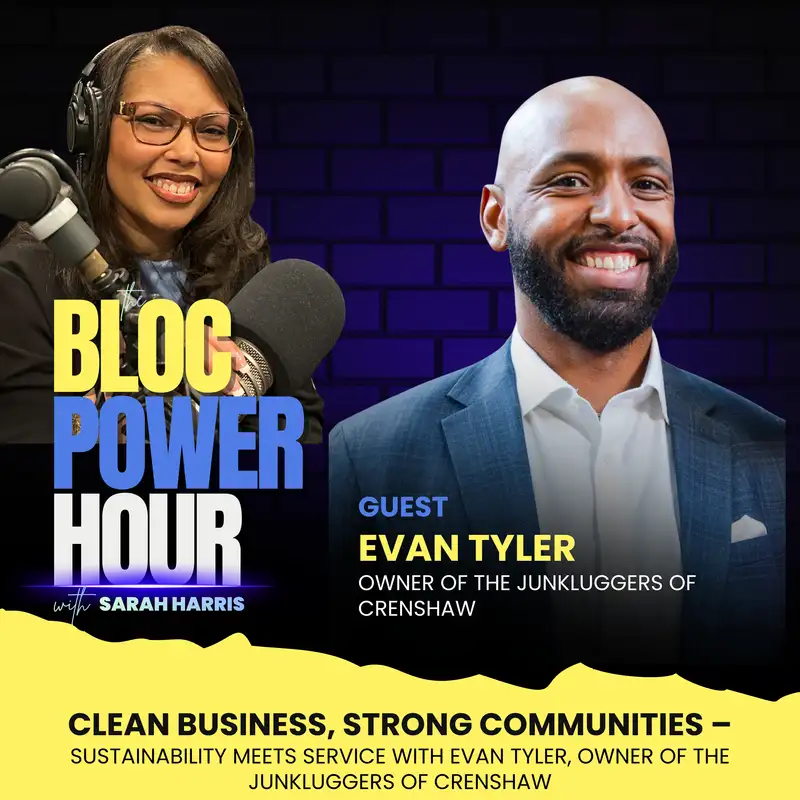
Clean Business, Strong Communities – Sustainability Meets Service with Evan Tyler
Download MP3Yeah. Sarah Harris.
Speaker 2:Turn the mic up. Turn the power up. Welcome to the block. To the block. Welcome Welcome
Speaker 3:to the block power hour. This is your host, Sarah Harris. We are back again. So excited for this show. We continue to bring you some amazing guests, and we are glad that you continue to tune in.
Speaker 3:Again, this is Sarah Harris, your host for the block power Hour, and we have an amazing guest today. He is Evan Tyler. He is the owner of the Junk Luggers franchise for Crenshaw. And we're going to get into some of his entrepreneurial journey and what brought him to be able to join up with a franchise. But today we are in our thirteenth episode, which is so amazing.
Speaker 3:I have come a long way and you have come a long way with us in this journey and it could not be made possible but by our sponsor US Bank. We appreciate them as a continuing partner for the Black Business Association, which this program is brought to you by from our media division, Elevate Media Collective. And so we want you to stay tuned with us, stay tuned on Instagram at block power hour and that's B L O C. Block Power Hour or also the Black Business Association, which is bbala.org. All right, getting to our program today.
Speaker 3:We continue to elevate the discussions on economic mobility and what the stories and journey are with our entrepreneurial brothers and sisters. And I'm really excited about this young man who's doing his thing. And it's like no different from any other story that you hear out there where somebody comes and discovers opportunity and they go for it. So with that, we had a previous show that was related to renewable energy and all of the things regarding what it takes to be able to recycle or invest in things that we can help to make a cleaner space that we live in. And so this is kind of like an extension of that.
Speaker 3:So we love being able to continue the themes for our shows. So Evan, glad to have you here today. Again, he is the owner of the Junk Luggers of Crenshaw. How are doing, Evan?
Speaker 1:Yes, Sarah. Thank you so much for having me. I'm doing great. Another beautiful day in Los Angeles and just glad to be here. And I wanna first of all express my gratitude for having me on the show.
Speaker 1:Really excited to diving into a little bit of Q and A and just having a conversation with you about some of the things that we're doing here in our community and how we can help out our neighbors.
Speaker 3:Alright. So let's learn a little bit about you because I believe that you are originally from Virginia, you said?
Speaker 1:Yeah. That's right. So I'm an East Coast guy. I moved out here a couple years ago. My wife had an opportunity to pursue a career option for her.
Speaker 1:And with that career option, I decided to relocate myself as well, as opposed to having her move to Virginia, and I've loved it ever since. We fortunately have some community already and some family members that have made sure that LA has been welcoming and felt like home for us. We go to Sunday dinners at some family's houses in Leimert Park and have since moved into the area to the Crenshaw area and have loved every minute of it. So moving out here has been a blessing. I haven't felt like I'm missing home or anything like that because I feel at home here where I am.
Speaker 3:Alright. Are the beaches good to you?
Speaker 1:Yeah, beaches are good. Again, I grew up on a beach myself. The water's a little colder here than the water from where I am back home, but I enjoy it nonetheless.
Speaker 3:Wonderful. You've been out here for how long you said?
Speaker 1:Yeah, about two and a half years now.
Speaker 3:So it's still kind of new to you a little bit, but getting to know the area, what made you just kind of settle into the Crenshaw area?
Speaker 1:Again, my wife had already had some connections to Leimert Park. I mean, having some family and support here just made it an easy transition for us. We found a nice place for us to live, and really fell in love with the community and everything that it has to offer, all of the history and all the progress that we're continuing to make here in this this very neighborhood. And I'm excited to be a part of that change as we're continuing to step forward in the right direction.
Speaker 3:Wonderful. So you came across an opportunity and it happens to be a franchise. Before we get into the nature of your business, what drew you to, you know, want to take up a franchise?
Speaker 1:Yeah, so I was working in the corporate space for a long time, and I was always interested in doing something and branching out a little bit on my own. However, oftentimes after finishing a long shift working at a manufacturing environment like I did, it didn't really leave too much room for dreaming or Mhmm. Pursuing any opportunities after, you know, working at a twelve hour or sixteen hour shift. So even though I thought about it, I never really pursued this opportunity until I kind of switched roles with my position and then said, you know what? Let me do a little bit of homework to see how I can build a future that's a little bit more autonomous for myself.
Speaker 1:And junk removal, of all things, ended up being something that Mhmm. I've always known about. I've always seen it as an opportunity. I think it can look a lot of different ways to a lot of different people rather. So whether that's a commercial move or a residential move or even doing some work to help clean up some curbside dumpings that you might see on some of our sidewalks and in our alleyways in our neighborhood.
Speaker 1:I just thought that this is a great opportunity to give back to the community, but also help my fellow neighbor.
Speaker 3:Awesome. So junk luggers. Okay. How did you hear about them and what did you think when you heard junk luggers?
Speaker 1:Yeah. Again, just doing some homework. I've researched some of the larger junk removal brands, not just locally, but even nationwide.
Speaker 3:So I'm sorry to interrupt, but so the space in terms of junk removal was something that you had thought about and was interested in?
Speaker 1:Yeah. Yeah. Oh, okay. Absolutely. And kind of one of those dirty jobs.
Speaker 1:I remember watching a show growing up called America's Dirtiest Jobs or something like And it's just always interesting to see how many other opportunities there are for people to do some of those things that you might want done or know that has to get done, but don't always think about how it gets done. Right? When your trash needs to be taken out, you just maybe roll that bin to the curb or put a trash bag in the dumpster and cross your fingers and hope that somebody removes it for you. Right? But when you think about it, somebody has to be the one that actually does the removal.
Speaker 1:And I know that there's an opportunity out there. So when I was talking to I actually had an entrepreneur coach about some opportunities to pursue.
Speaker 3:Okay.
Speaker 1:And when junk removal was one that she highlighted as well, I said, wow. That's perfect because that aligns with something that I'd already been thinking about, something I've been interested in, and I think a space that our neighborhood in particular could really use.
Speaker 3:I recently saw a clip, as a matter of fact, it's the Oprah Winfrey podcast, but she had a young woman on and it was about the effects of AI and what the scope of things will look like in the near future. And she was describing some things and Oprah interjected and talked about what it looks like to me it would be a landscape of a lot of entrepreneurs. And so when I think about that, I think about just the kind of what does it look like far as businesses and the opportunities are out there. And I feel like junk luggage is really gonna be one that will not be overtaken by AI. So it's a pretty safe bet in terms of it'll always be of use, of need that you have.
Speaker 3:So I think that your insights into this area is great thinking on your part to do that. So you also have a manufacturing and engineering background. Is any part of that kind of like shaping you and how you run your business today?
Speaker 1:Yeah, absolutely. I think that just that mentality that I developed while working in manufacturing was very much a roll your sleeves up and and get the job done. Working in a a large factory with a lot of people with skilled trade laborers, so electricians, pipe fitters, mechanics, folks that, again, oftentimes, you know, those career paths are maybe ignored or neglected a little bit. Similar to that, I think that junk removal and sanitation, if you will, are some of those fields as well where people don't always appreciate it until they need it done. I think just using that mentality of working around people who get the job done and knowing that I am one of those people who just can always go get the job done.
Speaker 1:Mhmm. I said, you know what? This is a good way for me to still have that autonomy and be a little bit more free in in what I'm doing, but also tap into some of that mindset and that skill set that I've developed by working in a manufacturing setting for a while.
Speaker 3:And so was this your first goal at entrepreneurship?
Speaker 1:Yeah, it is. So I'm learning so much. It's crazy because I started the company in July And that old saying of hindsight being twenty twenty, I've learned so much in these several months that I wish I knew back in July. But at this point, you know, I'm utilizing those learnings and making sure that I can implement everything that I've learned to do a little bit of a better job even than I'm doing now moving forward.
Speaker 3:And that is the crucial thing is that you just keep learning from even, you know, mistakes or what have you. There's value in that because you can continue to learn and grow. Evidently you did have a learning curve with this business and how you operate. And so we will get into more about your business. We do have to take a break for a moment, but I do want to learn more about, since this is your first go around with entrepreneurship, like, is there some type of, story or inspiration you have to continue on your journey?
Speaker 3:This is the Block Power Hour. I'm your host, Sarah Harris, and we will be right back. Back to the block power hour. This is your host, Sarah Harris. And we have in the studio today, Mr.
Speaker 3:Evan Tyler, owner of the franchise junk luggers of Crenshaw. So glad to have you in the studio. Again, we bring you conversations that really resonate with you, inspire you, want to make you think about your own business and your economic mobility. Stay tuned with us. Also, you can sponsor and donate.
Speaker 3:You can reach us at bbala.org. Again, bbala.org to support the show. And we do want to thank one of our sponsors, it is Coach Wendy, the Purpose Partner and you can find her on podcasts, but she is the purpose partner who transforms people's lives, are navigating the turning points in their lives, taking them from crossroads, becoming unshakable and your strategic grace and she's the purpose partner to show you the blueprint. And so we thank you to Coach Wendy, the purpose partner. All right, so back to our show today, we again have Mr.
Speaker 3:Evan Tyler, Welcome back, Evan.
Speaker 1:Thank you very much.
Speaker 3:And so we were talking about your journey now discovering yourself as an entrepreneur. I got to iterate because you know, when I think about this, I don't know if people do it to you or not, but I do think about. Absolutely.
Speaker 1:It's funny because we we drive a a big junk truck. Right? One of those Sunday dinners at my at my aunt's house, that's her ringtone. Is it? And somebody gave her a call while we were at dinner, and I thought that she was just playing a trick on me.
Speaker 1:They're like, did you do that just because, you know, I started this this junk removal business? She was like, no. I just left Sanford
Speaker 2:and Son. Like, that that's my
Speaker 3:That cannot be a coincidence.
Speaker 1:That's what I thought. But, you know, who knows?
Speaker 3:Love it. Love it. Love it. But it tickled me. I says, I gotta do it.
Speaker 3:I gotta do it. Sorry. Anyway, so yes. But am elated that this is your first go at entrepreneurial endeavor and you are just picking it up and running with it. So part of that is building your team.
Speaker 3:Just give us a little bit more insight into how you went about building your business.
Speaker 1:Yeah, absolutely. So again, I'm not originally from Los Angeles and I understand and respect the fact that a lot of our customers are looking for people that are familiar with their neighborhoods and familiar with the community and have a sense of that hometown pride that they can trust. So I was very intentional about hiring a team of people who are not just living here, but are from here and can teach me. Mhmm. I'm forever a student and always interested in learning more about where my feet are and having a a healthy respect for the people that have been here before me and have been here for a longer time than me and can can teach me so much.
Speaker 1:So learning about the neighborhoods here, learning about the history, just seeing all of the the beautiful growth opportunities that we continue to pursue here in this neighborhood. I was very intentional about hiring a group of folks that are from here and can navigate the streets here better than the GPS on the truck. So they've definitely helped helped me out. We've avoided a lot of traffic delays by knowing some of the back routes and that's all a part of just being strategic with the people that you bring into your circle.
Speaker 3:Indeed, indeed. I was reading in terms of that it's a business built by locals for locals, right? So evidently you are intentional about that.
Speaker 1:Absolutely.
Speaker 3:So junk removal isn't always seen as community building business, but you've made it one. And so how did that approach for you, you know, being intentional about that?
Speaker 1:I think if if you think about any growing or local business, you have to lean into community, whether you think about it in that way or not. If you own a sandwich shop on the corner, the people that are coming into that sandwich shop to support you are your neighbors, and they're your community members. If you own a laundromat, the people that are coming to wash their clothes, they are of that community. And a service like ours is very much the same. We are based right within several miles or a few miles from all of the people that we service.
Speaker 1:With that being said, we have to make sure that people are comfortable with us coming into their homes and coming into their spaces. So leading with that community aspect of it. And what that sometimes looks like is going to a local community event and volunteering our services. Right? Having that visibility that is going to allow our neighbors to trust us so when they do see us as a potential service provider for them, they can say, hey.
Speaker 1:I remember when they were doing a a cleanup on Crenshaw because literally that is stuff that we do. We helped clean up after a community brunch in Leimert Park this past weekend, and that is something that we do. It's something that we believe in. It's something that we stand for and will continue to do because giving back to the community is the only way that our community is gonna be able to continue to pour into us. So we take that approach by just having a a community first mindset to make sure that all of our neighbors are taken care of.
Speaker 3:And can you describe for us the region that you serve?
Speaker 1:Right. So when when you think about it from a broad perspective, we really serve South Los Angeles. So think of the I-ten as our northern border. So everything South Of The 10 is part of our territory. We go as far east, generally speaking, as the 110.
Speaker 1:So with The 10 being our northern border and the 110 being our eastern border and then kinda going as far south as about century. So just that general region. If you think Crenshaw, if you think South Los Angeles, if you think pockets of Inglewood, even our
Speaker 2:team is going to service
Speaker 1:the space.
Speaker 3:Right, and that's a good wide area, you know, in terms of being able to service and it's something, I can't say it enough, is what everybody needs each and every day. And I know like COVID, everybody was doing some major house cleaning, Yeah, absolutely, absolutely. So what type of jobs and career pathways can come from this type of business? I mean, you have the people who go around, help you to haul this stuff and pick it up, but there's a whole office to run and different types. So what are all the different types of career paths that you see?
Speaker 1:Yeah. I mean, it's vast, right? So a lot of logistics planning. But if we have a route of different jobs and we have to say what's the most efficient route to travel to make sure that we get from job A to job B to a donation site before hitting job c, there's somebody that has to be the the brains, if you will, behind that operation to make it make sense. Especially with the cost of diesel, you know, we're trying to be as
Speaker 3:efficient What as is what effect? Come on. Tell it. Tell it. Tell it to us.
Speaker 3:What has that effect been for you?
Speaker 1:It's a challenge. It certainly is. I mean, literally our diesel prices have almost doubled, almost overnight. For the past month or so, it's been another business bill. Again, going back to some of the things that you learn as a business owner that you maybe take for granted.
Speaker 1:Obviously, you got your your big costs that you are thinking of, like, we have to dump or there's some dump fees, you have to pay for your labor. You have to pay for fuel, but you don't necessarily think that those fuel prices are going to explode so quickly. Right? But with that being said, that economy impact also affects your customers. So not only is it more of a challenge for us to just simply do our job, we also have customers who may say, hey.
Speaker 1:Look. I've gotta make real life decisions between feeding my family or, you know, having my garage cleaned out.
Speaker 3:Mhmm.
Speaker 1:Unfortunately, your service is not a priority for me right now. And we certainly understand that, and we do our best to work with people to meet them where they are. If you've got a situation where you've really gotta get an old old appliance or old piece of furniture out of your space, we do our absolute best to make sure that the cost of it is not going to be that barrier. Because you deserve to have your space clean. You deserve to have a decluttered area to be able to live your life even if life's circumstances tend to hit you when you least expect them.
Speaker 3:And so as a franchise owner, what kind of maybe challenges or benefits or what have you to be able to adjust even with those kinds of things that you that come up? Because I I figured that I don't know if pricing is fixed because you're a franchise or do you have the option to be able to adjust or how is that operating under a franchise?
Speaker 1:Yeah. Because we're locally owned still, we have the optionality to be able to adjust our prices to meet our customers where they are. Mhmm. We do have obligations to the franchise system as a whole. We need to make sure that we're hitting certain targets.
Speaker 1:However, we still have to do our part to make sure that our community is taken care of and that our community comes first and that our customers come first. Right? But it is a fine line between balancing the let me take care of my customers, let me help this person who just simply can't do it for themselves, while also understanding that we've got our own obligations to a franchise that we have to take care of royalty payments that we had to make, target minimums that they're expecting us to hit in our area. We certainly need to, you know, be cognizant of the fact that those are real things. But ultimately, again, just leaning into our community, understanding that without the community, we're nothing, we had to put them first.
Speaker 3:So real quick, I want you to do it again at the end, but just tell people how they can reach you.
Speaker 1:Yeah, absolutely. You can reach us online at www.junkluggers.com/crinshaw. That's j u n k l u g g e r s dot com slash Crenshaw. We're also on Instagram at Junkluggers Crenshaw. And then you can give me a call directly at (323) 230-0122.
Speaker 1:Again, that's my direct line. And if you need anything and you're in our territory, I'd be more than willing to have a great conversation with you, provide you a free no cost estimate, no obligation estimate, and let you know that, hey. Look. We can get this out of here for you. Just give us a call.
Speaker 1:We'll come back with the truck and make sure that your space is cleared out.
Speaker 3:Excellent, excellent. So when we come back, I wanna kind of dig into a little bit more about franchise and, you know, some tips or something that somebody else is kind of thinking about taking up a franchise, be it junk luggers or any other one. But then also to get a little bit into that you do not only just residential, but commercial as well. And so some of your experiences from there. So we'll come back with that and more.
Speaker 3:This is the Block Power Hour. It's Sarah Harris, your host, and we'll be right back. Welcome to the block power hour. This is your host, Sarah Harris, and we have our guest here, Mr. Evan Tyler, owner of the franchise junk luggers of Crenshaw.
Speaker 3:We wanna thank our sponsor for today's show. It is coach Wendy, the purpose partner who we previously had on our show, and she is the one that will help you in your life's turning points, helping you to deal with crossroads, to become unshakable, and to act in strategic grace. And so we thank her for sponsoring the Block Power Hour. If you are wanting to be able to support the show, believe that it resonates with you, we invite you to go to bbala.org to learn more or to donate, and we appreciate everyone's support. Okay.
Speaker 3:Evan, we are back. We are back. So before we were talking about your experience on franchises, and so just for anybody who is considering a franchise, be it junk luggers or any other one, what kind of advice would you give them about obtaining a franchise?
Speaker 1:I'd say number one, just like anything, whether you're gonna franchise or or go into business on your own, do your homework. And I know it's an oversimplified answer, but it really is true. So when you're signing a franchise contract or franchise agreement, there are certain things that you are relinquishing. Right? So even though you may be a business owner yourself, there are certain contractual obligations that you are required to pay, whether it's a franchise fee that you're paying upfront, if you're paying royalties on every job that you do.
Speaker 1:There may be mandatory upgrades to a a building or a a restaurant, if you will, you know, if that is your franchise. However, you you need to also be aware that there are some benefits to a franchise system as well that you need to make sure that you're taking full advantage of, whether that be the the network of other franchise owners who are relatively local to you that you can reach out to and talk to and and get advice from, a franchise coach that we have internally who, can act as a strategic partner for me. But just really understanding all of the benefits and seeing if those benefits outweigh some of the challenges or the things that
Speaker 2:you may otherwise have to consider.
Speaker 3:And then real quick, in terms of, well, this is your first go at, so maybe it's not fair. I was going say just in terms of the experience between a franchise and just, you know, an entrepreneur starting your own business. But I suspect it's just having a bit more of that free will to do some of the things that you wanna do that maybe you're kind of restricted to do or something on a franchise.
Speaker 1:Yeah. And for me, you know, because this is my first time doing any type of business venture on my own, I appreciated the support of having a franchise, being able to kind of start to develop it as I was still working in the corporate space. So as I was still bringing a paycheck from my corporate side, I had a franchise coach that was kinda teaching me, hey. Here's some of the things that you can do as you're getting ready to launch your your junk removal business. Mhmm.
Speaker 1:And that was very valuable for me. Again, whether it's a franchise or any other type of business, you're going continue to learn, and you have to make sure that you take those learnings and apply those Mhmm. So that you don't fall behind. And that's something that I'm really trying to make sure I take advantage of is all of the lessons that I've learned since launching this business and making sure that I can better support myself and my family in the future.
Speaker 3:Good stuff, good stuff. So you serve both residential and commercial clients. And so what are some of the most common needs you're seeing right now from, well, both of them?
Speaker 1:Yeah, so this time of year, a lot of people are getting into that spring cleaning fever and a lot of our residential clients are getting rid of some old boxes of clothes oftentimes is what we've seen. We, as a business, we try to donate as much as we can. So just this past weekend, we actually had a customer who called us up and had just boxes and boxes of clothes that he needed to get rid of, but it was too much for him to just fit in his car. It was nothing for us to fit those items in our truck and then donate those on his behalf to the goodwill of Crenshaw and actually be able to provide our customer with that donation receipt that he gets able to use for his own records. So that's something that, you know, we try to make sure that we are intentional about making those donations and providing that donation receipt to our customers.
Speaker 1:Beyond those clothes and general spring cleaning that we're seeing, we're seeing a lot of people shoot, especially in LA, where people are getting ready to, you know, throw some food on the grill or you're have those backyard cookouts and everything. People are cleaning out those those backyard spaces and garage spaces if they have them, cleaning out those ADUs just to make it look more presentable as they're getting ready to maybe host some friends and family over for some barbecues. We had a lot of people getting their spaces ready for a big Easter event over the past couple of weeks and as they're getting ready to host their family and friends. So just in general, we're seeing a lot of people do some some spring cleaning this time of year. Okay.
Speaker 1:From a commercial standpoint, we've also been doing some larger warehouse cleanouts. Sometimes that's because a business is looking to relocate from one place to another, and they've got stuff that quite frankly is has been trashed to them for a long time, and it's just been, you know, accumulating space. We've been doing a few jobs at storage facilities with people that as they're relocating or moving to another stage in life, they're realizing that some of the stuff that they had in storage for the last five years maybe is no use to them anymore. So instead of continuing to pay that that monthly storage facility rent, they said, hey. Look.
Speaker 1:Donate what you can out of this storage facility. I'm tired of paying this rent at this storage facility. So we've been able to help people out in that way as well.
Speaker 3:Any interesting stories or something in dealing with people on your journeys with this business?
Speaker 1:Yeah, absolutely. So I think one of the cool things is not only am I the owner of the business, and I've got a team of folks that I've hired to work, but I also am very hands on with the business myself. So it's not unlikely that you'll see me on a job or I'll, you know, be the one with some gloves on and lifting something. And, man, literally our very first job ever was the heaviest item that we had ever I mean, that we even to this day that we'd ever done. It was at a a bakery that had an old industrial sized mixer.
Speaker 1:Right? I looked at it, and we do most of our pricing based on volume. So how big or small the items are that we're moving, and it didn't look like it was that much. So we gave them that estimate. They said, cool.
Speaker 1:Let's go ahead and knock it out. And me and my partner at the time, we just could not get this thing to budge. And it took a little bit of ingenuity and a little bit of grit and a couple of back braces. But eventually we were able to get this this mixer on a dolly and and loaded on the truck. So we left with a very satisfied customer who was probably
Speaker 3:And sore back. And a sore
Speaker 1:and definitely had to go straight to the store, buy some Epsom salt and sit in a nice bath afterwards. But yeah, was a 700 pound mixer from day one. And I remember looking at my partner and saying, I don't know if it's ever gonna get any harder than this. So now that we've knocked this out, we can do anything.
Speaker 3:It's all great. It's all good from here.
Speaker 1:Everything from here is good.
Speaker 3:Wow. So what do you do with a heavy kind of equipment like that? Well, I like to know is, because usually for me personally, it's the whole recycling thing or just like, is everything going to landfill or what have you? So I kind of like to know what do you do with items to responsibly, you know, handle them?
Speaker 1:Yeah, absolutely. I mean, we go to a recycling center that takes several different materials, metal recycling, they do cardboard recycling, white paper recycling, And actually that benefits us because instead of having to put it in a landfill and pay to dump it, we actually can recoup a few dollars that will go towards canceling out our dumping bill, if you will. My wife working in a school has also been the beneficiary of a few good So donated folks have gotten rid of bookshelves, and those bookshelves are now in her her school's library. Love it. You know?
Speaker 1:Folks are getting rid of, you know, sometimes they have books or old children's toys. And my wife's school has been, again, the just the beneficiary of some of these these items that people no longer want for themselves, but are still in good condition. And overall, I think that's just good business practice in general is, you know, looking at sustainability. Again, even if you're just looking at it from a dollars and cents standpoint, if you're donating an item, you're not having to pay to get rid of it. Right?
Speaker 1:Mhmm. Let alone the fact that, you know, Earth Day is coming soon and during this spring season, and we're trying to make a better living environment for this space that we all share, but it just makes money sense as well. So, you know, we try to not only be good stewards of our community, but also make the good business decisions as well.
Speaker 3:I figured that's a good feeling too, because you are doing the world some good by helping to clean up, but also to sustainably get rid of stuff in a way that helps as well. So with that, also too, there's reliability. And so what the difference is for your services from others in this competitive market, how do you differentiate yourself?
Speaker 1:I think that really just starting with the hiring process of looking at people that are of this community that we're serving. Right? And it makes you a lot more trustworthy when you can knock on somebody's door and, you know, strike up a conversation with something that is a a local event that's happening. Right? I think that our customers oftentimes feel a sense of trust when one of our teammates is a Crenshaw High School alum, for example.
Speaker 1:Right? And we are right next to Crenshaw High School. It's it's a good chance that that customer that we're serving went to Crenshaw. Their their kid went to Crenshaw or goes to Crenshaw. Right?
Speaker 1:So just that relatability factor, I think, you know, takes us a long way. We also are very clear that whenever we make an estimate, we're human, and we make mistakes sometimes too. Right? So if we ever overestimate you and say we estimate you the price of a half truck, but the items end up taking a little bit less space than that. Right?
Speaker 1:Say the items only take a quarter truck.
Speaker 3:Mhmm.
Speaker 1:We're gonna actually come down on that price that we charge you to the actual quarter truck price. Right? We're not going to, you know, say, hey. You agreed to this half truck price and then make you pay that. We're gonna be true and honest with you, show you before and after of how much these items actually took, and, make sure that you understand that, like, all of the labors involved, you don't have to lift a finger unless you're just pointing something out to us to come grab for you.
Speaker 3:And that goes towards your respectability, also to your brand and the things that people come to rely on to say, hey, and also to refer you, you know, they will say, hey, this is a great company, utilize them because they will, even if it's not going to cost as much as they originally quoted, they will readjust it. So I think that that goes a long way to your brand and good thinking as an entrepreneur. All right. So we're going to continue this conversation. A lot more to discuss.
Speaker 3:This is Sarah Harris with the Block Power Hour, and we will be right back. Welcome to the block power hour. I am your host, Sarah Harris, and we thank you for continuing to stay tuned and listen in for the block power hour. You can find us on Instagram at block Power Hour or go to the Black Business Association at BBALA to learn more or to donate. We appreciate you.
Speaker 3:We are here today with our guest, Mr. Evan Tyler, owner of the franchise Junk Luggers of Crenshaw. Welcome again to the Block Power Hour. It's been a delight talking with you today.
Speaker 1:I've enjoyed it. Thank you so much again for having me.
Speaker 3:Wonderful. So we've been discussing a number of things And one of the things I want to talk to you about growth opportunity for your business. And so part of that is, are you seeking opportunities related for contracts or partnerships or what is someone who you desire to partner with?
Speaker 1:Yeah. Absolutely. We're we're always again, we're trying to be community first advocates in supporting our neighborhoods. Right? So Council District 8, Council District 10, and and working collaboratively with the cleanup crews, business improvement districts in the West Adams area and in the in the LeMurk Park and Crenshaw area, any type of affiliation with the Kingdom Day Parade and Juneteenth and the Taste of Soul and the Crenshaw Mile, and the list goes on and on with so many just beautiful events here in our neighborhood and here in the area that we serve.
Speaker 1:We would love to just be a helping hand where, hey, look, if if the city is overwhelmed with some of the items that they had to pick up all around the city, consider us your friend to help focus on this neighborhood in particular. We'll be here to help.
Speaker 3:Because we do know there is a lot of junk to be picked up after these major events. And not only that, just the community partners where not everything is handled by the city for like the Taste of Soul or the King Day Parade, The community partners specifically like to contract with you or do business with you on anything. So you guys listening out there, we have a new businessman in town. Mr. Evan Tyler, owner of Junk Luggers of Crenshaw.
Speaker 3:So tell us what you provide for them in terms of when they reach out to you, what can they expect when they reach out to you?
Speaker 1:I mean, you can expect any type of service that you're looking for when it comes to a junk removal or trash removal and hauling service. Right? So what that looks like is if you have a big event, we've got a big truck, and we'll clean up any trash or debris or just leftover items that that need to be hauled away from this event so we can get our city back moving and operating as it should, at full capacity. Right? So sometimes this looks like cleaning up or just removing the trash bags from all of the the local trash cans that are in the route of a parade, for example.
Speaker 1:If there's any residual items that are left over from a, like, confetti standpoint. Right? If you had a big celebration, we'll get some brooms out. We'll sweep that up and haul that away too. But, also, you know, a lot of our neighborhoods, it's very common to to drive down and see a refrigerator sitting on the curb.
Speaker 1:Right? And in preparation for these events, we don't wanna have these items being an eyesore in our neighborhood as we're getting ready to celebrate. Right?
Speaker 3:Mhmm.
Speaker 1:We don't wanna see the abandoned mattress that's sitting on the sidewalk waiting for somebody to pick up. We'll come haul that stuff away. No problem. Because we've proven that we can already do it. We've done it before.
Speaker 1:We've helped prep for these big events, and we'd love to continue to do that to help our neighborhood shine.
Speaker 3:So you will work with the property owners that have stuff on their sidewalk or whatever to have it removed away, right?
Speaker 1:Right, absolutely. Sometimes it's a property owner, sometimes it's an illegal dump site, right? So it might not be somebody who put something in front of their own curb, it could be somebody coming from outside of our neighborhoods and letting that stuff go in our neighborhoods, which as awful as that is, it is a reality of something that does happen. And when that does happen, somebody's got to take care of it. Right?
Speaker 1:And we'd love to be the ones to help support our neighbors and clean that stuff up so they can
Speaker 2:live in a clean and decluttered space.
Speaker 3:And so when you see them out and about in the community, you cannot miss them. You cannot miss them because this is a bright green, lime green truck that was coming down. We will mention it again at the end, but tell them real quick because I want people to make sure that they're catching it whenever they're listening. How can they reach you?
Speaker 1:Yeah. Junkluggers dot com slash Crenshaw. That's gonna be an easy way for you to learn a little bit about our business. You'll be able to book us through that website. You can also visit us on Instagram at Junkluggers Crenshaw.
Speaker 1:You'll get a little bit of a behind the scenes look of what a day in the life looks like. You'll see on our page what some of the items that we haul looks like, some of the jobs that we've done. If you might, you might be thinking, hey, this garage clean out at my house is a little bit too much for them to handle. Then you check on our Instagram and see, oh no, they've done jobs. We've some examples of some jobs that are bigger and better than your garage.
Speaker 1:Right? And we've knocked it out. Mhmm. You'll see some of our community work where we've gone up and down Crenshaw, and maybe you've driven past us as we've pulled over and picked up some of those items that have been dumped on the side of the road and voluntarily hauled those items away. Mhmm.
Speaker 1:Because, again, that's the way that we think that's one of our responsibilities and our duties to
Speaker 2:our neighborhood to make sure that we live in a clean space.
Speaker 3:I know you've probably come across hoarders. Yeah. I saw on the news recently that there was some property that was left abandoned or what have you, and they had to go in there and haul out all kinds of stuff. So how do you do what what happens to you? What overcomes you when you see a situation where they're actually like hoarders?
Speaker 3:You just take a deep breath.
Speaker 1:Oh, we'll put a mask on to make sure our team is safe But for I mean, also in those situations, we also we just have to really remind ourselves this is somebody's space. Right? I love that. Yeah. And they got to this point for whatever reason.
Speaker 1:And and we've learned that some people have literally, they will hoard stuff as a sense of security. Mhmm. Because they're like, if there's enough stuff in here, nobody can sneak up on me without making a sound. That's been a true story we've heard before. Right?
Speaker 1:Mhmm. We've had people that just are ill and unable to physically move those items or take those items to the trash. And we had, you know, some people that just have a whatever mentality or mindset that says, this is okay, and I'm fine with living this way. Even if you and I may look at that space as, like, I personally might not live that way, but I'm here to support you. If you wanna make a positive change, we don't judge.
Speaker 1:We're here to support you and and make that change happen for you.
Speaker 3:You know, that's a sign of a real entrepreneur because you take into consideration the people that you're serving and I love and I appreciate about you. I really respect what you just said about that because, you know, I'm joking about it and everything, but you really are taking to heart as to why these things kind of come about and what they happen. So much respect for you on the way that you see your customers at the human level of and understanding where they're coming from.
Speaker 1:Yeah, we're here to help not judge.
Speaker 3:Okay. And so you say that you offer also a free estimate.
Speaker 1:Yeah, absolutely. So there's no commitment required for you to book us. Right? So you give us a call and say, hey. I'm thinking about this.
Speaker 1:I think I I've got a new couch coming in, but I gotta do something with this old one. I'm not really sure if I should just move it to the other side of the room or if I need to get rid of it. And we'll walk you through that process of what it looks like for us to to haul it away. Right? We may be able to evaluate it on the spot and say, this couch could find a new home with somebody else who would really appreciate it.
Speaker 1:We do have donation partners that might be willing to accept this couch. So as you're also creating space for your new couch, you're gonna give somebody else the opportunity to have a couch that they may not have otherwise had. Right? But all of that comes at no cost to you for us to come give you a visit and and give you that obligation free estimate. But while we're there, if you like what we're saying and we can come to an agreement, our team will knock it out on the spot and we'll haul it away for you, shake your hand and go on about our business.
Speaker 3:Awesome. Awesome. So as you continue on your entrepreneurial journey, give us a glimpse at what it looks like for you, you know, in the next two, three, maybe five years.
Speaker 1:Yeah. I think a lot now about legacy. I'm actually expecting my my first child. Alright. And and I think about, you know, I started this business as an entrepreneur to have freedom for myself, selfishly speaking.
Speaker 1:But now I think about the opportunity that is going to allow me to be able to support my family even though an entrepreneur is always working. Right? But allow me, you know, something that I can build to grow with my family and shoot, who knows? Maybe maybe years from now, a little man will be running the family business, you know? But I think in the, you know, shorter term future, being able to grow this business, it's very scalable.
Speaker 1:Right? So that might mean, hey. Now that our team is a little bit larger, we can service a wider territory. Mhmm. We might get another truck and be able to service more customers during any, you know, given time.
Speaker 1:Right? When some of those busier seasons pick up, when we have some of these holiday parades or celebrations. Right? We can have a team that's servicing a residential customer while we have another team that is doing a larger commercial job. So I look at doing my best to capitalize on all of these opportunities that can be found right here in our very own neighborhood, right here in our backyard.
Speaker 3:Right. Building and growing.
Speaker 1:Building and growing.
Speaker 3:Building and growing. So this conversation, I can't believe it's coming to
Speaker 1:my It's gone so fast.
Speaker 3:One more time, though. Real quick. Tell everyone how they can reach you.
Speaker 1:Yeah. Absolutely. Junkluggers.com/crenshaw. That's junkluggers.com/crenshaw or at Junk Luggers Crenshaw on Instagram or give me a call directly at (323) 230-0122.
Speaker 3:Repeat that one more time.
Speaker 1:Yeah. That's my direct line. (323) 230-0122, and you'll get you'll get the chance to speak directly to me. We'll talk about your drug removal needs.
Speaker 3:This is Evan Tyler, you guys, on the block power hour. We thank you once again for joining us. I'm your host, Sarah Harris. Stay tuned with us at block power hour on Instagram or bbala.org. Come back again.
Speaker 3:This is the block power hour. Thank you.
Speaker 2:Power hour hour. We talk business, culture, vision, and grind. Opportunities align when the community shines. Dreams get bigger when the people connect. Moving with the purpose and demand and respect.
Speaker 2:Innovation in our blood. Break the wind I strive. I win the message never dimming our pride.