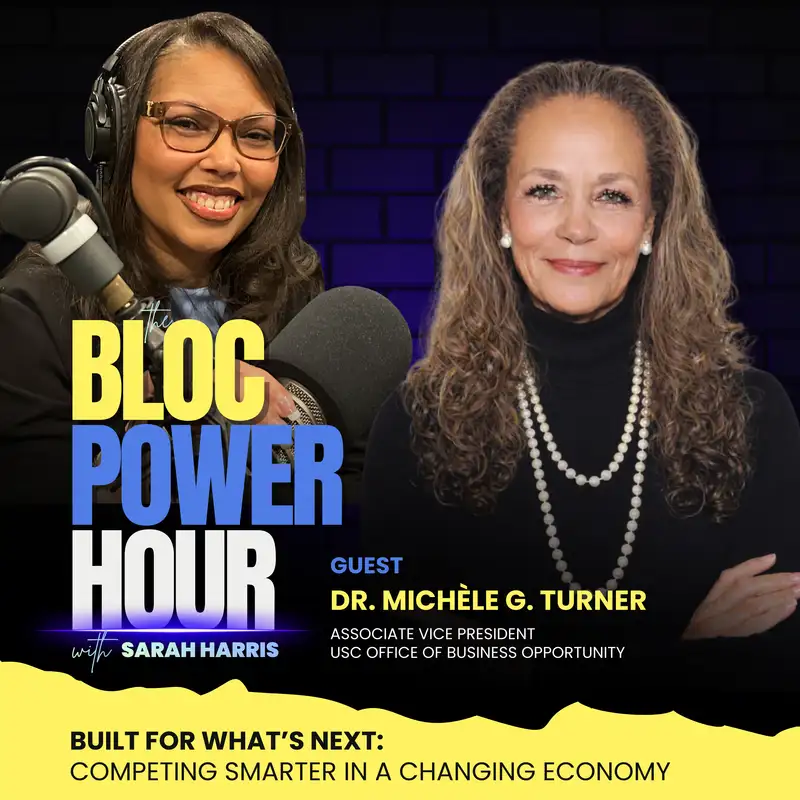
Built for What’s Next: Competing Smarter in a Changing Economy
Download MP3Yeah. It's Sarah Harris. Turn the mic up. The power up. Welcome to the Welcome
Speaker 2:back to the block power hour with Sarah Harris. That's me. Today, we're talking about something serious business owners should be thinking about competitive edge in a complex economy. We are here with doctor Michèle G. Turner on the insides of the USC's Access Summit coming up on March 4 and the future of small business.
Speaker 2:But before we jump into that, let's ground ourselves and what really is happening with artificial intelligence because this is not just a trend, it's an economic shift. Artificial intelligence is projected to contribute more than 15,000,000,000,000 to the global economy over the next decade. With generative AI alone, expect to drive trillions annually in new productivity across industries. And this isn't limited to Silicon Valley. Small businesses are already using AI to forecast revenue, manage inventory, and improve marketing and streamline operations.
Speaker 2:Doctor. Turner, I know that you're probably using AI in things that you do as well. The summit will be addressing this. And so I think it's important for us to have this conversation. Many people, many conversations are being happening around AI and you cannot have too many of them at this particular point because it really is, so much, nuances to it.
Speaker 3:Well, yes, that's true. But I'm one of those people that has really embraced the idea of artificial intelligence, especially in business. And that has a lot to do somewhat with my age and somewhat because of my experience. And the way that I look at this is that we are at a new inflection point with regard to how small businesses need to think about how they are building infrastructure. But we've been here before.
Speaker 3:Mhmm. And if you remember, or some of us might remember, and again, this is my age kinda coming out, but about thirty ish years ago or so when people were first starting to think about how to use personal computing in business
Speaker 2:Mhmm.
Speaker 3:You know, that was a first major inflection point for small businesses to really have the autonomy and the creativity to really jump into the game. Right. And so artificial intelligence is that new tool, frankly, that I think allows small businesses now to be truly agile in much the same way that our larger companies are also looking at it Mhmm. And really is going to provide a very substantial platform for our small businesses to differentiate their value and really accentuate the many reasons of why doing business with a small business is good business.
Speaker 2:Thank you for that. And as you were talking about in terms of the beginnings of it, one of the things I was rolling in because at the time that we're recording this, it is during Black History Month. Right? And so just kind of an interesting thing that I'd heard about was that NVIDIA, they are the company, of course, that's powering today's AI infrastructure. They named their chip architecture after renowned scientists, and their platform is called Blackwell, and that's after Doctor.
Speaker 2:David Blackwell, who was a pioneering mathematician and statistician. And in 1947, he became the first black scholar elected to the National Academy of Sciences, and he worked in game theory. And probability laid the foundation that continued to influence economics, data science, and decision making today. So I just thought that was pretty neat in terms of one, when NVIDIA, they roll out their chips and then they name them after renowned scientists. Well, one, they chose to name after Doctor.
Speaker 2:David Blackwell. So that was pretty interesting to me.
Speaker 3:It is. I did not know that.
Speaker 2:So that was just a little plug in regarding celebrating Black History Month. Thank you for the comments that you have, but let me introduce Doctor. Michelle G. Turner. She is the Associate Vice President for Business Opportunity at University of Southern California, where she works across the university to expand opportunities for businesses to participate in USC's supply chain and strengthening their ability to compete, scale and endure.
Speaker 2:And one of the main topics for today is that we were wanting to bring up about the Access Small Business Summit coming up on March 4, and that will address AI, small business growth and resiliency. And again, that's March 4 at the USC Hotel. Today, we'll be discussing about how businesses can compete smarter in today's changing economy. And welcome to the Block Power Hour.
Speaker 3:Thank you, Sarah. Thank you. Very honored to be here.
Speaker 2:Wonderful. So before we get into the summit though, tell me a little bit about yourself and what led you to work at USC.
Speaker 3:Well, okay. It's always hard to talk about yourself, but thank you for the opportunity. Well, I came to USC. I think I'm gonna start there because I had the good fortune to be successful in my career and successful in business, but I'm also very purpose driven. And I had the opportunity to initially come back to USC and lift up our outreach and rebuild our Black Alumni Association.
Speaker 3:And that's not to say that our Black Alumni Association wasn't the greatest in the world in the first place. Our predecessors had really done a beautiful job with creating community. But, you know, we were in a place where our alumni were evolving in terms of their professional careers and successes and being able to come back and really add into how black alumni could be very integral to the success of the institution itself Mhmm. At a different level, at a much elevated level, was what I was able to do. And so that absolutely fulfilled me.
Speaker 3:But at the same time, when we changed presidents, and USC has had about five presidents since the late two thousands now, I had an opportunity to really go into what truly interests me, and that truly is business opportunity, business building. That is really where my experience is. I have a deep experience in the tech world. I built my career with IBM for about sixteen years where I had the opportunity to be trained and mentored in terms of what constitutes scale and innovation with some of our largest companies in the country and really learning about competitive advantage there and looking around and kind of saying, wow. You know, with all of this success and all of this creative thinking, why can't our small businesses, you know, have access to this same kind of information?
Speaker 3:Mhmm. And now being able to really push these ideas out from my office, the office of business opportunity, has been a really creative space, an incredible space, because my office was created with the will and intent of our senior leadership at that time that really looked out and reevaluated our space within the communities that we serve, leaning into a very intentional philosophy about how we should, you know, create our own new anchor institutional strategies to do that. And so my office focuses on small business, capacity building, opportunities, strategies Mhmm. Those kinds of resource offerings so that our small businesses in our communities can connect with USC. Yes.
Speaker 3:There may be opportunities. Hopefully, there will be opportunities within our supply chain. But even if there are not, and that has a lot to do with small business alignment, you know, in in terms of our systems, etcetera. Right. But we want them to grow, and we want them to thrive because we know that thriving businesses create healthy communities.
Speaker 3:And so we've created an entire ecosystem around that intent.
Speaker 2:What's it like trying to get the word out about the opportunities that are available for small businesses?
Speaker 3:So that has created a lot of internal collaboration within USC that was different than what we had been doing before because, you know, saying that we're going to create opportunities is more than a notion, and it also doesn't happen overnight. You know, we absolutely had been an institution that had thrived on doing business the way most large institutions do business, you know, very, institutional, very legacy oriented. And so, you know, to really now move this idea about, small business inclusion, even though it made sense and we all felt that it was the right thing to do, we had to create new internal partnerships within our own enterprise. Mhmm. And we're a very large enterprise.
Speaker 3:It's not just campus, but our hospital and research operations. And once everyone got on the same page, we then had to peel that back and look at our systems and and think about how we could, you know, really create systems that could identify small businesses. And let's also not forget
Speaker 2:Right.
Speaker 3:That until very recently, we were very much able to dive very deeply into small business certifications that also, of course, included diverse classifications and and really look at, you know, what gaps there were in terms of where we were doing business and with who we were doing business. And so regardless, we have built those systems now. Has taken us a couple of years to do that, and we're ready to move forward.
Speaker 1:Okay.
Speaker 3:And now what we're trying to do is really look at how we evaluate opportunities, get the word out about those opportunities, and look at how we build successful partnerships. Because often for small businesses, their opportunities are going to be in terms of how they collaborate also with larger companies that can bring scale to us, can that bring some of the value that we need to see in our own supply chains. There's a lot of work.
Speaker 2:Yes. Indeed. Indeed. We're gonna hear more about this when we come Block Power Hour with Sarah Harris. And remember, you can find us at Block Power Hour when you search for our social media, and then you can be able to find the link for our podcast if you're not able to listen to us live.
Speaker 2:But again, this is the Block power hour. We will return shortly. Welcome back. Welcome back. This is the block power hour, and I am Sarah Harris.
Speaker 2:The block power hour is presented by the black business associations media division, elevate media collective. And we are here to elevate voices and come together as one. And so we are bringing information and timely topics. And today's topic is related to AI and small business growth opportunities. So we have our guests, Doctor.
Speaker 2:Michelle Turner from USC. Delighted to have you here.
Speaker 3:Thank you, Sarah.
Speaker 2:So we were talking about USC's Office of Business Opportunity and the opportunities there. As it relates to beyond contracts, how are you helping small businesses strengthen their operations and scale efficiently and build resilience?
Speaker 3:That's a great question. And I love it because often people think about when they first think about USC and small businesses, they most immediately run to the question of, well, how can I do business with USC? And I think the more important issue is, are you ready? And Mhmm. Our office, as I was saying before, has built an ecosystem to support businesses in their progression to be ready for contracting at an institutional level.
Speaker 2:Okay.
Speaker 3:And so we have developed accelerator programs for basic business kinds of concepts where even though we are focused on basic training, we really look at what constitutes how to build into a small business's strengths and start leaning into this idea of competitive advantage even at a very early stage with a new business.
Speaker 2:Mhmm.
Speaker 3:We have leadership development curriculum in partnership with the Marshall School of Business because especially with a small business, you know, a lot of the business success is dependent on the decisions Mhmm. That the CEO, leadership, founder has to make competitively. And so we have offered now two cohorts for, CEOs and the execs that, you know, are responsible for decision making in small businesses.
Speaker 1:Mhmm.
Speaker 3:Every year, we host our annual business summit where we bring in guest speakers and partners, you know, to speak about best practices and share our knowledge, you know, outside of a curriculum. And then on top of that, we have various workshops throughout the year where we invite our small business community, all of these for free. And in these ways, we are really hoping to stabilize a business, help it become more resilient, help it to understand better, you know, the more full arc of what being ready to contract with a USC or a larger contractor might be about. So, you know, when they are ready in that fashion, they will be much
Speaker 2:Thank you. And I'm happy to say in terms of what the Black Business Association, we have had the opportunity to have a couple of our members to go through one of your cohorts and training for small businesses. So we just appreciate being a partner and your reach into the community to make these things happen.
Speaker 3:Thank you. Thank you. We are really proud of those programs and I love them. I've actually been heavily involved in the curriculum development and teaching mentoring and coaching and just the range of the businesses that we're seeing, I think are something that our communities can be very proud of. And so as we continue, you know, to offer programs like this in partnership, we hope to, from our part too, to continue to build lasting relationships with these businesses.
Speaker 2:Yes, indeed. And you do that well. We appreciate your work. We appreciate it truly. All right, so let's transition into talking about anchor institutions and USC of course operates as an anchor institution.
Speaker 2:What responsibility does that carry in terms of expanding economic opportunity for local business community?
Speaker 3:Anchor institutions can be a lot of different things, and they are. The way that we choose to define it is with respect to economic development. Mhmm. USC, the last time that we looked at it, has an $8,000,000,000 economic impact in the LA County region. But what we also found was that that impact, it being derivative to $8,000,000,000 from around a $3,000,000,000 spend, didn't really include a high proportion of small businesses.
Speaker 3:And so imagine what we could do if we did change that. And that really is our work. We know and have made the decision to stay within the communities that we are in. We are not over on the West Side Of Los Angeles. We are not near the ocean.
Speaker 3:We are not in these vacation resort spots.
Speaker 2:Mhmm.
Speaker 3:We are in communities that people work and live and unfortunately, you know, are also seeing a reversal of fortune, you know, given all of the business cycles that we've all now had to endure, whether they've been COVID or post fire recovery or what have you. Correct. You know? We are here, and we know that given the knowledge resources that we have, certainly the scale of influence that we have, that we have a great deal to offer in terms of helping businesses learn about what they could be doing and also offering the opportunities for partnerships and networks. These are things that really, you know, when you look at it, are the right thing to do.
Speaker 3:So when you ask about what responsibility we have, responsibility is really driven by intent. Mhmm. And I'm just very honored to say that our senior leadership, our president, all of our senior executives, the team that I work with are very joined in this intent, you know, to create better communities. And so we're very poised in terms of what could happen and this is the journey that we're gonna take ourselves on, you know? And as we do that, we're building partnerships, with organizations
Speaker 2:And that like is way to go, yes. Partnerships are the way to go. Just the campus itself is right in the community, right? Down Figueroa near Downtown LA and Exposition Park and all of that. So it's just, you could see just as itself physically as an anchor Thank you.
Speaker 2:Into
Speaker 1:the
Speaker 2:Yes. So you have described today's environment as increasingly complex. What does the complexity look like for small businesses here in Los Angeles?
Speaker 3:I think the reality is, as I mentioned earlier, we're at an inflection point because of the rapid development of AI. Mhmm. And, you know, we're certainly over the last few years, a lot of the barriers with regard to small business inclusion, you know, had more to do with systemic kinds of barriers, organizational decisions that people would make or not make in terms of how they would incorporate small business partnerships. But the fact of the matter remains that when a small business is and I'm speaking primarily contracting with organizations like ours. Let's say that that's the opportunity.
Speaker 3:When a small business looks at that, one of the most important things that they have to be able to answer is how are they adding value to that institution's business? Or even if you weren't looking at larger contracting, how is this small business adding value for their customers? Mhmm. And because of the way that AI is developing now, the technology platforms that it's providing larger companies as well as small companies in terms of how they are now able to assess market information, be much more agile with regard to decisions that they're making in terms of the markets they wanna be in, the products that they are offering. If you do not have the data, if you do not have the infrastructure in your companies to be solid and agile, you'll lose.
Speaker 3:Mhmm. And this is really where we are. So I think the whole conversation about AI is forcing small businesses to look at their investments Yes. In infrastructure not as a nice to have, but as a necessity. And so very much the same way that my work with Fortune 50 corporations, you know, we would really hammer through the numbers in terms of what is that return on investment?
Speaker 3:How do I justify the cost for technology or information or people, you know, that can bring me this intelligence? Small businesses are going to have to go through their own very urgent reflections on what constitutes return on investment for them in order to grow and scale.
Speaker 2:From your observation, how much are small businesses adapting AI or are they slow to really pick it up? Are you kind of encouraged or not?
Speaker 3:Well, I think we are early enough in this conversation where we can help provide some guidelines in how small businesses assess AI solutions. And, you know, I will be the first to tell you one of the things that does scare me or causes me just a little bit of alarm is that the conversations about vibe coding or creating your own agents and and things to do things, you know, very easily just by talking to Claude or or so. That's not the way to run your business. You know? You need a better AI infrastructure that can grow, that can be maintained, that can be updated as your business grows, as your systems need to be maintained and updated.
Speaker 2:Well, that will lead us to our next conversation after we come back from the break because we will get into why Access twenty twenty six, the summit matters. When we come back, we'll discuss this. This is the Block Power Hour with Sarah Harris. If this conversation and our whole programming is resonating with you, we invite you to support us, to donate, to become a sponsor. You can get information at bbala.org.
Speaker 2:Again, that's bbalabbalaj.org, where you can find information on the Black Business Association site. We will be right back. Welcome back. This is Sarah Harris. This is the Block Power Hour, and we are so elated to be able to have Doctor.
Speaker 2:Michelle Turner with USC from the office of business opportunity. And we've been discussing a number of things, but today we're going to get into the direct subject regarding USC's access summit, and it is related to AI small business growth and opportunities. And so we're going to see what this is all about. So in general, what is the summit and who is it really designed for?
Speaker 3:Well, the summit is designed for small business owners and their partners in decision making. And we've been doing this now for about four years and it really is an opportunity for us at USC to share our knowledge and what we know about best practices. You know, take some of the information that we're teaching in our classrooms and share them with the community for a half of a day. We know our business owners can't sit too long.
Speaker 1:Mhmm. I know. We get antsy. Yes. So, you know, we we take
Speaker 3:the morning. We feed you breakfast. We feed you lunch. And in between breakfast and lunch, we have some really great pieces of knowledge sharing going.
Speaker 2:Wonderful, wonderful. And so when you talk about competitive advantage, because it centers on that, What does real competitive advantage look like for a small to midsize business?
Speaker 3:So this year we are really emphasizing the idea, the concepts of competitive advantage because what we have found, especially post COVID, is that a lot of the technical assistance programs are really only scratching the surface in terms of good business operations. But a successful resilient business is so much more than that. And as I was saying earlier before, you know, it really does matter in terms of what your business strength is and how you are delivering that, you know, to create customer value. And so competitive advantage is that. You know?
Speaker 3:How are you taking your strengths? You certainly had an idea about your product. There is a why, but why does it matter? And how are you operationalizing that better than your competitor? And this is the conversation because a lot of our small businesses have a great idea, and they wanna open that brick and mortar or they wanna go into that ecommerce business.
Speaker 3:Mhmm. And they're very insular in how they think about it. They think just because it's their great idea that that's good enough, and they don't understand how to look
Speaker 1:Mhmm.
Speaker 3:At a competitive marketplace and position themselves in it and then win. And so, you know, really being able now to introduce this idea of competitive advantage at the small business conversational level is really important, especially when you consider now that, again, you know, getting back into the topic of AI implementation, there are now the tools to allow a small business to act as aggressively as a large business. You know, if they start to understand how they can build upon their competitive advantage. And when you're able to do that, then as a small business, you don't have to just compete on lowest bid
Speaker 2:Mhmm.
Speaker 3:Or lowest price. You know, you really can structure your growth in a very resilient way. You can survive business cycles much more strongly. You know? And so there is a way to think about this.
Speaker 3:And believe me, larger companies build that competitive advantage thinking into their business models.
Speaker 2:I think that a lot of times we just jump in and we on the surface or the top layer, we do what we you know, we have like you said, have the idea and run with that, but we don't really take the time to be strategic thinkers and really survey what the market is and the landscape is. And we really need to take that time to really understand and know our business. There's so many different things that are happening that, you know, if you of course, we talk about AI all the time, but there are so many things that if you're not on top of it, it will just swallow you up and you'll be considered like a dinosaur in it. So it's just, I'm glad that you bring up about competitive advantage because we really need to start thinking in those terms about more defining our businesses. So in saying that, what do you see where businesses fall short?
Speaker 3:I would really have to say with absolute clarity that they fall short due to short term thinking. And I say this, you know, given so much experience in coaching small businesses, certainly in advising and and teaching in the curriculum that we have. And those who have been through my programs know that we can spend hours, you know, really peeling back what it is that they need to focus on because often small businesses will come with a full plate of I can do all this.
Speaker 2:Mhmm.
Speaker 3:But they're not strong in any of it. And this fragility of not just idea, but infrastructure to support all these things, you know, really puts a small business at risk. And so now, you know, kind of reverse engineering that conversation, you know, it seems to be a very basic idea. What is it that you do well? Mhmm.
Speaker 3:And how can we position this competitively so it makes a difference and allows you to articulate that value to your customer? And, by the way, make sure you deliver it. Right. You know? This is where we start getting into the uniqueness of small businesses.
Speaker 1:Mhmm.
Speaker 3:And the fact that they are small and agile and quick to respond. Right. You know, these are all the things that we want to see a small business be able to do. Mhmm. And yet we want them to also be able to keep their doors open year to year because they're able to do it.
Speaker 2:This will be off the top of your head or whatever in terms of any particular business that comes to mind is like an example of those that are really thinking about their competitive advantage.
Speaker 3:I will tell you, I don't want to put any of them on the spot because, you know, we're at a time now where certainly many businesses in our community are dealing with so many different challenges. But I will say this. I've seen several businesses that because now they are restructuring their business models to look at competitive advantage Mhmm. They're able to survive the pivots they need to make. Okay.
Speaker 3:You know, if they need to retract on how fast that they were expanding because that was not quite a great business decision, they have been able now to look at platforms where they can be successful
Speaker 2:Mhmm.
Speaker 3:And come onto those platforms, you know, with a much more aggressive strategy for success.
Speaker 1:Mhmm.
Speaker 3:And, you know, I think that the things that I'm seeing watching businesses that, you know, we've been dealing with for quite a while, really move through these pivots is a testament to how they are now rethinking their business model with respect to what they do well.
Speaker 2:I like the story of South LA Cafe. Joe was looking just to have a coffee shop and then it just had ballooned into so much more and now they have several locations. They have a podcast. They do a regular community outreach with groceries and food giveaways and stuff and so they began to really think about how they would be in the community more than just another coffee shop, right? And then another one is Prosperity Market where they have a platform where they have other businesses to be able to come in, you know, for produce mainly, for their wares.
Speaker 2:But then they went a step further and built a mobile unit and got sponsored for two more mobile units that they now take those on to deliver goods across from anywhere. And so I just really commend the ingenuity of business owners like these that really can really think about their positioning in the market and how they can really make the best impact. That's just my little thing. I really love seeing people who really kind of thrive on those ends. And so I want to ask you in terms of for Access Summit, you want to talk about how can people register?
Speaker 2:Also it's free, right?
Speaker 3:It is free. So glad to say that this is a free opportunity to come in and meet not just USC potential partners, but other businesses. It is an opportunity to build community and certainly to network. And people can register from our website. Our website is businessopportunity.usc.edu.
Speaker 3:And there will be an invitation on the website, and it has the link. And all you have to do is give us some information about you so that we know you're coming and show up.
Speaker 2:And show up. This is the fourth year, Okay, am I so good stuff on that. When we come back, I do wanna hear a little bit about the speakers that you have on tap and some of the programming. Thank you. That would be great.
Speaker 2:This is the Block Power Hour. I am Sarah Harris and we will be right back. Welcome. We thank you for listening in. We appreciate everyone who tunes in.
Speaker 2:The block power hour can be found on podcasts as well as here on seven ninety k ABC. Check out bbala.org to learn more about that or find us online at block power hour. As always, we do appreciate the support through donations and sponsorship to be able to support this programming, to be able to continue. And so we will continue our conversation with Doctor. Turner and it has been a delight having you here today.
Speaker 2:We are going to wrap up some of the things about the summit. One of the things I did want to get into is like, who will be there? Who's going to be speaking and what kind of topics will there be?
Speaker 3:I always get excited for the summit because I get to bring in great partners that I have the honor to work with, you know, because I know what they know and I know the value that they have. You know, I try to cram all that into four hours. So this year, we are so thrilled to welcome our partners with the Los Angeles Economic Development Corporation.
Speaker 2:Yes.
Speaker 3:They will be bringing to our small business owners an outlook for an economic outlook for the Los Angeles County region, which is gonna be, you know, great information, post fire and, frankly, pre event or while we are in the large event mode that we are in in Los Angeles that is going to be driving so much revenue within the region. We are also bringing in some people very dear to me from the Act One Group. And Act One, of course, is Janice Bryant Howroyd's billion dollar company that is not just staffing, but also technology. And they will be bringing information about AI solutions for small business. And one of the reasons I'm so excited about that is because AI solutions for small business now are very scalable, and they're very affordable.
Speaker 3:Yes. And, you know, when you're dealing with a reputable company, which Act One is, not that we're selling anything, but, you know, just to be able to share what examples of software solutions that help a small business build really solid infrastructure could look like.
Speaker 2:Mhmm.
Speaker 3:So I'm very excited about that. We at USC were designated as a university center with the economic development agency nationally, and, we're able as as a partner there to share best practice information nationally. And so we're bringing in a research partner that is looking at what we have found to be repeatable factors for sustainable growth. And we're really taking a hyper local view in terms of what sustainable growth businesses look like in LA County. So we're sharing that information out, and we're also sharing the opportunity for small businesses who would be interested in extending the study here in Los Angeles to participate as study members.
Speaker 3:So we will be talking about that. And then we're bringing in partners from our Leventhal School of Accounting to really speak about business advisory supports from an accounting, financial services, risk management perspective. And, you know, the great thing about this particular panel, which is led by one of our amazing professors at the school of accounting, Sylvia Sweeney, who who I I love. Mhmm. She will be leading a panel of experts.
Speaker 3:This information is free. And then, of course, after the summit is over, our small businesses can ask questions off of clock time. You know? So they're not gonna be paying for this. But, you know, at the same time, they will have access to information, which is really what the summit is all about.
Speaker 3:Mhmm. Providing high level, high value information for free to our small businesses to hopefully give them a lot to think about in this time that we're in and move forward.
Speaker 2:Well, definitely if you're a small business owner, you wanna make sure that you are there because to have an opportunity, especially when you can attend for free, to be able to have that kind of access. I see why the summit is named access, but really to have that kind of access to those people that will be in the room there, it's really invaluable.
Speaker 3:And Sarah, let me just also say we will be talking about ways that our small businesses would have access into doing business with USC, of course, so that we can share that information, which is often so very hard to find. It's like digging through a labyrinth, but we will have partners there who can also answer those questions and speak about business readiness as well.
Speaker 2:Awesome. Love it. So one more time, let's give the information. It's going to happen on March 4, right? Yes, ma'am.
Speaker 2:And it's free.
Speaker 3:From 08:30 to noon. Although if you have questions and you wanna sit and talk with someone, we will still have the room until about 02:00. So Wonderful. We will be at the USC Hotel, and all of the information can be found on our website at businessopportunity.usc.edu.
Speaker 2:Give it one more time.
Speaker 3:Businessopportunity.usc.edu.
Speaker 2:Wonderful, wonderful. So if you are a business owner, I hope that you are taking this opportunity to be able to strengthen your business through what you will be able to glean from this summit. Again, it's so great to be able to be a partner with USC through the Black Business Association, so we are happy that they are providing this opportunity. Some closing questions I wanna be able to know is in uncertain cycles, what separates businesses that endure from those that struggle?
Speaker 3:I have to get back to that planning. I just can't overemphasize that enough. A solid business model, a solid business plan. We spend a lot of time within our programming throughout our curriculum, you know, getting under what that really can mean for a business, how to set good goals, how to, you know, be accountable for short term versus long term goals, of course. But in order to, you know, endure through business cycles, you have to be able to position yourself to access the information that's going to signal to you what's really going on in your markets, make good decisions, and not just capitalize.
Speaker 3:You know, it's not just a question about getting access to capital, but it is a matter of what do you do with it, you know, again, with good planning and good decision making.
Speaker 2:Well, wonderful. You know, I hope that you've been able to get some great nuggets out of this conversation. It's really important for businesses to think about their competitive advantage and this is one opportunity to do that. But I wanna get into some fun, unique things, some kind of trivia stuff that I learned about USC. Uh-oh.
Speaker 2:And let's see if what you know about USC. Make it kind of fun and light. And so can you name three famous alumni? You know, USC has a lot of people that's come through. Name three that you can think of.
Speaker 3:Oh my gosh. Okay. So can I name them in groups? Because I mean, we have all like the most amazing football players, not to mention Sam Darnold. So there's one.
Speaker 3:Mhmm. But we have so many I just have to give a shout out to our amazing black alumni. Shout out to Ryan Coogler. We know you are gonna bring home some Oscars. And we have some amazing, amazing alumni who who people don't normally see, you know, and and shout out to all of our scientists, people like Charles Bolden, you know, who was an astronaut, very much involved with NASA before he retired.
Speaker 3:I mean, I I could just go Mhmm. Down a list of thousands. So
Speaker 2:Well, there's one that's known as queen of television? Queen of television. Who? Shonda Oh,
Speaker 3:well, okay. So here's a guess. Shonda, we love Shonda. Shonda was a graduate student. And so many times when we talk about alumni, we first go to that undergrad level of those four year Trojans and then our graduate alumni.
Speaker 3:And Ryan is also one of those. So didn't mean to miss you, Shonda. We love you.
Speaker 2:No. Just me kind of seeing some of the different people out there that have done it. And there's Regina King, there's America Ferrera, and Meghan Markle. A lot that you have. Don't know
Speaker 3:about Meghan.
Speaker 2:Don't know about Meghan.
Speaker 3:No. Mother though, her mother did attend USC. Regina attended for a minute, but we still count her, you know.
Speaker 1:Well, know these people. Yeah, we terms
Speaker 2:of what they've do. Healthcare, their experience there at USC. Well, it was just some of the interesting ones that I kind of pulled out. We are about to wrap. It's been so quick today.
Speaker 3:I know it has been.
Speaker 2:Can't So believe quick. I do wanna find out one thing. What's your favorite place on the campus?
Speaker 3:Oh my gosh. My favorite place on the campus is a place that I would always send my students to and they just needed some quiet time. There is, it's a library, which I know sounds just really strange in this era where everyone is looking at their phones for information. But we have this beautiful old library in the Mud Hall Of Philosophy at USC that's just, I love the architecture there. I love the sense of peace and quiet.
Speaker 3:And a lot of times, because it's a little bit off the beaten trail, you know, people will not find you there.
Speaker 2:Well, is great to be able to disconnect. We have so many things that are coming at us all the time and it is really great to be able to just kind of get away from it. A lot of time the head be buzzing. But I thank you for today. Has been a wonderful conversation.
Speaker 2:I appreciate you and we hope to have you back.
Speaker 3:Oh my goodness. Well, let me just say before we close, my office, the Office of Business Opportunity is so honored to be here. We love the work that the Black Business Association is doing, especially under your leadership. And let me also say that with a lot of of heartfelt connection, we miss Skip
Speaker 2:Mhmm.
Speaker 3:You know, who is also one of our alums. So continue the the great job that you are doing, Sarah. We are very
Speaker 2:proud of you. That. Most appreciate that. Well, this has been the Block Power Hour. I'm Sarah Harris, and we can't wait for you to return with us next week.
Speaker 2:Thank also catch us at Block Power Hour online or bbala.org. Thank you so much.
Speaker 1:This is the block. Our our our. We talk business, culture, vision, and grind. Opportunities align when the community shines. Dreams get bigger when the people connect.
Speaker 1:Moving with the purpose and demanding respect. Innovation in our blood. Break the wind I strive. I win the message never dimming our pride.